

Someone on your team just typed "corporate event playlist" into Spotify. They scrolled past three ads, picked the one with 47,000 likes, and hit shuffle.
Congratulations. You just outsourced the emotional backbone of your $80,000 event to an algorithm that doesn't know your audience, your brand, or the difference between a product launch and a retirement party.
I've watched it happen hundreds of times. The cocktail hour opens with Ed Sheeran's "Shape of You" — a song that peaked in 2017 and now functions as audio wallpaper. Dinner gets a jazz playlist that sounds like a dentist's office. And then someone — usually the same person who picked the playlist — panics at 9 PM and switches to "Party Hits 2024" because "people aren't dancing."
They're not dancing because you gave them nothing to danceto. You gave them background noise with a BPM.
The Generic Playlist Problem (It's Worse Than You Think)
Here's what a generic playlist actually communicates to your attendees:We didn't think about you.
That's it. That's the message. When "Don't Stop Believin'" comes on for the four-thousandth time at a corporate event, nobody believes. They check their phones. They find the coat check. They start composing tomorrow's "thanks for the invite" email in their heads.
And look — I'm not here to trash Journey. (Okay, maybe a little. We actually wrote a whole piece onif you want the full roast.) The issue isn't any single song. It's theapproach. A playlist assembled by nobody, for nobody, played at everybody.
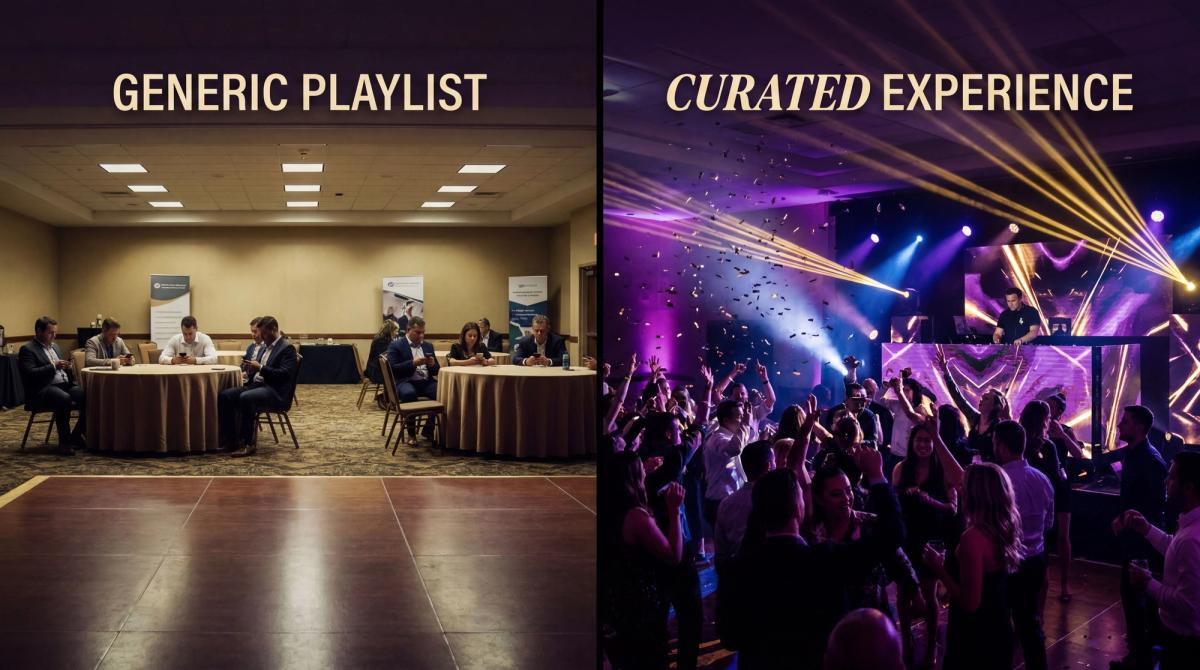
Music isn't decoration. It's infrastructure. It shapes how long people stay, how much they talk to each other, whether they remember the night or just the parking validation.
Research fromconfirms what any good DJ already knows: tempo directly modulates emotional response. Fast tempo increases arousal and positive emotion. Slow tempo calms. The wrong tempo at the wrong moment doesn't just fall flat — it actively works against whatever you're trying to accomplish.
So when your Spotify playlist drops a 70 BPM ballad right after your CEO's big announcement? That's not ambiance. That's sabotage.
What Intentional Music Curation Actually Looks Like
Let's kill the myth that "curated music" means "some guy with expensive headphones picks cooler songs." That's not it.
Intentional curation means every song serves a purpose within the event's arc. It means the musicknowswhat's happening in the room — even when the room doesn't know it yet.
Here's what that looks like in practice:
Phase 1: Arrival & Registration (Background, Not Boring)
The goal is warmth without intensity. You want people to feel like they've arrived somewhere worth being. Mid-tempo, familiar-enough tracks at a volume that lets conversation flow but fills the silence.
This is where generic playlists actually do their worst damage. They either go too aggressive (nobody wants house music while they're finding their name badge) or too sleepy (smooth jazz that makes the venue feel like a hotel lobby in 2004).
Phase 2: Dinner & Networking (The Invisible Accelerator)
This is the phase most planners completely ignore. The music during dinner isn't "just background." It's controlling the pace of conversation, the energy of the room, and — believe it or not — how long people think they've been sitting there.
Studies show that. Faster music makes time feel shorter. So if you've got a 90-minute dinner and you don't want people checking their watches at minute 45, your BPM matters.
Phase 3: The Energy Build (Where Amateurs Panic)
This is the moment of truth. The speeches are done. The awards are given. Now you need to transition 400 people from "politely seated" to "actively engaged."
A generic playlist handles this by... skipping from Michael Bublé to "Uptown Funk." Cold. No build. No arc. Just whiplash.
A professional builds this transition over 15-20 minutes. Tempo climbs gradually. Familiar hooks start appearing. The volume comes up just enough that people have to lean in — and then realize they'd rather stand up.
Phase 4: Peak Energy (Read the Room or Lose It)
Here's where everything generic fails. Because "peak energy" doesn't mean the same thing for a tech company's holiday party as it does for a law firm's annual gala. The 25-year-old marketing team wants Sabrina Carpenter. The partners want Earth, Wind & Fire. A good DJ gives them both — in the right order, at the right moment.
Check out how this actually sounds when it's done right:
That'sperforming a live cover of "Espresso" — the kind of track that gets the room moving because it's current, it's recognizable, and it's performedlivewith an energy no playlist can replicate.
Phase 5: The Cool-Down (Don't Just Stop)
The worst thing you can do is end abruptly. One minute it's peak energy, the next minute someone kills the music and turns on the fluorescents. Mood: destroyed. Memory: tainted.
A proper cool-down brings the energy back down intentionally. Slower tempos, deeper grooves, songs that make people sway instead of jump. By the time the lights come up, people feel like the evening came to a natural, satisfying close — not like someone pulled the plug.
Why Live Music Changes Everything
I know what you're thinking. "Arthur, this all sounds great, but we can't afford a full band."
First — you might be surprised. Live entertainment isn't always the budget-breaker people assume, especially when you work with anthat knows how to match the right act to the right event.
Second — live music doesn't have to mean a 12-piece orchestra. Some of the most electric moments I've seen at corporate events came from duos, trios, and hybrid DJ-plus-live-musician setups.
Like this:
That's a beatboxer and a violinist. Two people. One mic and one instrument. And they command a room better than any playlist ever could.
Or take a trio that can cover modern hits with live instrumentation:
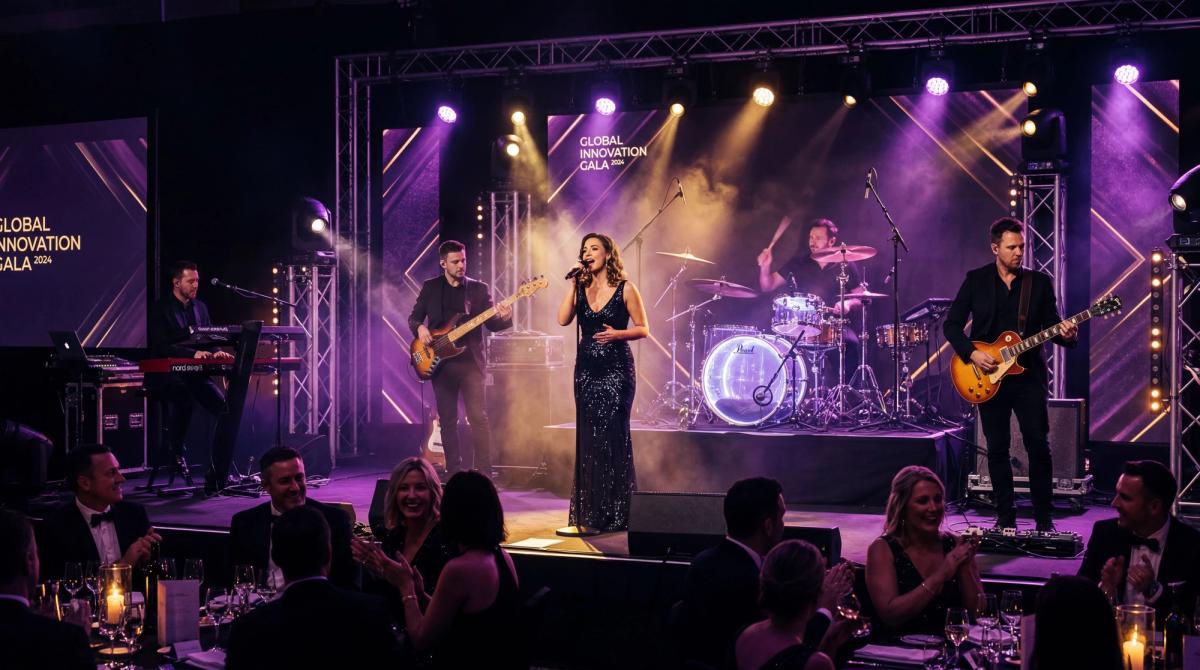
The research backs this up too.that live music at corporate events boosts engagement significantly — people stay longer, interact more, and rate the overall experience higher. It's not just entertainment. It's an investment in how your event is remembered.
The Nuclear Option: Let Your Audience Choose
Here's where it gets interesting.
What if instead ofguessingwhat your audience wants to hear, you just... asked them?
That's exactly whatdoes. It's a proprietary system that lets guests request songs in real time — from their phones, no app download required. The performers see the requests, gauge the room, and work them into the setlist live.
Think about what that means for a second. Instead of hoping your pre-built playlist hits the mark, you're letting 400 people collectively tell you what they want. The music becomes a conversation between the stage and the floor.
I've seen this turn rooms around in minutes. The moment someone hearstheirsong — the onetheyrequested — they light up. They grab their friends. They hit the dance floor. And suddenly the event isn't something that's happeningtothem. It's something they'repart of.

That's not something a Spotify playlist will ever do.
The Real Cost of Getting Music Wrong
Let's talk money. Because that's usually where the conversation dies.
Your company is spending — conservatively — $50,000 to $150,000 on a corporate event. Venue, catering, AV, décor, logistics. And then someone decides to "save money" by running a playlist through the house speakers.
You just saved maybe $2,000 to $5,000. And you compromised the single element most responsible for how the eventfeels. The music is what people hear when they walk in, what they dance to, what plays during the awards, and what they remember three weeks later when someone asks, "How was the company party?"
Nobody has ever said, "The canapés were incredible but the music was terrible — still, great event though." It doesn't work that way. Bad music poisons everything around it.
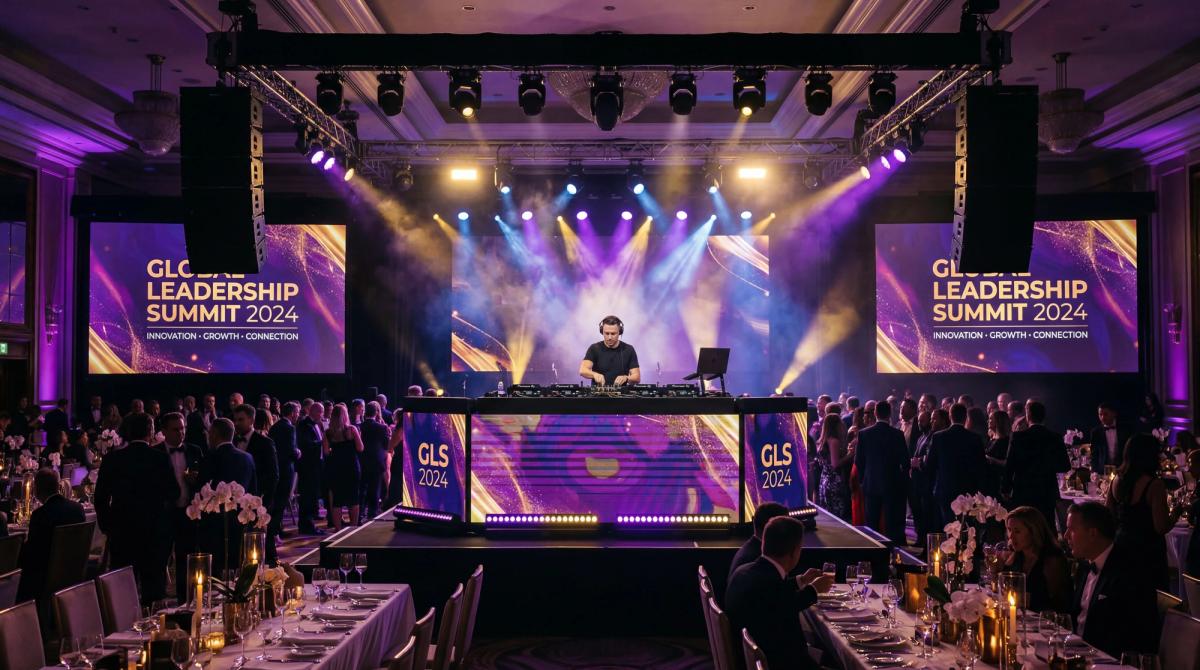
Working with a professionalmeans the music isn't an afterthought — it's woven into the event design from the first planning meeting. The entertainment matches the theme, the timeline, and the audience. Because when you're spending six figures on an event, a Spotify playlist isn't cost-effective. It's negligent.
Your Pre-Event Music Checklist
Before your next event, run through this:
- Know your audience demographics.Age range, cultural mix, industry. A tech startup's holiday party and an insurance company's awards gala need fundamentally different approaches.
- Map your event timeline to energy phases.Write down every segment — arrival, dinner, speeches, dancing — and assign a target energy level (1-10) to each.
- Create must-play and do-not-play lists.Yes, both. The do-not-play list is arguably more important. (Refer back to our songs nobody wants to hear at an event list for inspiration.)
- Budget for professionals.Whether that's a DJ, a live band, or a hybrid act. This is not where you cut corners.
- Consider audience participation.Tools like uRequest Live let your guests shape the experience in real time. It's the difference between performingatpeople and performingwiththem.
- Do a sound check.The best music in the world means nothing if the speakers distort at volume or the mic feedback drowns out the vocalist.
Frequently Asked Questions
How do I choose music for a corporate event?
Start with your audience, not a genre. Identify the age range, cultural makeup, and vibe of your event. Then map your timeline to energy phases — arrival needs warmth, dinner needs mid-tempo sophistication, and the party portion needs a professional who can read the room and build energy gradually. Skip the Spotify search. Hire someone who does this for a living.
Is a DJ or a live band better for corporate events?
It depends on the event format and your budget. DJs offer flexibility and a massive song library. Live bands deliver energy and spectacle that no speaker system can replicate. The best option? A hybrid — live musicians paired with DJ elements, or a group like uRequest Live that performs live covers of songs your audience actually requests in real time.
How much does a corporate event DJ cost in Toronto?
Professional corporate DJs in Toronto typically range from $1,500 to $5,000+, depending on the event size, duration, and what's included (lighting, MC duties, premium sound). Live bands and hybrid acts will run higher. The real question isn't "how much does it cost?" — it's "what's the cost of getting it wrong?" when you're spending $50K+ on the event itself.
What songs should you avoid at corporate events?
Anything with explicit lyrics (obvious). Anything that clears a dance floor by being too niche. And a long list of overplayed tracks that make people groan — "Cha Cha Slide," "Macarena," "Cotton Eye Joe." We wrote an entire post on. Read it. Share it with your DJ.
Can event guests request songs in real time?
Yes — and they should.is a proprietary system that lets guests request songs from their phones during the event. The live performers see the requests and work them into the setlist in real time. No app download needed. It turns passive attendees into active participants, and it consistently produces the most energetic dance floors I've ever seen at corporate events.
Does music really affect how people perceive an event?
Absolutely. Music influences mood, energy, social behavior, and even time perception. Research published inshows that tempo directly modulates emotional states — fast music increases arousal and positive emotion, while slow music calms. Your music choices are literally shaping how your attendeesfeelabout the entire event. This isn't opinion. It's neuroscience.
Ready to ditch the playlist and give your event the music it deserves? [Talk to our team](https://www.fusion-events.ca/services/toronto-event-planners) about entertainment that actually moves people — or explore [uRequest Live](https://www.fusion-events.ca/innovative-event-entertainment-urequest-live) to see what audience-driven music looks like in action.