
Nobody remembers the DJ.
That's not a knock on DJs — some are great. But when your VP of Sales describes last year's gala as "fine, good music I guess," you've got an entertainment problem. The bar for corporate events has moved, and "DJ plus open bar" isn't clearing it anymore.
I've spent years buildingand the pattern is always the same: the events people actually talk about on Monday morning are the ones that did something unexpected. Something participatory. Something that made 400 adults in business casual forget they were at a work function.
Here are ten ideas that do exactly that. No turntables required.
1. Interactive Game Shows
Why it works:You're turning spectators into contestants — and suddenly everyone's paying attention.
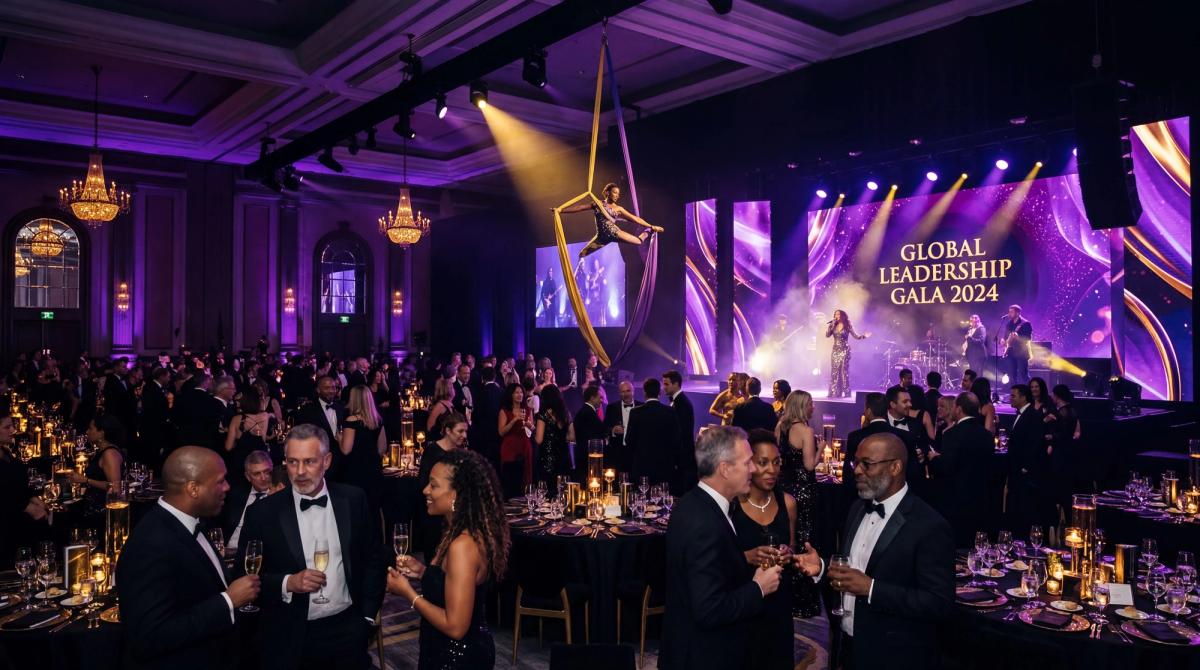
Live hosted game shows are the sleeper hit of corporate entertainment. Think structured chaos: a professional host running team trivia, head-to-head challenges, or custom games built around your company's inside jokes and industry knowledge. The best ones feel like a late-night TV show landed in your ballroom.
The magic is participation without pressure. Nobody has to get on stage if they don't want to. But give a table of accountants a buzzer and a trivia question about the company's founding year? They'll fight for it.
What separates a great game show from a cringey one is production value and a host who can read a room. Wireless buzzers, live scoring on screens, walk-on music — these details matter. It's the difference between "team-building exercise" and "the best thing that happened at the conference."
Best for:Annual conferences, awards galas, holiday parties, team offsites.
Pro tip:Customize the content. Generic trivia is fine. Trivia about your CEO's embarrassing first-day story is unforgettable.
2. All-Request Live Bands
Why it works:The audience builds the setlist. Every song is a hit because they chose it.
Traditional corporate bands play a pre-set list of crowd-pleasers and hope for the best. An all-request band flips the model entirely: guests request songs in real time, and the band performs them live. It turns passive listening into active collaboration — and the energy difference is enormous.
pioneered this format with proprietary request technology that lets guests browse, request, and vote on songs from their phones. The band sees requests in real time and builds the show around what the room actually wants to hear. No more guessing whether this crowd is a hip-hop crowd or a classic rock crowd. They tell you.
The result? Dance floors that fill up faster, stay full longer, and feel electric — because every song is a collective choice.
Best for:Galas, holiday parties, product launches, any event where the dance floor matters.
Pro tip:The request data is gold for planners. You get a real-time read on your crowd's energy and preferences — intel you can use for next year's event.
3. AI Photo Activations
Why it works:Guests leave with shareable content that markets your event for you.
Forget the prop box and the strip of four photos. AI-powered photobooths have completely rewritten what's possible. Guests step in front of a camera, and AI transforms their image into something wildly creative: trading cards, magazine covers, superhero comics, LinkedIn headshots with a twist, vintage movie posters — all branded with your event's identity.
runs 15+ AI styles and layers branded overlays on every output. Guests scan a QR code, get their images instantly, and share them on social. For planners, there's an analytics dashboard that tracks engagement — how many photos were taken, how many were shared, which styles were most popular.
The ROI math is simple: if 300 guests each share one AI-generated image to their networks, you've just earned thousands of organic brand impressions from a single activation.
Best for:Trade shows, product launches, brand activations, conferences, galas.
Pro tip:Match the AI style to your event theme. Tech company? Go with the trading card or sci-fi poster. Financial services? The magazine cover or executive portrait hits different.
4. Beatbox & Violin Fusion Acts
Why it works:Nobody expects it. And that's the entire point.
Genre-blending performers break the pattern of "background music that everyone ignores." When a beatboxer and a violinist step on stage together and start ripping through a set that moves from Bach to Beyoncé to drum and bass, the room stops and pays attention.
is the gold standard here — a beatboxer and violinist who create full, layered arrangements live. No backing tracks. No DJ support. Just two people making sounds that shouldn't work together but absolutely do.
This kind of act works during cocktail hour (where it's a conversation starter), during dinner (where it elevates the atmosphere), or as a featured performance (where it genuinely wows). It's versatile in a way that most entertainment isn't.
Best for:Cocktail receptions, awards ceremonies, executive dinners, product reveals.
Pro tip:These acts are also incredible for walkabout performance — moving through the crowd during a reception. Intimate and unexpected.
5. Luxury String Quartets Playing Pop
Why it works:Elegant aesthetic, contemporary soundtrack. Your guests feel sophisticated while singing along in their heads.
A string quartet playing Vivaldi is beautiful. A string quartet playing Sabrina Carpenter, Dua Lipa, and The Weeknd? That's a vibe.
Pop-crossover string quartets have exploded in demand because they solve a real problem: how do you create a premium atmosphere without boring your guests? Classical instrumentation makes any room feel elevated. Modern repertoire keeps the energy relevant. Together, they create this fascinating tension where the setting says "black tie" and the music says "this is actually fun."
The visual impact is significant too. Four musicians in formal attire with beautiful instruments photograph exceptionally well — your event content team will thank you.
Best for:Cocktail hours, dinner service, ceremonies, luxury brand events.
Pro tip:Book a. Some groups add a vocalist or rhythm section for later in the evening, giving you two acts for the price of one transition.
6. Team Building Through Music
Why it works:Creating something together builds connection faster than any trust fall ever could.
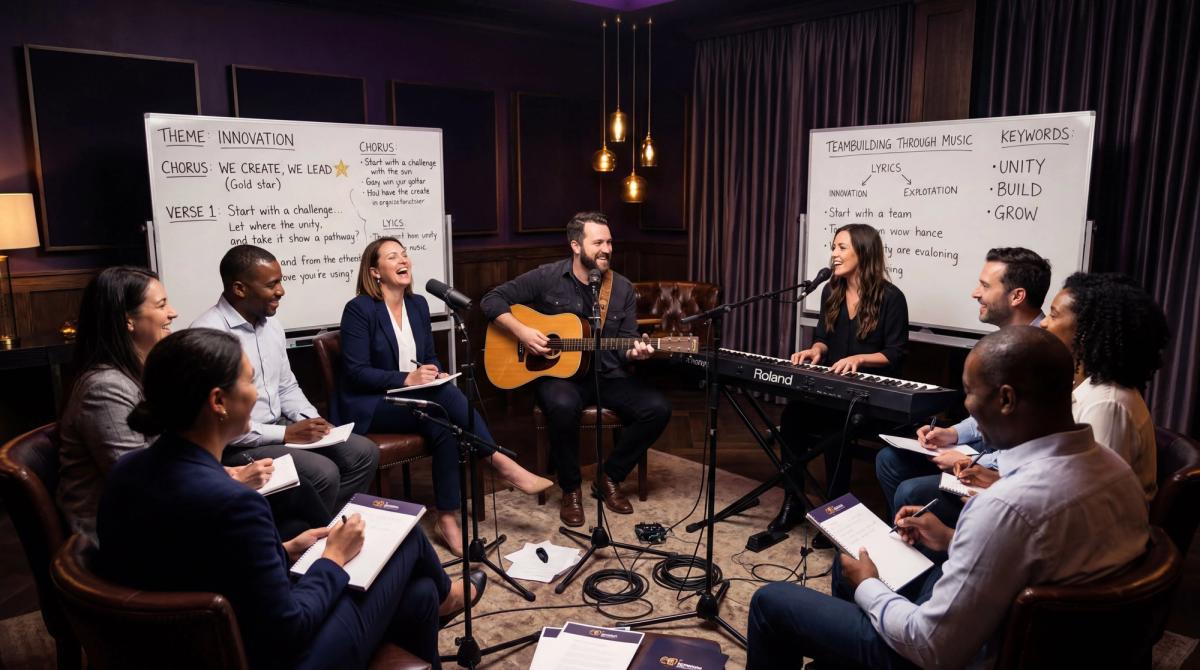
Most team building is something people endure. Musical team building is something people genuinely enjoy — because the output is tangible and immediate. You walked in as strangers from different departments. Ninety minutes later, you've written and performed an original song together.
runs collaborative songwriting sessions where groups work with professional musicians to create original music. No musical experience required. Facilitators handle the hard parts — melody, chord structure, arrangement — while participants contribute lyrics, ideas, and eventually performance. The final product is a recorded song the team owns.
Drum circles are another entry point. Lower commitment, higher energy, zero talent required. A facilitator hands out percussion instruments and builds a rhythm from nothing. Within minutes, a room of 200 people who couldn't keep a beat individually are locked into a groove together. It's weirdly powerful.
Best for:Team offsites, leadership retreats, onboarding events, department kickoffs.
Pro tip:Record everything. The video of your CFO absolutely nailing a drum solo is worth more than any team photo.
7. Live Polling & Crowd-Sourced Experiences
Why it works:When the audience controls the outcome, they're invested in the outcome.
Live polling technology has matured to the point where you can build entire event segments around real-time audience input. Not just "raise your hand if you agree" — actual decision-making that shapes what happens next.
Imagine a keynote where the audience votes on which topic the speaker dives deep on. Or an awards show where attendees vote for winners in real time, with results displayed live. Or a cocktail hour where crowd votes determine the next song, the next cocktail special, or the next performer.
The 2026 trend reports fromandboth highlight participation over observation as a defining shift in corporate events. People don't want to sit and watch anymore. They want to steer.
Best for:Conferences, town halls, multi-session events, hybrid events.
Pro tip:Display results on screens throughout the venue. The visibility of collective decision-making is what makes it feel exciting rather than administrative.
8. Immersive Digital Activations
Why it works:They turn your venue into content and your guests into participants.
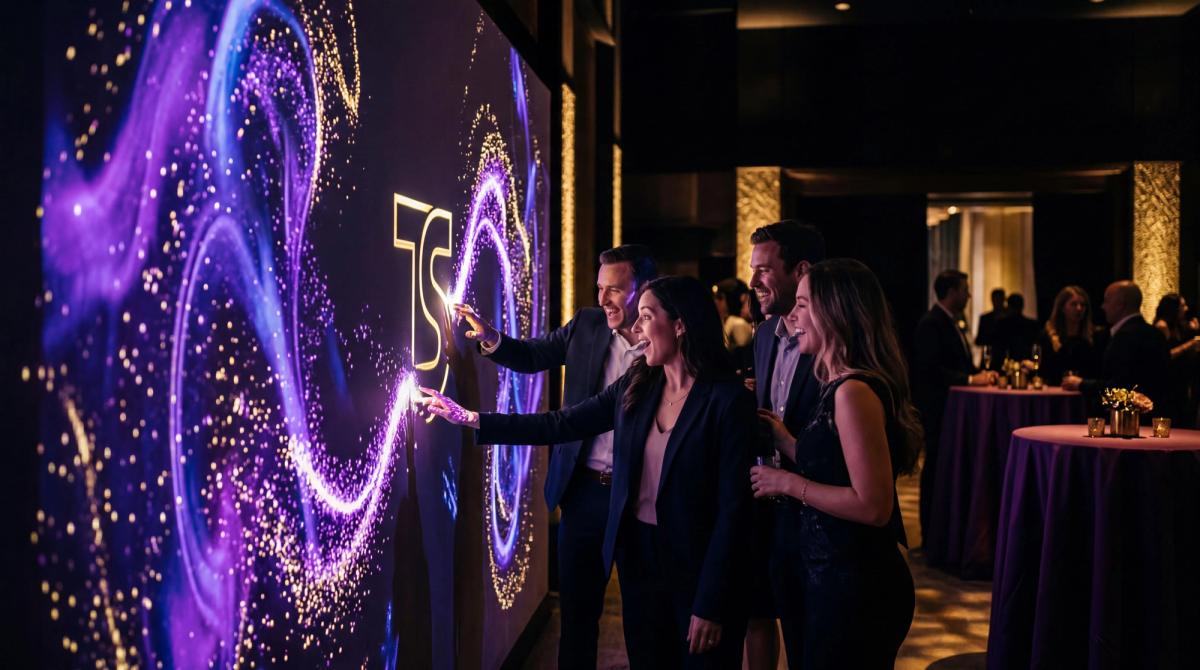
Interactive walls that respond to touch or movement. Projection mapping that transforms a blank ballroom into a branded universe. AR experiences that overlay digital elements onto the physical space through guests' phones. These are no longer bleeding-edge experiments — they're bookable, scalable, and increasingly expected at premium events.
Thehighlights full sensory design — layered lighting, bold scenic touches, and branded moments — as a defining characteristic of standout 2026 events. Digital activations are the fastest path to creating that layered, immersive feel.
What makes these activations powerful for corporate events specifically is the branding opportunity. Every digital surface is a canvas. Logo reveals, product demonstrations, data visualizations, social media feeds — all integrated into the environment rather than slapped on a banner.
Best for:Product launches, trade shows, brand experiences, annual galas, conferences.
Pro tip:Work backward from the photo opportunity. The best digital activations are designed to be photographed and shared. If it doesn't look incredible on camera, rethink the execution.
9. Comedy + Corporate Roast Shows
Why it works:Laughter is the fastest way to make 500 people feel like they're in on the same joke.
Custom comedy written for your specific audience hits different than a comedian doing their regular set. The best corporate comedy acts spend weeks researching the company — interviewing executives, reading internal newsletters, learning the inside jokes — and then deliver a set that feels like it was written by someone who works there.
The corporate roast format takes this further. A comedian (or a brave executive) roasts departments, projects, and personalities — with love, obviously — and suddenly the company's quirks become shared comedy. It's team building disguised as entertainment.
The key word is "custom." Generic stand-up at a corporate event is risky. Jokes about airline food don't land when your audience wants to hear jokes about the CRM migration that took eighteen months. Specificity is what makes corporate comedy work.
Best for:Holiday parties, awards dinners, milestone celebrations, executive retreats.
Pro tip:Give the comedian access. The more real information they have, the funnier and more relevant the set will be. An NDA and a 30-minute call with three employees is usually enough.
10. Silent Disco with Themed Channels
Why it works:Three parties in one room. No noise complaints. Maximum choice.
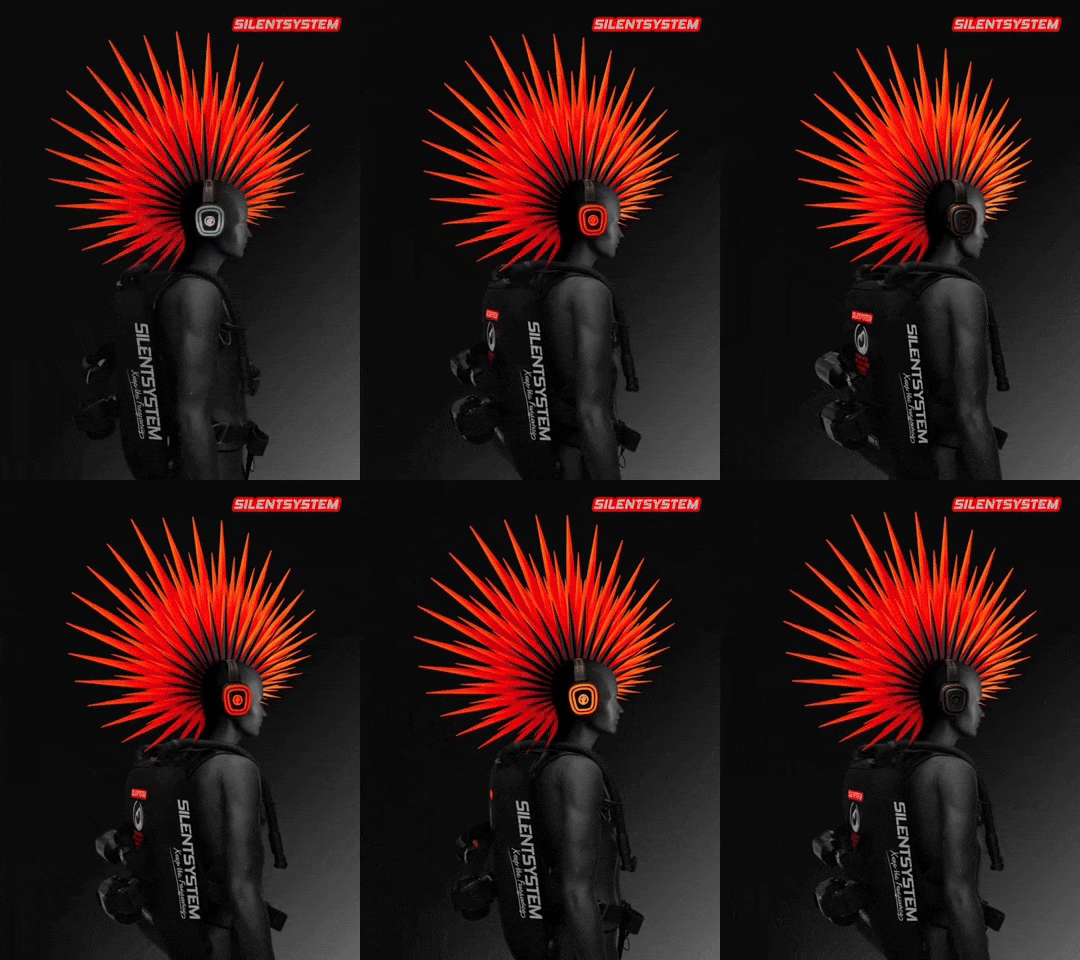
Silent discos solve the oldest problem in event entertainment: you can't please everyone with one genre. With wireless headphones offering three (or more) themed channels — say, Top 40, throwbacks, and EDM — every guest finds their lane. And the visual comedy of watching half the room dance to music you can't hear never gets old.
For corporate events, the format has specific advantages. You can run a silent disco in spaces that don't allow loud music. You can set it up alongside a seated area without sound bleed. And the opt-in nature means your quieter guests can participate at their own volume — or take the headphones off and have a conversation.
The themed channels are where you can get creative. Company history channel (songs from the year the company was founded to now). Executive picks (the CEO's guilty pleasures). Decade battles (crowd votes on which era wins). The format is a blank canvas.
Best for:After-parties, holiday events, conferences, multi-generational crowds.
Pro tip:Color-coded headphones (LED lights change with the channel) create a visual spectacle. From above, the dance floor looks like a living light show.
The Common Thread
Look at the list again. Every single one of these ideas has something in common:participation. The audience isn't watching entertainment happen to them — they're part of it. They're requesting songs, creating AI portraits, voting on outcomes, writing songs, choosing channels.
That's not a coincidence. It's the direction the entireis moving. The events that win are the ones that give people agency. A reason to put their phone down. A story to tell.
A DJ and a dance floor can absolutely be part of that. But if that'sallyou've got? You're leaving the best moments on the table.
Frequently Asked Questions
How much does corporate event entertainment cost beyond a DJ?
It varies widely, but expect to invest between $2,000 and $15,000+ for premium entertainment options like live game shows, all-request bands, or digital activations. Simple additions like a string quartet or silent disco typically start around $2,000–$5,000. More complex productions — interactive technology, custom comedy, immersive installations — can range from $5,000 to $20,000+. The right question isn't "how much does it cost" but "what's the per-guest impact on the experience?" A $10,000 activation for 500 guests is $20 per person for a memorable highlight.
Can these entertainment ideas work for smaller corporate events (under 100 people)?
Absolutely. In fact, several of these ideas — fusion performers, custom comedy, musical team building, live polling — actually workbetterwith smaller groups because the intimacy amplifies the impact. Game shows scale down easily with fewer teams. Silent discos work with as few as 50 headsets. AI photobooths have no minimum. The key is matching the format to your group size and venue.
How far in advance should we book unique corporate entertainment?
For premium acts and custom experiences, three to six months is ideal. High-demand dates (December holiday season, September–October conference season) book even earlier. Custom comedy and team-building music sessions need at least four to six weeks of lead time for research and preparation. If you're booking within a month, options will be limited — but not nonexistent. Start with yourearly to lock in the best talent.
What corporate event entertainment works best for hybrid or virtual audiences?
Game shows, live polling, and AI photo activations translate well to hybrid formats. Game shows can include remote participants via video. Live polling is inherently device-based, so remote attendees participate identically.works entirely through phones, so virtual attendees can participate from anywhere. Silent discos and physical installations are tougher to translate — consider pairing them with a livestream and a separate virtual engagement layer.
How do we choose the right entertainment for our corporate culture?
Start with your audience, not the entertainment. A conservative financial services firm and a tech startup need fundamentally different energy levels. Ask three questions: What's the average age range? What's the formality level? What do you want peopledoing— networking, celebrating, bonding, or learning? A string quartet fits a formal reception. A game show fits a team celebration. Anfits any crowd that wants to dance. When in doubt, mix formats across the evening — elegant during dinner, interactive after.
Can we combine multiple entertainment ideas at one event?
This is actually the best approach. Layer your entertainment across the event timeline: a string quartet during cocktails, a game show segment during dinner, and a silent disco or all-request band for the after-party. Add an AI photobooth as an always-on activation throughout. The variety keeps energy high and ensures there's something for every personality type. Just make sure each element has its own moment — don't stack competing entertainment simultaneously.
Looking for entertainment that actually moves the needle at your next corporate event? [Explore Fusion Events' full entertainment roster](https://www.fusion-events.ca/entertainment-agency) or [check out interactive experiences](https://www.fusion-events.ca/services/interactive-experiences) designed to get your guests off the sidelines.