
How to Host a Casino Night Party That Feels Like the Real Floor
The complete host playbook: table math for your guest count, chip and prize structures, Ontario legality basics, themes, and the entertainment that keeps the room buzzing.
Legality & Format Basics (Ontario)
Run it as a funny-money event, not real gambling
The safest and most common corporate format uses funny money: guests buy in with fake chips, play for fun, and cash out for raffle tickets or points toward prizes, never real cash. No real money changes hands at the table, so you sidestep the licensing headaches that come with actual gaming. This is the default we recommend for almost every corporate casino night.
Know when a licence is actually required
In Ontario, real gaming for money is regulated. Charitable casino events and anything where prizes have real value can fall under the Alcohol and Gaming Commission of Ontario (AGCO) and municipal lottery licensing rules. A pure funny-money party with no cash prizes usually sits outside that, but the line depends on your format and prize value.
Confirm your local rules before you commit
We are event people, not your lawyers, so treat this as a starting point and not legal advice. Rules vary by municipality and change over time. Before you lock a format that involves any kind of prize value, buy-in, or charity fundraising component, confirm the current requirements with the AGCO and your municipality, and loop in your legal or compliance team.
Separate the buy-in from the prizes
A clean structure keeps you well clear of gambling territory: guests attend the event (often free, or ticketed as a normal corporate function), receive an equal starting stack of funny money, and compete for prizes awarded on final chip count. The ticket price, if any, buys the experience, not a chance to win money.
Keep alcohol and gaming areas thoughtfully planned
If you are serving alcohol, you likely already have a Special Occasion Permit or a licensed venue handling it. Casino nights run late and get lively, so plan your bar service, last call, and safe-ride options the same way you would for any corporate party with an open bar. This is standard event duty of care, not a casino-specific rule.
Casino Tables & How Many You Need
Blackjack: the workhorse table
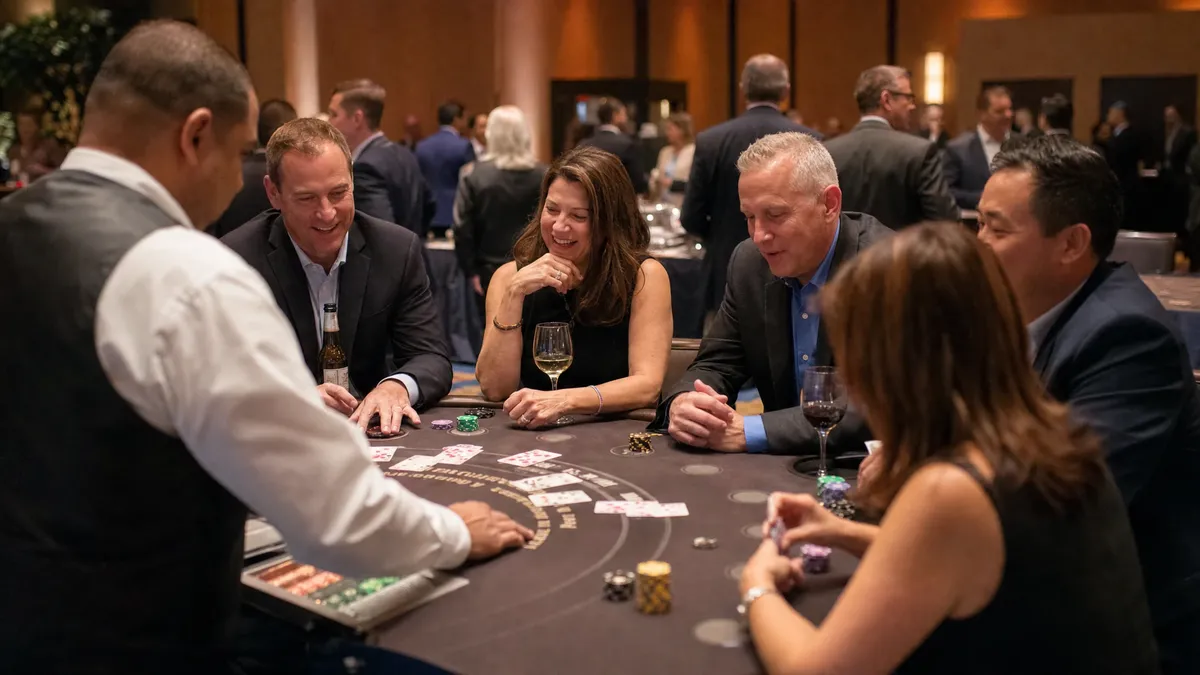
Blackjack is the backbone of every casino night. It is easy to learn, fast to play, and seats roughly 7 players per table. Most guests gravitate here first, so it should be your most numerous table type. Plan for blackjack to absorb the largest share of your floor traffic.
Roulette: the crowd magnet
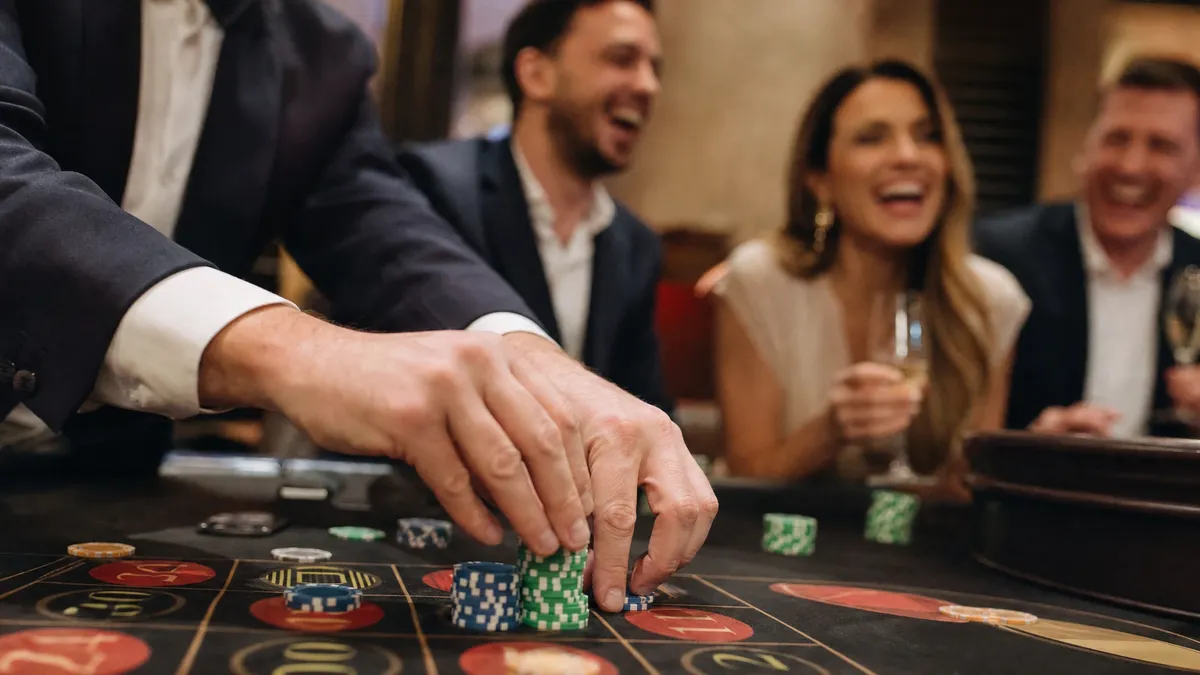
A roulette table draws a standing crowd because the spinning wheel is pure theatre and the betting is simple. One table can engage 10 to 15 guests at once, players and spectators together. The visual and audible drama of the wheel makes it the natural centrepiece of the room.
Craps: the loudest table in the room
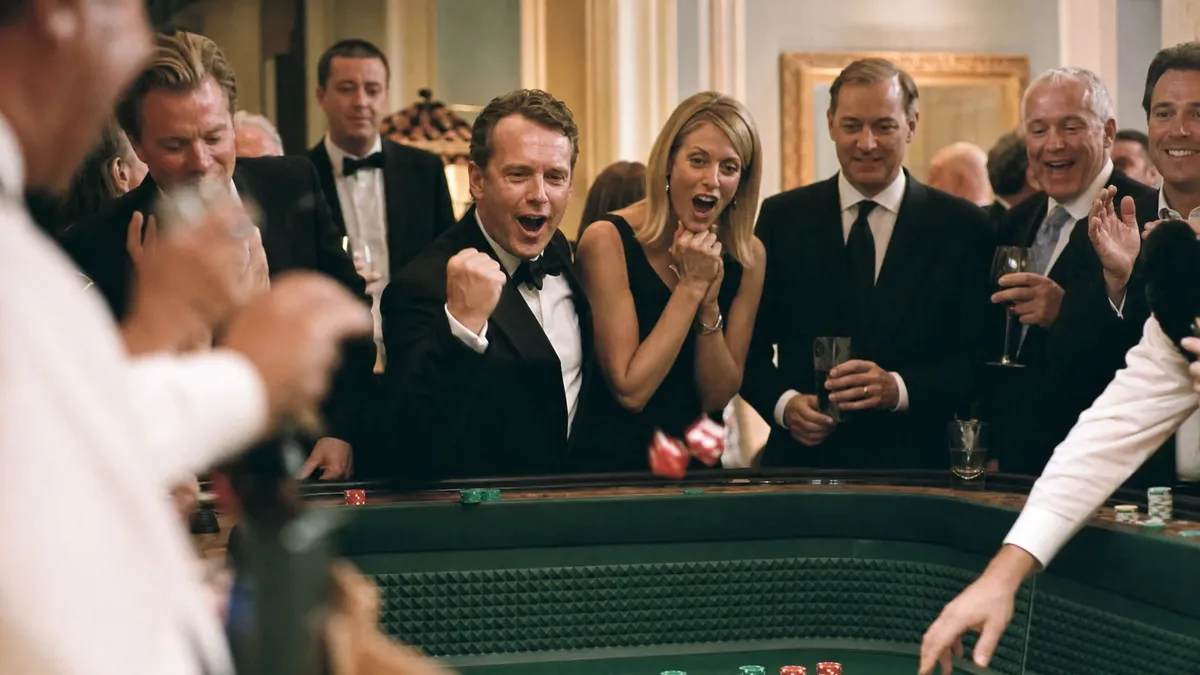
Craps is the highest-energy game on any casino floor. The whole table roots for the shooter, so a good craps table generates the most noise and the biggest crowd of the night. It has a steeper learning curve, which is exactly why a great dealer who teaches as they go is worth their weight in chips.
Poker: for the serious players
Texas Hold'em poker tables reward guests who want a longer, more strategic game. A poker table seats up to 8 to 10 players and tends to hold the same crowd for extended stretches. It is ideal if you plan to run a tournament arc with a final table finish.
The rule of thumb: one table per 12 to 15 guests
The reliable planning ratio is one gaming table for every 12 to 15 guests. That keeps waits short and the floor active without paying for tables that sit empty. For 100 guests, plan on roughly 7 to 8 tables; for 200 guests, 14 to 16. Adjust up if you expect everyone to play at once.
A sample table mix for 100 guests
A balanced floor for 100 guests looks like this: 3 to 4 blackjack tables, 1 to 2 roulette tables, 1 craps table, and 1 poker table. That spread covers every skill level, gives you a marquee game (craps or roulette) as the centrepiece, and keeps traffic flowing. Scale the mix proportionally for larger crowds.
Big Six wheel and money wheel add spectacle
A Big Six or money wheel is a low-skill, high-visibility filler that anyone can play in seconds. It works beautifully near an entrance or during arrivals, giving early guests something to do while the room fills. It is not a main attraction, but it smooths the awkward first 30 minutes.
Give every table room to breathe
Casino tables need a standing crowd around them, so budget roughly 100 to 150 square feet per table including player and spectator space. Cramming tables together kills the energy and creates bottlenecks. A slightly under-filled floor always beats an over-packed one.
Format & Flow: Chips, Rounds & the Tournament Arc
Give everyone an equal starting stack
Hand every guest an identical bundle of funny money at check-in, typically a set value like $500 or $1,000 in fake chips. Equal buy-ins keep the competition fair and the leaderboard meaningful. It also removes any awkwardness about who paid what to get in.
Offer a re-buy to keep people in the game
Early knockouts kill the mood, so build in a mid-event re-buy or top-up: guests who bust out can grab a second stack, often in exchange for a small charity donation or a raffle ticket purchase. It keeps the floor full through the back half of the night and adds a fundraising angle if you want one.
Structure the night in clear phases
A casino night runs best on a loose timeline: arrivals and cocktails, open floor play, a mid-event re-buy, last call at the tables, then cash-out and prizes. Signposting the phases keeps momentum building toward a climax instead of letting the energy sag into a slow fade.
Run a tournament arc for competitive crowds
For groups that love competition, layer a tournament over the open play: qualifying rounds at the poker or blackjack tables feed a final table of top chip-holders near the end of the night. The final table becomes a spectator event, with the whole room gathered around to watch the finish.
Cash out into raffle tickets, not money
At the end of play, guests trade their chip totals for raffle tickets or prize-draw entries. More chips means more tickets means better odds at the prize table. This keeps the whole thing squarely a game of fun while still rewarding the best players, and it stretches the excitement into a final draw.
Assign a pit boss to keep the floor honest and fun
A designated pit boss or floor host ties the room together: they welcome guests, explain games, settle rules questions, and keep the energy up between tables. Think of them as the MC of the casino floor. On a busy night, they are the difference between organized fun and mild chaos.
Keep dealer-to-table staffing right
Every table needs a professional dealer, and busy tables like craps or roulette sometimes need two staff. Under-staffing means slow play, long waits, and a floor that never catches fire. Budget one skilled dealer per table minimum, plus a floating host or two for the whole room.
Casino Night Themes That Set the Tone
James Bond black-tie
The 007 theme is the gold standard for a reason: tuxedos, cocktail dresses, martinis shaken not stirred, and an air of high-stakes glamour. It gives guests a clear, aspirational dress code and instantly elevates the perceived production value. Baccarat and roulette fit the Bond world perfectly.
Vegas glitz
A Las Vegas theme leans into neon, showgirls, Rat Pack swing, and big-and-bold energy. It is the most flexible casino theme because almost anything reads as Vegas: Elvis impersonators, bright lights, a lounge singer. It suits large, high-energy corporate crowds that want spectacle over subtlety.
Roaring 20s Gatsby
The 1920s speakeasy theme brings Art Deco glamour, feathers, flapper dresses, jazz, and a touch of Prohibition-era mischief. A hidden-entrance speakeasy conceit and a password at the door make the whole event feel like an exclusive secret. It photographs beautifully and gives a live jazz band a perfect home.
Monte Carlo elegance
For a more refined crowd, Monte Carlo evokes European high-society sophistication: understated luxury, champagne, and a focus on the classic games. It is less costume-driven than Bond or Vegas, which suits senior executive and client-facing events where over-the-top themes might feel off.
Retro Rat Pack lounge
A Rat Pack lounge theme channels 1960s cool: Sinatra and Sammy Davis Jr., whiskey, sharp suits, and swinging live music. It hits a nostalgic sweet spot for many corporate audiences and pairs naturally with a crooner or a swing band. The vibe is sophisticated but relaxed.
Casino Royale meets your brand
The best corporate casino nights bend a classic theme around the company itself: branded chips, a signature cocktail named for the team, table felts in corporate colours, and custom trivia between rounds. The casino format is a canvas, and a light brand layer makes it unmistakably your event, not a rental package.
Entertainment Pairings That Keep the Room Alive
A live band over a background playlist
Recorded music fills silence; a live band builds energy. A band that reads the room and shifts the setlist as the night moves keeps the floor charged in a way a static playlist never will. Our roots are in live wedding and corporate bands, and we learned to swap the next song mid-show because we could feel it would not land. That instinct is what a casino floor needs.
An all-request band so guests drive the night
Audiences are tired of being talked at, and a casino night is already about participation, so the music should be too. An all-request live band like our uRequest Live lets guests choose the setlist in real time, which turns the soundtrack into another game everyone plays. It fits the casino format perfectly: the crowd is already in charge of their own fun.
An interactive game show as the second act
When the tables close, the room needs a next thing. A hosted interactive game show like our Majority Rules, where the whole audience votes from their phones, scales from 50 to 2000-plus guests and keeps everyone engaged after cash-out. We launched it to about 300 event planners in Edmonton and were rebooked within two months, because participation beats presentation every time.
Strolling performers to work the floor
A casino floor has natural lulls between hands, and roving entertainment fills them. A close-up magician moving table to table or a caricature artist near the bar gives waiting guests something to enjoy without pulling them off the floor. It layers on top of the gaming rather than competing with it.
A photo activation for the shareable moment
Casino nights are dress-up nights, and guests want proof they looked the part. A photo booth or AI photo activation themed to your casino night gives them a branded, shareable keepsake and seeds your event across social feeds. It is the single most reliable way to extend the night beyond the room.
Put the bar where the action is
The bar is a gravity well: put it next to the action or it pulls your party apart. Position it within sight of the gaming floor so guests grab a drink and drift back to the tables, rather than parking at the bar all night. Where the bar sits quietly decides whether your floor stays busy or empties out by 9pm.
Prize Structures That Keep the Floor Packed
Award prizes on final chip count
The simplest, cleanest structure ranks guests by their final funny-money total and awards prizes to the top finishers. It keeps the competition legible all night (everyone knows roughly where they stand) and gives the cash-out a clear, satisfying payoff. Top chip-holder takes the headline prize.
Run a raffle so everyone can win
Pure chip-count prizes only reward the winners, so pair them with a raffle where chips convert to tickets. More chips means more entries and better odds, but every guest with any chips left has a shot. This keeps busted-out and casual players invested right through to the final draw.
Choose experience prizes over cash
Keep prizes as non-cash rewards, both to stay clear of gambling territory and because experiences land harder than money. Think dinner for two, a spa day, a premium tech gadget, an extra vacation day, or a reserved parking spot for a year. Experiential and status prizes generate more buzz than an equivalent cash value.
Tier the prizes for a clear podium
Structure prizes as a clear podium: a standout grand prize, a strong second and third, and a spread of smaller prizes through the raffle. A visible tier gives the night a proper finish and gives more people a reason to keep playing hard right up to last call.
Add novelty awards for personality
Beyond the chip leaders, hand out novelty awards: biggest single win, unluckiest player, best-dressed high roller, most enthusiastic newcomer. These spread the recognition around and give the host a run of fun moments during the awards segment that go well beyond just the winners.
Fold in a charity angle if it fits
Casino nights make natural fundraisers: charge a modest entry, sell re-buys and extra chips for donations, and route the proceeds to a cause. It adds meaning to the night and can strengthen your event's story, but the moment real money and prizes mix, licensing rules apply, so confirm the charity gaming requirements with the AGCO and your municipality first.
Expert Pro Tips
Frequently Asked Questions
Is a casino night party legal in Ontario?
How many casino tables do I need for my guest count?
What casino games work best for a corporate casino night?
How does the funny-money and prize system work?
What are good casino night themes?
What entertainment should I pair with a casino night?
How much does a casino night party cost?
Tell us your guest count and date and we will design the floor, the tables, and the entertainment around it.
Plan Your Casino Night
Get StartedPair your casino night with Majority Rules or an all-request live band for a second act the whole room plays.
See Interactive Entertainment
Contact Us