
Circus Performers: The Real Guide to Aerialists, Stilt Walkers and Fire Acts
Aerialists, acrobats, stilt walkers and fire acts turn a room into an event. Here is what each one needs, what your venue will actually allow, and how to book them without a last-minute disaster.
Aerialists and Acrobats: What They Actually Need
A rated rigging point, not a nice-looking beam
Aerial acts hang from the ceiling, and the load is not gentle. A performer on silks generates dynamic forces well beyond their body weight when they drop and catch. You need a structural point rated by an engineer or a certified rigger for at least 1,000 to 2,000 lbs, in writing. A decorative beam, a sprinkler pipe or a drop ceiling will not do it and can kill someone.
Ceiling height is the whole ballgame
Silks and aerial hoop need real vertical room. As a rule of thumb, silks want 20 to 24 feet of clear height, aerial hoop and straps can work in 16 to 18, and a hanging cube or chandelier act sits somewhere between. Measure to the lowest obstruction, not the peak. That chandelier or HVAC duct in the middle of the room is what actually limits the drop.
Free-standing aerial rigs when the ceiling says no
No rated points? A free-standing aerial rig or A-frame truss solves it, but it eats floor space and needs a footprint of roughly 15 by 15 feet plus ballast weight. It also reads as equipment, so plan the sightlines and lighting around it. Budget more too, since the rig, transport and a rigger add real cost on top of the performer.
Ground acrobatics need floor, not ceiling
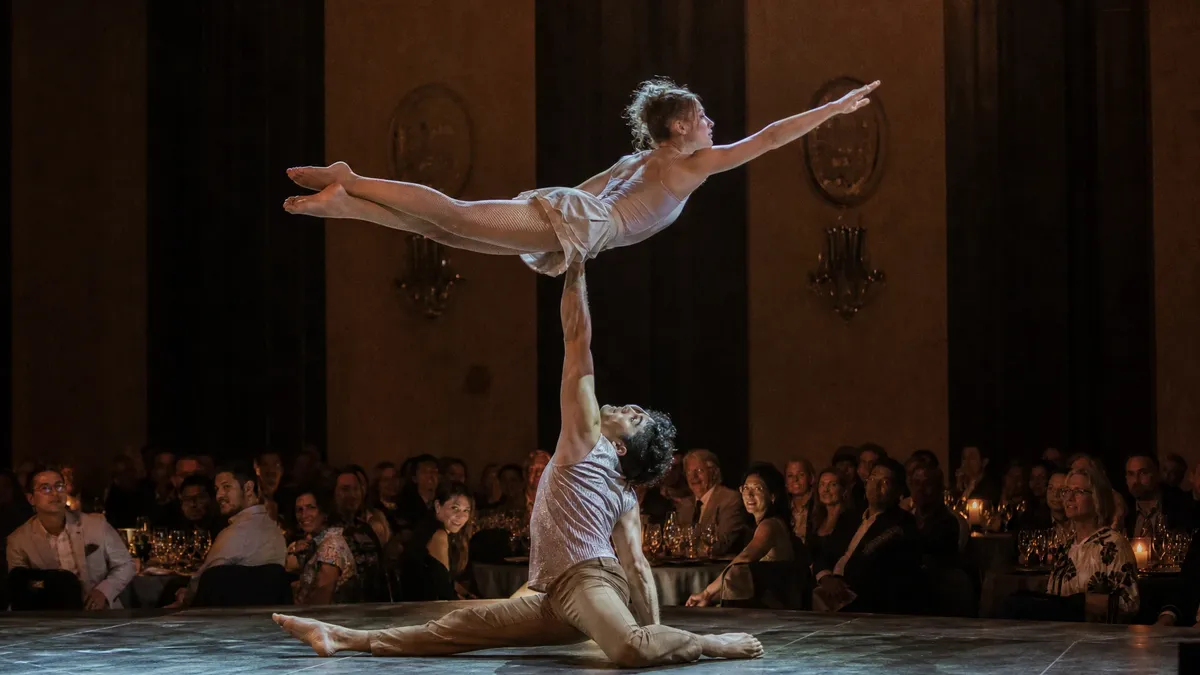
Hand-to-hand, banquine, Chinese pole and acro-balance acts are floor-based, so they skip the rigging headache entirely. What they need instead is a flat, non-slip, level surface and clearance for tumbling passes. Carpet, uneven staging or a raked floor is a real injury risk. A sprung or marley floor is ideal for anything with big dynamic moves.
Spotters, crash mats and a safety perimeter
Professional acrobats will tell you where the mats go and how much clear space they need around a trick. Give them that perimeter and keep guests and cocktail tables out of it. The most common event injury is a guest wandering into a tumbling lane, not the performer missing a move.
Load-in time and a rigging call
Aerial rigging is not a plug-and-play setup. A rigger needs access to the ceiling, often a lift or scaffold, and one to three hours before doors depending on the number of points. Book that window into your venue schedule, because if the room is being flipped from a lunch, the rigging call and the flip cannot happen at the same time.
Insurance and a certificate of liability
Any reputable aerialist or acrobat carries their own liability insurance, and any real venue will demand a certificate naming them as additional insured. If a performer cannot produce a COI, that is your signal to walk away. Amateur aerial is where events go wrong.
Stilt Walkers and Roving Characters
Stilt walkers need eight feet of clearance, everywhere they go
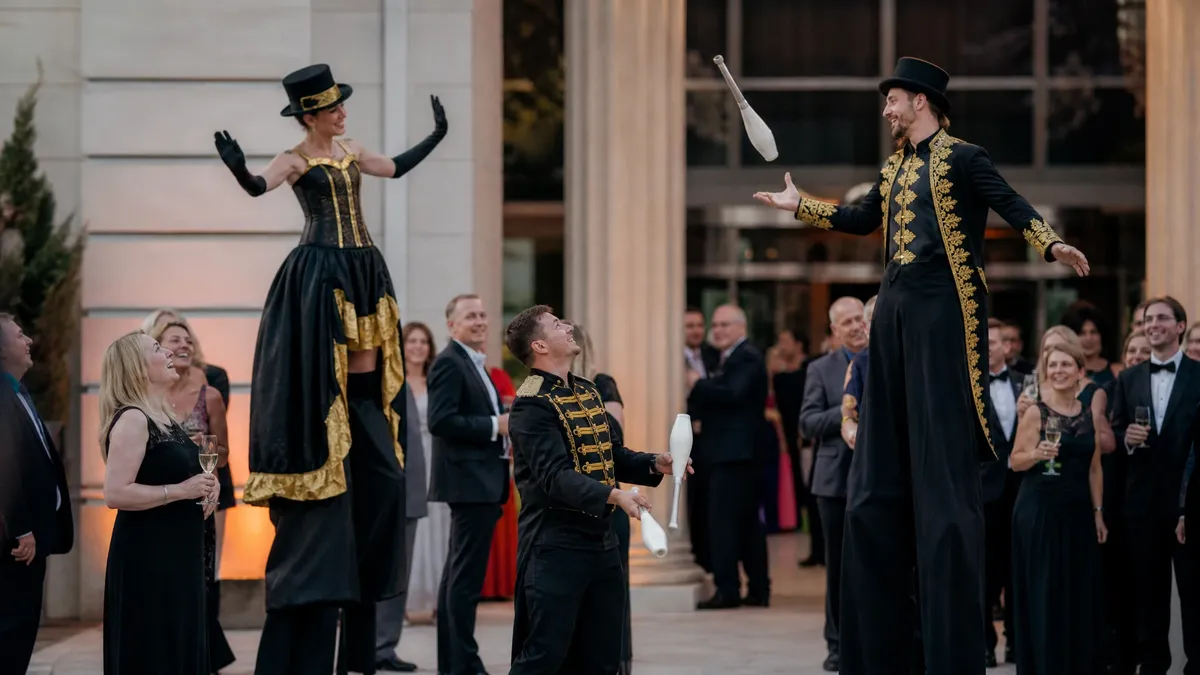
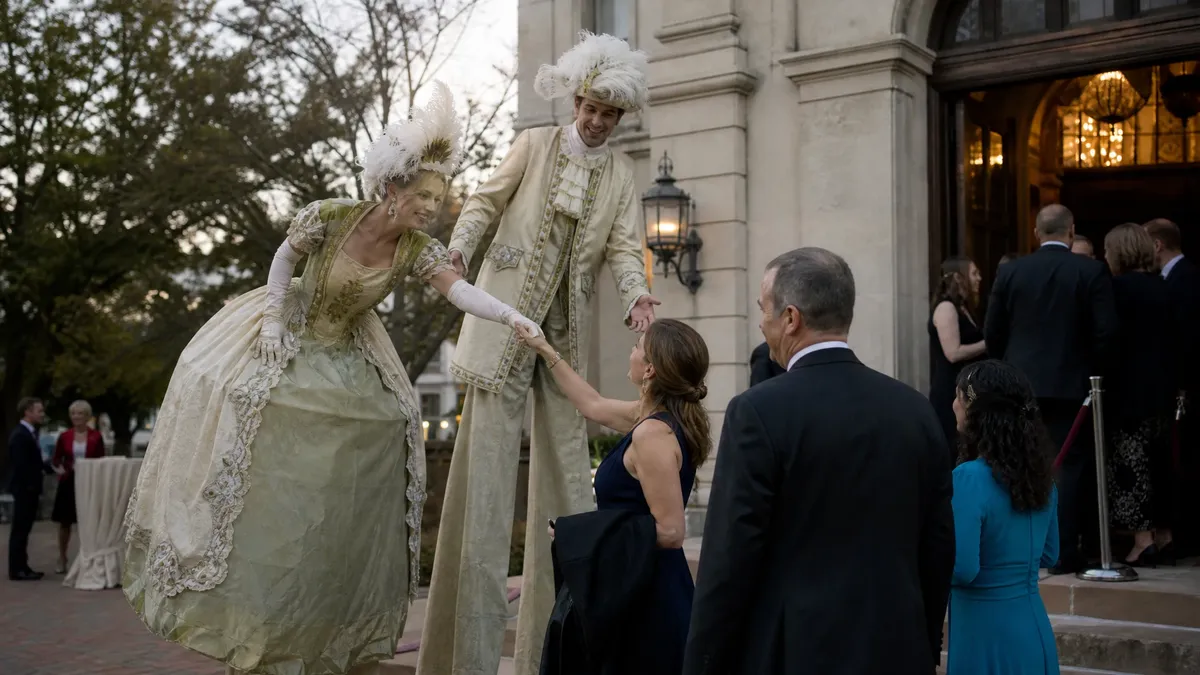
A stilt walker stands seven to nine feet tall, so every doorway, chandelier, low soffit and string of festoon lighting on their route becomes a hazard. Walk the actual path they will roam before the event and flag anything under nine feet. A ballroom with a grand entrance and 12-foot ceilings is perfect. A converted loft with exposed ductwork is a problem.
A flat, dry, predictable floor
Stilts and stairs do not mix, and stilts and wet floors mix even less. Roving stilt characters need level flooring, no unexpected steps, no thresholds they cannot see, and absolutely no rain if the act is outdoors. Cobblestone patios, grass and ramps all need a conversation first. Give them a spotter for any transition or crowd crush.
A place to get up and get down
Performers do not put stilts on in the middle of your reception. They need a private back-of-house space with a sturdy chair or a raised ledge to strap in and a discreet route to the floor. Build that into your run sheet, because a stilt walker appearing from behind a curtain lands far better than one assembling in the corner in full view.
Roving characters set the theme in the first 30 seconds
Living statues, LED robots, mirror-suit performers, feathered showgirls and themed characters are the cheapest way to signal an event's tone the instant guests walk in. They work the arrival and cocktail windows, pose for photos and fill the awkward gap before the program starts. This is atmosphere on a budget, and it is almost always booked too late to be styled properly.
Costumes are half the booking
The difference between a memorable roving act and a person in a rented suit is the costume and the character work. Ask for recent photos of the specific performer in the specific look, not a stock gallery. For branded or themed events, good acts will tailor the costume to your palette if you give them lead time.
Photo moments and where you place them
Roving characters are a photo magnet, so put them where you want the crowd to gather and where your photographer has good light. Near the entrance, by the step-and-repeat or anchoring a dead corner of the room. Never park them next to the bar, because the bar is already a gravity well and you do not want two crowds fighting for the same six feet.
How many, and for how long
Stilt walkers and character performers work in short, high-energy sets, typically 45 minutes on and 15 off, because the costumes are hot and the stilts are tiring. For a room of 200-plus, two to four roving performers keep the whole floor covered. One lonely character in a big room reads as under-produced.
Fire and Danger Acts: The Venue and Insurance Reality
Your venue decides before you do
Fire performance lives and dies on venue approval, and most indoor venues say no by default. Before you book a fire act, get written permission from the venue and, where required, the local fire marshal. Sprinkler systems, smoke detectors and fire-code occupancy limits all come into play. Assume the answer is no until someone with authority puts yes in writing.
Indoor fire is a different animal than outdoor
Outdoors with clearance, fire acts are relatively straightforward. Indoors, you are dealing with smoke detectors that will trip, ceiling heights that trap heat, and fuel storage rules. Some venues allow LED and pixel-poi performances that mimic fire with zero flame, which is often the smart answer for a hotel ballroom that will never permit the real thing.
Fuel safety, a dedicated safety officer and extinguishers
A professional fire act travels with its own safety kit: fire blankets, extinguishers, a duvetyne safety station and often a dedicated safety person who is not performing. Fuel is stored and handled away from guests. If a performer shrugs at these questions, they are not a professional, and you should end the conversation there.
A generous safety perimeter and no drunk-guest surprises
Fire acts need a hard perimeter that guests cannot cross, ideally roped or staffed, and clearance overhead and to the sides for spinning props. This is a real reason to place a fire act early in the evening rather than at 11 pm when the room has had four hours at the bar. Sober crowds and fire are a much better combination.
Specialized insurance, not a generic policy
Fire and danger acts must carry insurance that explicitly covers pyrotechnics or fire performance. A standard performer liability policy often excludes fire, so read the certificate, do not just collect it. The venue will want to be named as additional insured, and some will require proof before load-in or they cancel the act on the spot.
Danger acts: sword swallowing, glass walking, escape
Beyond fire, the danger-act family includes sword swallowing, glass walking, bed of nails, whip cracking and escape artistry. These read as high-stakes to the audience but are often easier on the venue than fire, since there is no flame or smoke. They still need clearance, a clean performance area and a performer who can hold a room while they build tension.
Outdoor fire finales that photograph
If you have an outdoor space and the approvals, a fire finale is an unbeatable closer. Fire fans, dragon staff and fire breathing against a night sky give your photographer and your social feed a hero shot. Coordinate with the venue on wind, ground surface and a clear downwind zone, and always have the safety officer positioned before the first light.
Cirque-Style Stage Shows
A produced show, not a string of solo acts
A cirque-style stage show is a choreographed production with a through-line: multiple disciplines, a soundtrack, lighting design, costumes and a running order that builds. This is the difference between hiring six performers and staging a show. It belongs in the program as a headline moment, not as background during dinner.
Stage, wings and a proper technical rider
Cirque shows come with a technical rider covering stage dimensions, aerial points above the stage, wing space to enter and exit, power, and a lighting and sound spec. Read the rider before you commit, because retrofitting a ballroom to meet it after the fact is where budgets explode. If the room cannot meet the rider, the show gets scaled or replaced.
Themed shows built around your brand or occasion
The best cirque productions bend to the event. A product launch, a gala theme, an anniversary or a brand color story can all be woven into the choreography, costumes and music. This takes lead time and a creative conversation, but a show designed around your reason for gathering hits far harder than a generic package dropped into the room.
Live music turns a show into an experience
Our roots are in live music, and we will tell you plainly that a cirque act performed to a live band or vocalist lands differently than one performed to a backing track. The music breathes with the room. We built our reputation swapping the setlist mid-show because we could feel the next song would not land, and that instinct is exactly what elevates a staged production into a live experience.
Run time, pacing and where it sits in the night
A full cirque show typically runs 20 to 40 minutes, and pacing matters. Drop it after the main course when energy dips, or use it to open the evening with a bang. Do not bury a produced show behind speeches or let it compete with dinner service. Give it a clean window and a real introduction.
Rehearsal, tech time and a real load-in
A staged show needs a tech rehearsal and often a full day of load-in for rigging, lighting focus and a run-through. This is not a 30-minute setup. Build the venue access into your contract, because a show that cannot rehearse is a show that will have problems in front of your guests.
Ambient Circus for Cocktail Hours
Champagne aerialists and living-table performers
Ambient circus is decor that moves. A champagne aerialist pouring bubbly from a hoop, a strolling-table performer whose skirt is the canape station, or a contortionist in a giant coupe glass turn the cocktail hour into a talking point. These acts pose, pour and interact rather than command a stage, and they photograph beautifully.
Low-clearance ambient acts for tight rooms
Not every room can hang an aerialist, and that is fine. Living statues, hula-hoop artists, LED jugglers, mirror performers and cyr wheel acts work in normal ceiling heights and modest footprints. If your venue is a low-ceilinged restaurant or a corporate atrium, these are the acts that fit without a rigging conversation.
Interactive over decorative wins every time
Audiences are tired of being talked at, and the same is true of being performed at from a distance. Ambient acts that interact, teach a guest to spin a plate, pose for a photo, hand over a drink, beat the ones that simply stand and look pretty. Participation beats presentation, even at the cocktail hour.
Placement is everything in a mingling crowd
During a cocktail hour, guests roam, so spread your ambient performers to pull the crowd across the whole space rather than clumping them in one corner. And keep them away from the bar. The bar is a gravity well that already pulls the party toward it, so use performers to seed energy in the parts of the room that would otherwise die.
Short loops, not one long set
Ambient performers work in repeating loops so that guests arriving at different times all catch a moment. A champagne aerialist might do a 10-minute pour every half hour. Plan the loop timing with the act and tell your catering and photo teams when the highlights hit so nobody misses the shot.
Styling to the event, not off the shelf
Ambient circus sells the theme, so the costume and prop styling should match your palette and story. Gold and black for a gala, neon and LED for a tech party, vintage circus for a carnival theme. Give the act a moodboard and lead time and they will show up looking like they were made for your event, not booked from a catalog.
How to Book Circus Acts Safely (The Part Everyone Skips)
Confirm rigging points in writing before you book aerial
The single most common circus-booking failure is contracting an aerialist for a room with no rated rigging. Get the venue to confirm, in writing, either certified structural points with a load rating or their approval to bring in a free-standing rig. Do this before the deposit, not after. No documented points means the act does not happen.
Collect a certificate of insurance from every act
Every performer should carry liability insurance, and you should collect a certificate of insurance naming the venue and, where required, your company as additional insured. For fire and danger acts, verify the policy explicitly covers those disciplines. A performer who cannot produce a COI is a performer who will get your event shut down.
Do a site visit or a detailed venue tech pack
Nothing replaces walking the room. A site visit catches the low duct on the stilt walker's route, the sprinkler head above the aerial point and the raked floor the acrobat cannot tumble on. If an in-person visit is impossible, demand a full tech pack: ceiling heights, floor plan, rigging plot, power locations and photos. Guessing is how events break.
Match the act to the room, not the room to the act
Fall in love with the room's constraints first, then choose acts that fit. A 12-foot ceiling rules out silks but is perfect for stilts and ambient floor acts. An outdoor space with approvals unlocks fire. Let the physical reality of the venue drive the shortlist, and you will never be the planner cancelling an act three days out.
Get the safety plan, perimeters and load-in schedule up front
A professional act will happily give you a safety plan: perimeter sizes, mat placement, spotter needs, a rigging call time and a load-in schedule. If you have to pry this out of them, that tells you something. Fold their requirements into your venue timeline so the flip, the rigging and the sound check are not all fighting for the same hour.
Book early and design the act into the event
The best circus moments are designed in from the start, not bolted on to fill a gap. Bad entertainment is almost always the thing booked last-minute to plug a hole in the run sheet. Lock your acts early, style them to your theme, place them where they build energy, and give the logistics room to breathe.
Use one agency to run the whole thing
Coordinating aerialists, riggers, a venue and insurance across three vendors is where the wheels come off. A single agency that vets the acts, reads the venue's rigging plot, checks the certificates and owns the run sheet removes the risk from your plate. That coordination is exactly the job we have done for 20 years, and it is what keeps the surprises out of your event.
Expert Pro Tips
Frequently Asked Questions
How much do circus performers cost for a corporate event?
What does a venue need for an aerialist to perform?
Can we have fire performers indoors?
How much clearance does a stilt walker need?
Do circus performers carry their own insurance?
How far in advance should we book circus acts?
What is the difference between roving performers and a cirque stage show?
Tell us your venue and date and we will match aerialists, stilt walkers or a full cirque show to what the room can actually hold.
Talk to us about circus acts for your event
Get StartedCircus acts pair well with participation-driven formats like our Majority Rules game show when you want the whole room involved, not just watching.
See our interactive entertainment options
Contact Us