
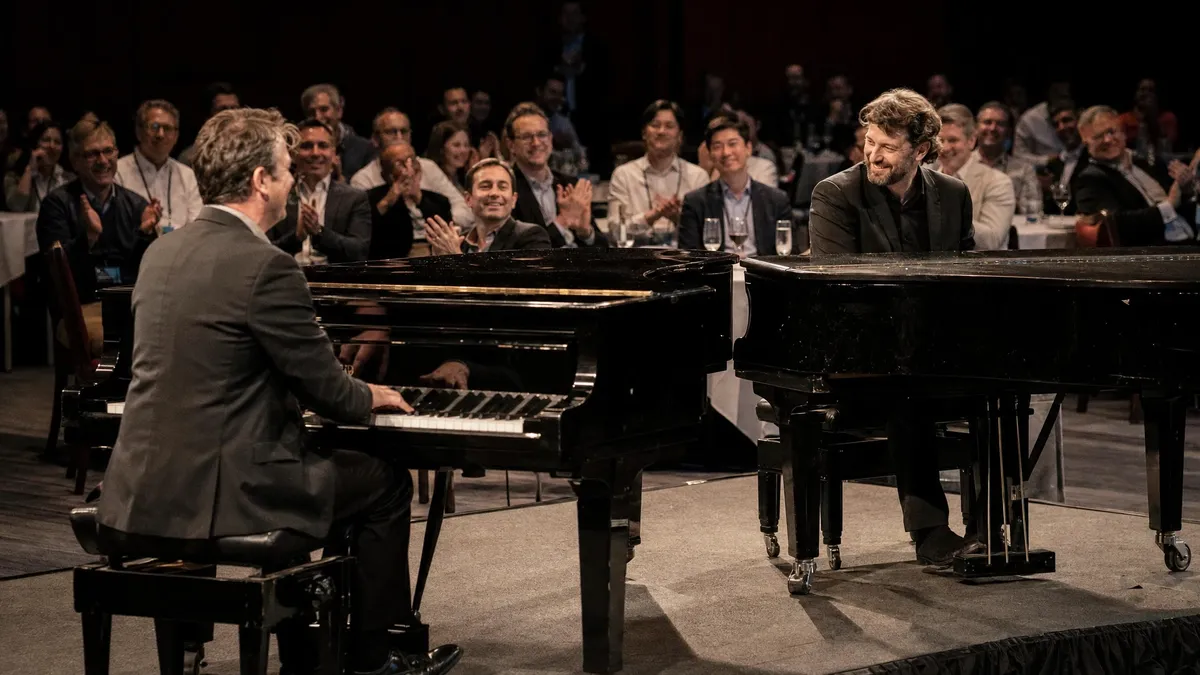
Dueling Pianos: The Complete Guide to the Most Interactive Show at Any Event
Two pianos, zero setlist, one room that will not stop singing. Here is how dueling pianos works, why it kills at corporate events and weddings, and how to book a duo that reads the crowd.
What a Dueling Pianos Show Actually Is
Category: The Format
Two Pianists, Facing Off
The core setup is two players at two pianos (or two stage keyboards) positioned face to face or side by side, both mic'd for singing. They trade lead on songs, back each other up, and openly compete for the room's attention. The rivalry is theatrical, not real, but the energy it creates is genuine. That head-to-head format is what separates dueling pianos from a solo piano player or a background jazz trio.
It Is All-Request, Not Pre-Programmed
There is no locked setlist. Guests submit requests all night, usually on napkins or request slips passed to the stage, and the players build the show live from what the room asks for. This is the whole point. The audience is not watching a performance that would happen the same way in an empty room. They are steering it. Every show is different because every crowd is different.
The Players Are Comedians First
The best dueling pianists are entertainers who happen to play piano, not pianists who occasionally talk. Between and during songs they roast the crowd, run the birthday and bachelorette bits, MC the whole flow, and keep the banter moving. Musical chops get you in the door. Comic timing and crowd control are what actually carry a two-hour show.
Tips Drive the Show
In a classic dueling pianos show, money moves the queue. Guests tip to get their song played, tip to skip someone else's, tip to make the other guy stop playing. It is a running gag and a genuine engagement engine. At corporate and private events the tip mechanic often gets softened or turned into a charity pot, but the playful economy of it keeps the room leaning in.
Crowd Singalong Is the Product
The songs skew toward tracks everyone already knows the words to: Billy Joel, Elton John, Journey, Bon Jovi, Whitney, Neil Diamond, plus current singalong anthems. The goal is not to show off obscure repertoire. It is to get 200 people screaming the same chorus at the same time. When a dueling pianos show is working, the room is louder than the pianos.
It Scales From A Corner to a Main Stage
Dueling pianos flexes to the room. In an intimate setting it is a tight, conversational two hours where the players know half the crowd by name. In a ballroom it becomes a full production with lighting, big sound, and a stage. The format does not change. The dial on energy and scale does. That range is why it fits everything from a 40-person office party to a 500-seat gala.
Why It Works for Corporate Events and Weddings
Category: The Case For It
Participation Beats Presentation
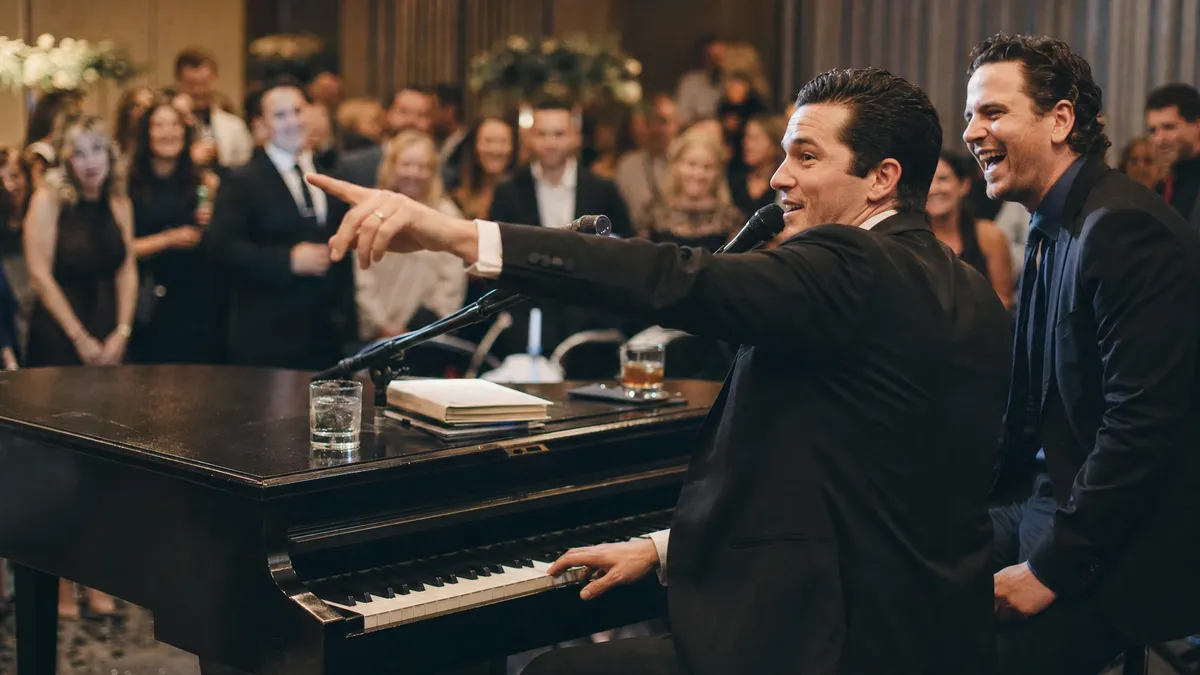
Audiences are tired of being talked at. A dueling pianos show flips your guests from spectators into participants the moment they scribble a request and pass it up. That is the same bet we made building Majority Rules, our interactive game show where the whole audience votes from their phones. When people help make the entertainment, they remember the night. Dueling pianos is one of the cleanest ways to buy that participation.
It Breaks Down Corporate Hierarchy
Nothing levels a room like the VP and the summer intern both getting roasted for their song choice. Dueling pianos does not care about your org chart. That shared, slightly ridiculous experience is exactly the kind of mixing corporate events are supposed to create and almost never do. People who would never talk at the open bar end up singing the same chorus.
One Act Fills the Whole Room's Energy
A dueling pianos duo carries a room the way a full band does, with two people and a much smaller footprint. You get high-energy live music, an MC, comedy, and audience interaction from a single booking. For planners juggling budget and stage space, that density of value is hard to beat.
It Handles the Wedding Energy Arc
Weddings need music that shifts from cocktail elegance to late-night chaos, and dueling pianos handles the whole curve. Soft and classy while guests arrive, building through dinner, then a full singalong dance alternative once the formalities end. For couples who love the idea of a band but want something guests will actually talk about, a piano duel is a genuinely different answer.
It Is Recession-Proof Fun
Dueling pianos does not depend on a trend, a headliner, or an expensive production gimmick. Two great players and a live crowd is a formula that has worked for decades and will keep working. When budgets tighten and clients still want a night people remember, an act that runs on interaction rather than pyro is the safe, smart spend.
Bad Entertainment Is an Event-Design Failure
Weak entertainment is almost always booked last minute to fill space, and everyone in the room can feel it. Dueling pianos is the opposite bet. It is entertainment designed to be the reason people showed up, not background noise near the dessert table. Book it as the centerpiece of your program, not the afterthought, and build the night's flow around it.
How to Book and Stage a Dueling Pianos Show
Category: Logistics
Set Length: Two to Three Hours
A standard dueling pianos show runs two to three hours, typically split into sets with short breaks. Two hours is plenty for a focused corporate crowd. Weddings and long gala nights often want three, sometimes with a quieter opening set that builds into the full duel. Longer than three hours and you usually want a second act or a DJ to fill the tail of the night.
Space and Stage Requirements
You need room for two pianos or keyboards, two players, and their gear, plus clear sightlines from the whole crowd. A riser helps in bigger rooms so guests at the back can see the interaction, because seeing the players is half the show. Confirm ceiling height, power, and load-in access with your venue early, especially if the duo is bringing acoustic instruments.
Piano vs Keyboard: Know the Trade-Off
Real acoustic pianos look and sound magnificent but are heavy, need tuning, and are brutal to move into a downtown venue with a freight elevator and a curfew. Professional stage keyboards deliver a full, tour-grade piano sound with none of that pain, and most audiences cannot tell the difference once the show is rolling. For the vast majority of events, twin keyboards are the right call.
Sound and Mics Are Non-Negotiable
Both players sing and talk constantly, so the show lives or dies on vocal clarity and crowd mics. A professional duo brings a PA scaled to your room and knows how to balance piano against two lead vocals against a screaming singalong. Ask who provides sound, whether a dedicated engineer comes with the act, and how they handle a bigger room. A great show with muddy vocals is a bad show.
Book Early for Peak Dates
The best dueling pianists book months ahead for prime dates: December corporate season, wedding weekends from May through October, and holiday party season. A strong duo available on short notice for a peak Saturday is a question worth asking. Start four to six months out for corporate events and nine to twelve for weddings to get your first-choice players rather than whoever is left.
Confirm What Is Included
Get the quote in detail. Confirm number of players, performance hours, sound equipment and engineer, lighting, MC duties, travel within the GTA, learning any must-play songs, and how requests are handled on the night. Hidden costs are the most common source of friction in entertainment contracts. The cheapest quote is rarely the best value if it strips out sound, an engineer, or setup time that others include.
Place the Bar With Intent
The bar is a gravity well. Put it next to the action and it feeds your crowd toward the pianos. Put it across the room and it quietly pulls your party apart, draining the audience away from the show right when the energy should be building. When you map the floor, treat the bar's position as an entertainment decision, not just a service one.
Give the Duo a Real Brief
The more the players know, the better the show. Tell them the occasion, the crowd's age and industry, the vibe you want, any names or in-jokes worth dropping, and above all your do-not-play list. A five-minute brief before the event is the difference between generic crowd work and bits that feel written for your room specifically.
Song Requests, Themes, and Formats
Category: The Experience
How the Request System Works
Guests write a song on a slip or napkin and pass it to the stage, often with a tip to jump the line. The players juggle the incoming pile in real time, weighing what the room needs next against what has just been asked for. A skilled duo reads the queue like a DJ reads a dance floor, holding the big singalong back until the moment it will detonate rather than burning it early.
Reading the Room and Swapping Songs
The real craft is knowing when the requested song is not the right song. We built our company on exactly this instinct. In our band days we would swap the setlist mid-show because we could feel the next tune would not land. A great dueling duo does the same, pivoting from the request in hand to the one the room actually needs. That live judgment is the entire value of a human act over a playlist.
The Birthday and Bachelorette Bits
Every dueling pianos show has running crowd bits: pulling up the birthday guest, roasting the bachelorette party, getting rival tables to out-sing each other. These are the hooks that make the audience part of the show rather than an audience at all. For a corporate crowd, a retirement, a promotion, or a big client win can anchor the same bit beautifully.
Themed and Era-Specific Nights
Dueling pianos bends easily to a theme. Run an all-80s night, a decades journey, a country-heavy set for the right crowd, or a holiday-song duel for a December party. The format is flexible because it runs on requests, so steering the pool toward an era or genre is as simple as briefing the players and salting the request slips with a theme.
The Do-Not-Play List
Just as important as what you request is what you ban. A short do-not-play list keeps an ex's song, an off-brand track, or that one number that clears every dance floor out of the night entirely. Professional players honor it without complaint. Hand it over early so it is baked into how they build the show, not a scramble mid-set.
Blending Dueling Pianos With a Band or DJ
Dueling pianos does not have to be your only act. Pair it with a DJ for the late-night stretch, hand off to a live band for a different flavor, or open with a solo pianist during dinner who then becomes half the duel. Because the format shares its all-request, crowd-first DNA with our uRequest Live band experience, these acts stack together naturally under one program.
Clean vs Uncensored: Set the Tone
Dueling pianos comedy runs from family-friendly to raunchy, and you get to choose. A company holiday party with clients in the room wants a different edge than a 30th birthday. Tell the duo exactly how blue they can go. Good players calibrate instantly. The mistake is assuming they will guess your comfort level correctly without being told.
What Separates Great Duos From Average Ones
Category: Quality

They Control the Room, Not Just Play It
Average players perform songs. Great ones run the room. They sense when energy is dipping and yank it back up, they know when to talk and when to shut up and play, and they can turn a dead crowd around inside two songs. That command is invisible when it works and painfully obvious when it is missing. It is the single biggest gap between a memorable act and a forgettable one.
Deep, Genuinely Broad Repertoire
A top duo can credibly play across decades and genres, from Piano Man to current chart hits to a country anthem to a Motown classic, and pivot between them on request. Range is not a long list of songs they technically know. It is the confidence to take almost anything the room throws and make it work. In a diverse market like Toronto, that breadth is what keeps every table in the show.
Comic Timing You Cannot Fake
The banter is not filler between songs. It is the show. Great dueling pianists have real comedic instinct: the roast that lands without stinging, the bit that builds, the read on when a joke has run its course. This is the hardest thing to teach and the easiest thing to spot in a live video. Watch the talk breaks. That is where average duos die.
They Make the Audience the Star
The best players understand the night is about your guests, not about them. They pull people in, hand the room its moments, and step back so the crowd feels like the show. Average players make it about their own performance. When the audience walks out saying how much fun they had, rather than how good the pianists were, you booked the right duo.
Rock-Solid Professionalism Offstage
Great acts show up early, sound check properly, carry backup gear, dress for your event, and roll with a schedule that slips. They carry liability insurance most venues require and put clear terms in writing. Professionalism offstage predicts professionalism on the night. If a duo is disorganized before the event, that same chaos shows up in front of your guests.
Chemistry Between the Two Players
Two brilliant solo pianists do not automatically make a great duel. The magic is in how the pair play off each other: the rivalry, the timing, the way one sets up the other's punchline. Duos who have logged real hours together have a rhythm you can feel. That partnership is the act, which is why locking in which two players you are getting matters as much as the company name on the contract.
Expert Pro Tips
Frequently Asked Questions
What is a dueling pianos show?
How much does it cost to hire dueling pianos in Toronto?
How much space and what equipment does a dueling pianos act need?
Is dueling pianos good for a corporate event or a wedding?
How do song requests work at a dueling pianos show?
Can dueling pianos players keep the show clean for a corporate crowd?
How far in advance should we book dueling pianos?
Planning a corporate event or wedding in Toronto? Tell us your date and crowd, and we will match you with a dueling pianos show that reads the room.
Get a Free Quote
Get StartedLove the all-request, crowd-powered energy of dueling pianos? uRequest Live is the same DNA in a full live band where your guests pick every song.
See Our All-Request Live Band
Contact Us