

Silent Disco: How It Works, Ideas, and How to Actually Run One
Everything you need to throw a silent disco that lands: how the headphones and channels work, corporate and wedding ideas, equipment and rental basics, and the mistakes we see people make.
How a Silent Disco Actually Works
Category: The Basics
The headphones are the entire party
Instead of a PA system blasting the room, each guest wears a wireless headphone that receives the music over radio frequency. No speakers, no sound bleed, no one shouting over the bass. The dance floor is loud inside the headphones and near silent to anyone standing in the doorway.
Multiple channels let guests pick their music
The signature move of a silent disco is multi-channel headphones, usually two or three channels. Each channel carries a different DJ or genre, and guests flip a switch on the ear cup to choose. One person can dance to hip-hop while the person next to them is deep in 80s pop, on the same floor, at the same time.
LED colours show what everyone is listening to
Every headphone glows a colour that matches its active channel, red for one DJ, blue for another, green for a third. Glance across the room and you can instantly see which music is winning. The colour war is half the fun and it is the thing that ends up all over social media.
Live DJs beat a static playlist
The channels can run off pre-built playlists, but a live DJ reading the room is what separates a good silent disco from a forgettable one. A DJ watching the colours shift can chase the crowd, drop the track that pulls people back, and build energy in real time. This is exactly how we work: our roots are in live bands where we would swap the setlist mid-show because we could feel the next song would not land.
Guests control their own volume
Each headphone has its own volume dial, so the person who wants it thunderous and the person who wants it comfortable both get their way. This solves the single biggest complaint at normal parties, that the music is too loud to talk and too quiet to dance.
The transmitters do the heavy lifting
Each channel broadcasts from a transmitter connected to that DJ's mixer or audio source. The transmitter range covers the dance floor and usually well beyond it, which is why guests can walk to the bar or the patio and never lose the music. That reach is a feature, not a bug.
It is genuinely quiet outside the headphones
This is the part people underestimate until they see it. With no speakers running, the ambient sound in the room is just voices and footsteps. That is what unlocks venues, timelines, and neighbours that a normal DJ setup would fight with all night.
How to Run a Silent Disco at a Corporate Event
Category: Corporate
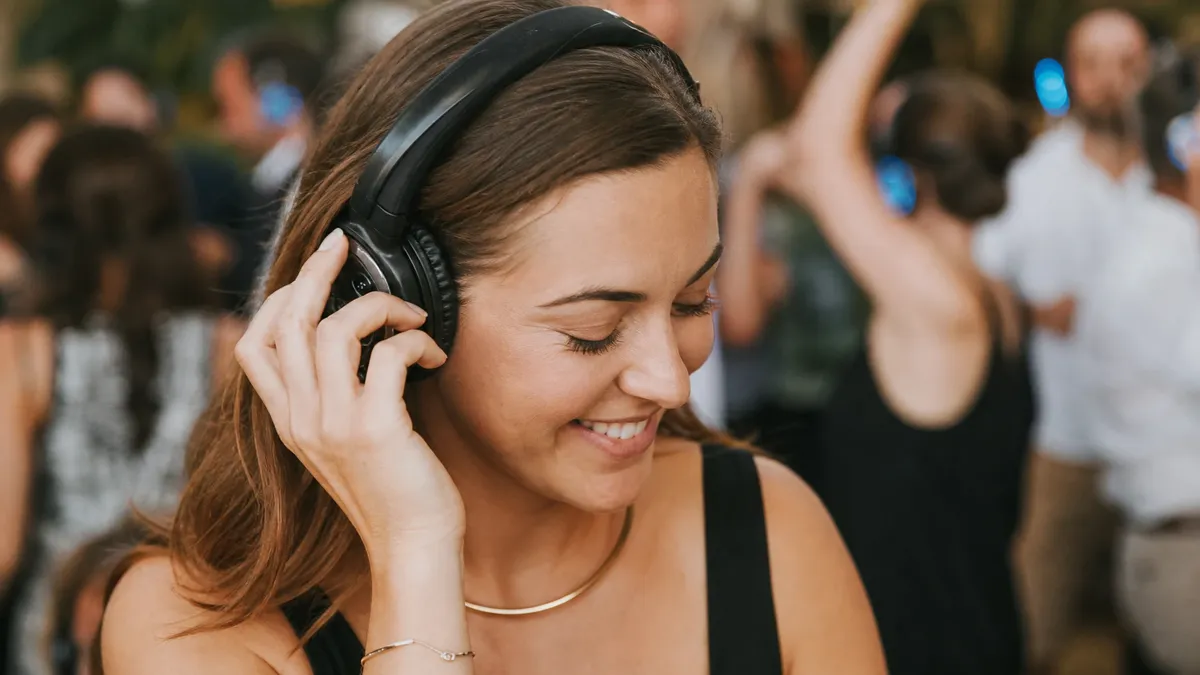
Use it as the after-dinner pivot
The awkward moment at every corporate event is the transition from seated dinner to party. A silent disco nails it: headphones get handed out during dessert, the DJs start, and the room converts from banquet to dance floor without a jarring blast of speaker volume clearing the tables.
Solve the shared-venue and hotel ballroom problem
Corporate events often run in hotel ballrooms with a wedding on the other side of an air wall, or in venues with a hard sound curfew. A silent disco sidesteps all of it. Your party can go full energy at midnight with zero noise complaints and zero risk of shutting down the room next door.
Turn it into a team-versus-team colour battle
Assign departments or tables to root for a channel and project a live count of which colour is dominating the floor. Competition pulls introverts onto the dance floor faster than any open bar. We build entire interactive formats around this idea because audiences are tired of being talked at.
Layer it over networking, not against it
Because guests can lift a headphone to talk, a silent disco does not kill conversation the way a wall of speakers does. People dance, chat, deal-make, and jump back into the music. It is one of the rare entertainment formats that makes networking easier instead of harder.
Brand the headphones and the channels
Custom LED colours, a channel named after your product, a company logo on a sign at the booth, all of it is easy to theme. For a launch or an award night, the branding shows up in every photo a guest posts without any extra effort from your team.
Pair it with a live band for the best of both
You do not have to choose between live music and a silent disco. Run a live band or an all-request act earlier in the night, then flip to silent disco for the late shift when the venue curfew or the neighbours would otherwise force you to pull the plug.
Plan the bar around the dance floor
The bar is a gravity well. Put it too far from the action and it pulls your party apart into two rooms that never reconnect. With a silent disco, keep the bar within sight of the floor so guests can grab a drink and stay in the music instead of drifting into a quiet corner.
Book it on purpose, not last minute
The corporate events that flop are the ones where entertainment gets booked last to fill space. Bad entertainment is an event-design failure. Decide early that the silent disco is the centrepiece of the night, build the run of show around it, and it will carry the whole event.
Silent Disco Ideas and Themes
Category: Ideas
Decades battle across the channels
Give each channel a decade: 80s on red, 90s on blue, 2000s on green. Guests channel-hop through their own nostalgia and the colour split across the room is a live poll of the crowd's age and taste. It is a guaranteed conversation starter.
Genre wars
Instead of decades, split by genre: hip-hop, throwback pop, and electronic. This works brilliantly for a mixed crowd where no single genre would satisfy everyone. Everybody finds their channel, nobody suffers through 40 minutes of music they hate.
Silent disco yoga or fitness
Not every silent disco is a night party. A morning session with a guided instructor on one channel and an ambient soundtrack on another turns a wellness activation or a conference breakout into something people actually remember. The shared headphones create a strangely intimate group focus.
Silent disco walking tour or roaming party
Because the transmitter range is large, guests can move through a space and stay on the music. Roam a rooftop, a gallery, a multi-room venue, or a garden while the party travels with them. It breaks people out of the single-room trap most events fall into.
Head-to-head DJ showdown
Put two DJs on two channels and let them openly compete for the crowd, watching the colours to see who is winning and adjusting their sets to steal listeners. Announce the live count between songs. It gives the DJs a scoreboard and the guests a reason to keep switching.
Sing-along channel
Dedicate one channel to pure crowd-pleasing sing-along anthems. The comedy of a room full of people belting the same song while, to an outside observer, standing in total silence, is the single most shared clip that comes out of any silent disco.
Holiday party silent disco
For a company holiday party in a shared venue or a restaurant back room, a silent disco delivers full party energy in a space that could never host a normal DJ. One channel of holiday classics, two channels of dance, and a room that would otherwise be a polite dinner becomes a real night out.
Kids and family channel
At a family day or a multi-generational event, run a kid-friendly channel alongside the adult channels. Children get their own party on the same floor as the grown-ups, and parents can flip over to check in without leaving the dance floor. It keeps the whole family in one room.
Silent disco plus interactive game show
Combine formats for a night nobody has seen before. Run our interactive game show where the whole audience votes from their phones, then flip everyone to silent disco headphones for the dance segment. Participation is the through-line, and the crowd never once becomes a passive audience.
Equipment, Channels, and Logistics
Category: Logistics
Count your headphones against peak attendance
Base your headphone count on the busiest moment of the night, not the guest list. Not everyone dances at once, but you never want a guest waiting for a headset while the floor is full. A rough rule is one headphone per expected guest plus a 10-15% buffer.
Pick your channel count deliberately
Two channels suits a focused crowd with a clear split. Three channels is the standard for a mixed party and gives the colour war enough variety to be fun. More than three usually fragments the room so no single channel ever reaches critical mass on the floor.
Understand transmitter range and placement
A single transmitter per channel typically covers a large room and spills well outside it. Range drops when the signal has to punch through walls or a dense crowd, so central, elevated placement matters more than raw wattage. For sprawling or multi-room venues, you may need signal boosting.
Plan for batteries and charging
Headphones and transmitters run on rechargeable batteries. A quality set lasts a full event on one charge, but a multi-day festival or a very long night needs a charging rotation. Confirm battery life and whether spare charged units are included before you book.
The venue and noise-bylaw advantage is the real selling point
This is the logistical superpower. Because there are no speakers, a silent disco laughs at noise bylaws, sound curfews, shared-wall venues, residential neighbours, and outdoor events near homes. Venues that would never permit an amplified party will happily host a silent one.
Sort out the audio source for each channel
Each channel needs its own clean audio feed, whether that is a live DJ's mixer, a laptop, or a media player. If you are running live DJs, they bring and connect their own gear to the transmitters. If you are self-running playlists, you need a device and a plan for each channel.
Rental versus full production
You can rent bare headphones and transmitters and run everything yourself, or book a full production that brings the gear, live DJs, an on-site tech, and the check-out staff. Self-serve rental is cheaper on paper. A produced silent disco is the difference between equipment in a room and an event that actually works.
Budget by headphone count and channels
Cost scales with how many headphones you need, how many channels you run, and whether you add live DJs and on-site staff. A small self-run rental is modest. A full corporate or wedding production with three live DJs, custom branding, and a tech on site is a real line item. Price it early so it is not a surprise.
Silent Disco for Weddings
Category: Weddings
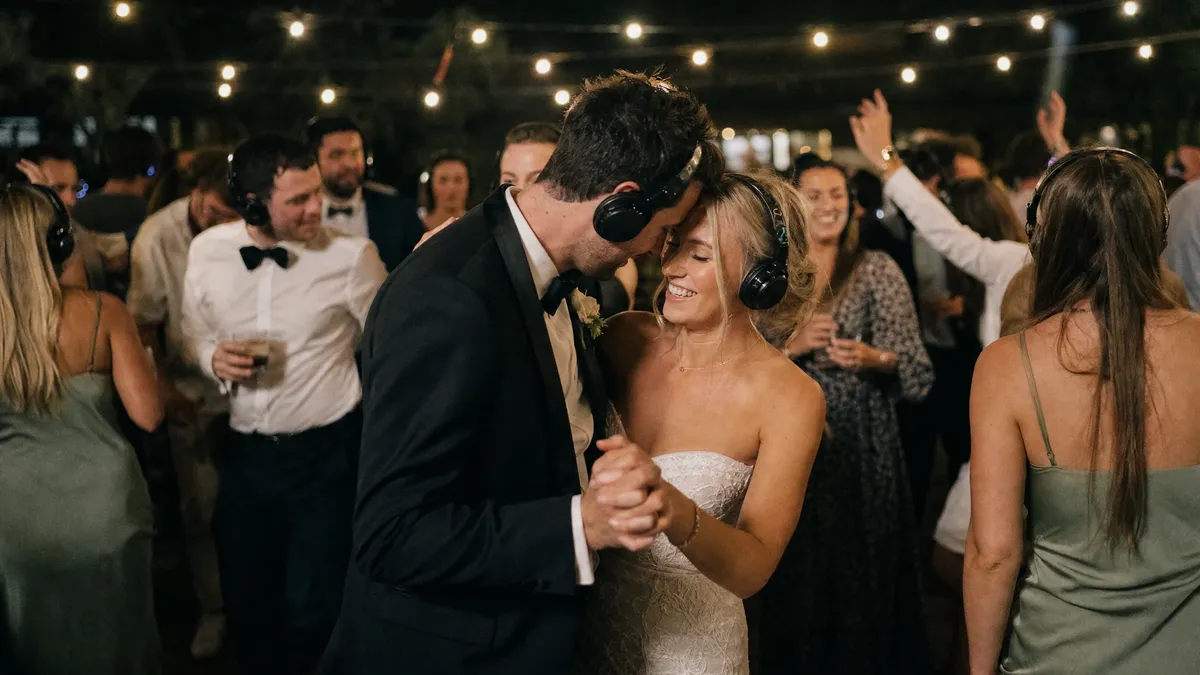
It solves the venue curfew problem
Half the wedding venues worth booking come with a hard sound curfew, especially barns, estates, and anything near residential streets. A silent disco lets the reception keep dancing long after the amplified music would have been shut down. The party ends when the couple wants it to, not when the bylaw says so.
Give the generations their own channels
The eternal wedding fight is grandma's classics versus the cousins' club music. Silent disco channels end it. Put the older crowd's favourites on one channel and the late-night bangers on another, and everyone dances to what they love in the same room without a single request-line argument.
Run a live band first, then switch to silent
The dream wedding night is a live band or an all-request act for the first dances and the peak of the reception, then a switch to silent disco headphones for the late-night set once the venue's amplified curfew hits. Guests never notice the transition except that the party gets to keep going.
Keep older guests and kids in the room
Because guests set their own volume and can lift an ear cup to chat, a silent disco is far gentler on older relatives and sleepy kids than a wall of speakers. They stay in the room and part of the celebration instead of retreating to the lobby to escape the volume.
The photos and video are unbeatable
A dance floor of guests singing their hearts out in total silence is the wedding content that goes viral in the family group chat. It is genuinely funny, genuinely joyful, and completely different from every other wedding your guests have been to.
Perfect for intimate and non-traditional venues
Backyard weddings, rooftop receptions, gallery spaces, and restaurants that would never allow a full DJ rig are all fair game for a silent disco. It brings a real dance party to venues that were never built to host one, which opens up the couple's options enormously.
It doubles as a talking point all night
Guests who have never been to a silent disco spend the first ten minutes delighted and confused, and that novelty becomes the conversation that carries the reception. It is entertainment and icebreaker in one, which is exactly what a room full of two families who barely know each other needs.
Common Silent Disco Mistakes
Category: Mistakes
Ordering too few headphones
The fastest way to ruin a silent disco is a guest standing on the edge of a packed floor with no headphones to grab. Undercounting to save money backfires the moment your event gets popular. Always buffer above your guest count, because a silent disco with no headphones is just a quiet room.
Running playlists instead of live DJs
A pre-programmed channel cannot read the room. When the floor thins out, a playlist keeps grinding through tracks nobody is feeling while a live DJ would have already pivoted. For anything beyond a small casual party, live DJs are what make the format work.
Ignoring transmitter placement
Shoving the transmitters in a back corner because that is where the outlet is guarantees dropouts at the far edges of the room. Radio signal hates walls and crowds. Central, elevated placement is not optional, and skipping the setup walk-through is how you find the dead zones during the party instead of before it.
Too many channels
Four or five channels feels generous but splits a mid-size crowd so thin that no channel ever fills the floor. The energy of a silent disco comes from a mass of people on the same colour hitting the same drop. Three channels, maximum, for almost every event.
No one explaining how it works
Guests who have never worn silent disco headphones need ten seconds of instruction: here is the power, here is the volume, here is how you switch channels, here is what the colours mean. Skip that and you get a floor of confused people fiddling with ear cups instead of dancing.
Booking it as an afterthought
Bad entertainment is almost always booked last-minute to fill a hole in the schedule. A silent disco slotted in two weeks out with no thought to the run of show, the room layout, or the crowd will underperform. Decide early that it is the centrepiece and design the night around it.
Putting the bar across the room
The bar is a gravity well. Park it far from the dance floor and half your guests will migrate to it and never come back, headphones dangling around their necks. Keep the bar, the floor, and the energy in one tight cluster so the party stays whole.
Treating the crowd as an audience
The worst silent disco is one that forgets its own point. This format exists because participation beats presentation. If you set it up like a stage show with the crowd watching a DJ booth, you have wasted the one thing that makes a silent disco special: every guest is a participant, not a spectator.
Expert Pro Tips
Frequently Asked Questions
How does a silent disco actually work?
How many channels should a silent disco have?
Do silent discos get around noise bylaws and venue curfews?
How many headphones do I need for my event?
Is a silent disco good for a corporate event?
Can you use a silent disco at a wedding?
Should I rent silent disco equipment or hire a full production?
What are the most common silent disco mistakes?
Tell us about your event and we'll produce a silent disco that fits your venue, your crowd, and your curfew, gear, DJs, and on-site tech included.
Plan Your Silent Disco
Get StartedExplore the full roster of live bands, interactive formats, and party entertainment we produce for corporate events and weddings across Toronto.
See Our Event Entertainment
Contact Us