

The Complete Wedding Photo Booth Guide
Every booth type, guestbook idea, placement trick, and vendor question you need to turn a corner of your reception into the line everyone remembers.
Photo Booth Types for Weddings
Category: Choosing a Format
Open-Air Photo Booth
An open-air booth uses a backdrop, a camera, and a light with no enclosure, so a huge group can pile into one shot. It is the most flexible format for weddings because it photographs beautifully, fits into a styled corner, and handles everyone from a couple to a dozen bridesmaids. If you want something that looks like part of the decor instead of a carnival attraction, start here.
Enclosed Classic Booth
The old-school curtained booth gives guests privacy, which is exactly why the photos get wilder. Nobody watching means people commit to the bit. The tradeoff is capacity, since these fit two to four people comfortably, and footprint, since the cabinet is bulky. Choose it for the nostalgia and the strip prints, not for big group shots.
360 Spin Booth
Guests stand on a platform while an arm with a camera orbits them and captures a slow-motion video clip they can share instantly. It is the format built for social feeds, and it draws a crowd because watching is half the fun. It needs a good chunk of open floor and a ceiling that clears the arm, so it is not a fit for tight lofts.
AI Photo Booth
An AI photo booth takes a guest photo and restyles it in seconds, dropping your friends into cinematic portraits, themed scenes, or custom looks matched to your wedding. It is the newest category and the one that gets the loudest reaction, because the output feels personal and nobody has seen their face rendered that way before. You set the styles in advance so every image stays on-brand for the night.
Audio Guestbook
Not every keepsake is a photo. An audio guestbook is a vintage-style phone guests pick up to leave a voice message for the couple, and the recordings are stitched into one file you keep forever. Pair it with a photo booth and you capture both the faces and the voices of the night. It is quiet, low-footprint, and disarmingly emotional to listen back to.
Glam and Beauty Booth
A glam booth applies a soft skin-smoothing black-and-white filter in the style of celebrity step-and-repeat photography. It flatters everyone and it suits a black-tie or luxe wedding aesthetic. The look is polished rather than playful, so it pairs best with couples who want elegance over goofy props.
Roaming and Mirror Booths
A roaming booth is an attendant with a mobile camera and printer who works the room, so the booth comes to your guests during dinner instead of waiting for them. A mirror booth is a full-length reflective screen with interactive prompts and signatures on the touchscreen. Both are conversation starters, though roaming shines for seated-dinner weddings where a fixed line never forms.
Guestbook and Favour Integrations
Category: Keepsakes
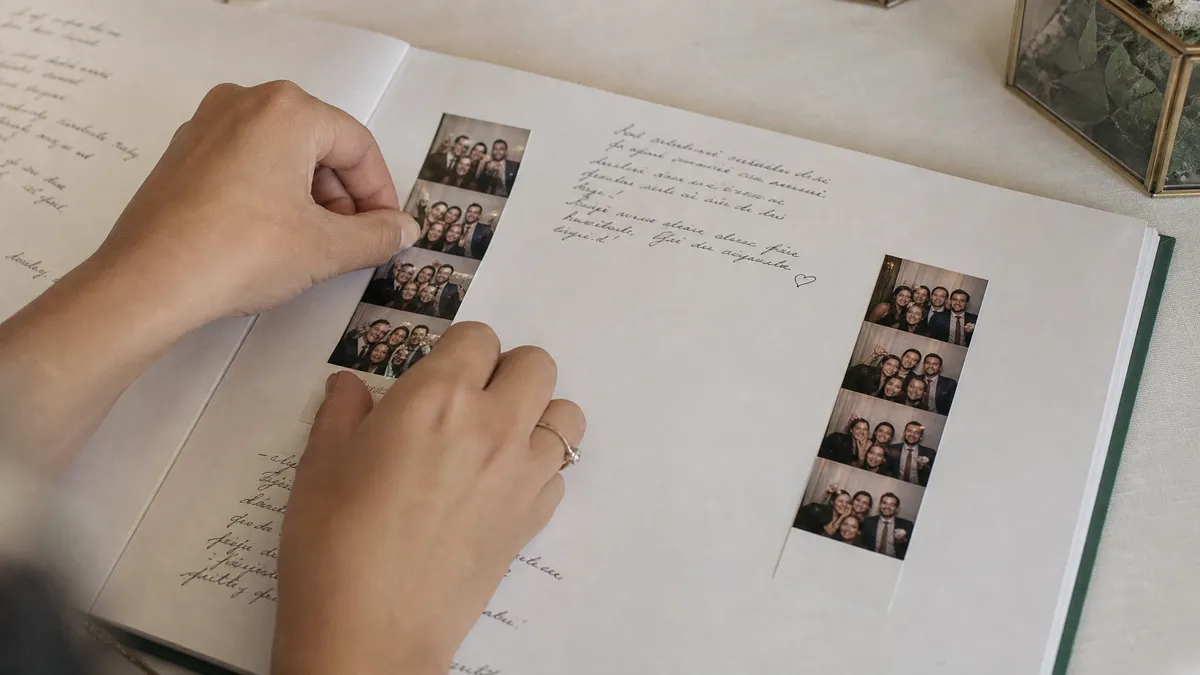
The Photo Strip Guestbook
The classic move: guests get one printed strip and drop a duplicate into an album next to a handwritten note. You leave the reception with a book of faces and messages instead of a stack of loose prints. It is the single best reason to choose a booth that prints on-site rather than digital-only.
Custom Print Templates
Your prints can carry your names, wedding date, monogram, or hashtag baked into the layout. A well-designed template turns a throwaway photo into a branded favour guests actually keep. Send your invitation suite or colour palette to the vendor so the print design matches the rest of your paper goods.
Prints as Favours
A photo booth print is the rare wedding favour that never gets left on the table. It is personal, immediate, and free to you beyond the booth cost. Skip the sugared almonds and let the booth be the thing your guests carry home in their pocket.
Audio Guestbook Recordings
Combine a photo booth with an audio guestbook and you keep both the image and the voice of every guest. The voice messages become a keepsake you replay on anniversaries, and they capture the toasts your friends were too shy to give at the mic. It is the most underrated pairing at a wedding.
Digital Guestbook and Live Gallery
A live gallery pushes every booth photo to a shared online album guests can browse and download in real time. It works alongside a physical guestbook rather than replacing it, and it is how out-of-town relatives who left early still get their photos. Confirm how long the gallery stays live after the wedding.
Scrapbook Stations
Set up a small table beside the booth with pens, glue, and washi tape so guests assemble their own page in your album. It turns a passive keepsake into an activity and fills the guestbook with color and handwriting. Works best at relaxed weddings where guests linger rather than rush the dance floor.
Placement and Timing at the Reception
Category: Logistics
Put the Booth Near the Action
The bar is a gravity well, and so is the booth. Place it near the dance floor and the bar and it stays busy all night. Tuck it in a hallway or a side room and it dies, no matter how good it is. Traffic is the whole game, so give up your best corner for it.
Open During Cocktail Hour
Cocktail hour is when guests are milling, drinks are flowing, and there is nothing else to do yet, so the booth fills instantly. Opening early also thins the line later when everyone wants to dance. If your booth package includes idle hours, spending them on cocktail hour is the highest-return choice you can make.
Reopen After the First Dance
The dead zone between dinner and a full dance floor is exactly when the booth earns its keep. Once the formal dances end and the energy shifts, a booth right by the floor catches the guests who are not ready to dance but are not ready to sit either. That transition is where a booth quietly saves your reception timeline.
Give It Real Estate and Power
A booth needs floor space, a nearby power outlet, and a load-in path that does not cross your styled tables. Open-air needs depth, a 360 needs clearance, and every booth needs a dedicated circuit so it does not trip a breaker mid-reception. Confirm all three with your venue before the day.
Plan the Lighting
Booths photograph best under their own controlled light, but the surrounding room matters too. A booth parked under a harsh exit sign or a color-washing uplight will fight the camera all night. Position it where the venue lighting is neutral, or where the vendor can fully control the light with their own kit.
Match Booth Hours to the Timeline
Most couples book three to five hours of booth time. Line those hours up with cocktail hour and the open dance floor, not with the dinner service when everyone is seated and eating. A booth running during plated dinner is a booth running for an empty room.
Backdrops and Props That Match Your Aesthetic
Category: Styling
Match the Backdrop to Your Wedding, Not the Booth Company
A generic sequin backdrop screams rental and clashes with a carefully styled wedding. Choose a backdrop that echoes your florals, your color palette, or your venue architecture instead. The booth should look like you planned it, not like it was wheeled in from another event.
Floral and Greenery Walls
A living or faux floral wall is the most requested wedding backdrop for a reason. It photographs richly, doubles as decor before the booth opens, and suits nearly every aesthetic from garden to glam. Coordinate the flower colors with your bouquets so the whole palette reads as one.
Custom and Branded Backdrops
A step-and-repeat with your monogram, a neon sign with your names, or a custom-printed backdrop turns every photo into a branded keepsake. It is the most personal option and it makes your prints unmistakably yours. Order it early because custom fabrication needs lead time.
Venue-as-Backdrop
Sometimes the best backdrop is the room you already paid for. A grand staircase, a heritage brick wall, a waterfront window, or a garden view often beats any rental panel. An open-air booth pointed at a great architectural feature gives you photos that could only have happened at your wedding.
Curate Your Props, Do Not Dump Them
A bin of plastic sunglasses and inflatable guitars undercuts an elegant wedding. Curate a small, tasteful prop set instead: quality signs, a few elegant hats, maybe a custom cutout tied to your story. Less clutter means better photos and a look that matches your decor.
Signage and Instructions
A small styled sign telling guests how to use the booth, sign the guestbook, and find the live gallery removes all friction. Guests hesitate when they are not sure what to do, and hesitation kills the line. One clear sign keeps everyone moving.
Coordinate With Your Overall Decor
The booth area is a photo set within your reception, so it should share the same florals, linens, and lighting language as the rest of the room. Loop your planner or decorator in on the booth corner early. When it all matches, guests barely register the booth as a separate vendor, which is the goal.
Digital Sharing and Privacy
Category: Data and Sharing
Instant Text, Email, and AirDrop
Modern booths let guests send their photos to themselves by text, email, or AirDrop within seconds. This is the feature that gets your photos shared to social feeds the same night and keeps the booth feeling current. Confirm the venue has enough cell signal or wifi for instant sharing to actually work.
The Online Gallery
Every booth photo lands in a shared online gallery guests can browse, download, and reshare after the wedding. It is where you relive the night and where relatives who missed the booth still get their shots. Nail down how long the gallery stays live, since some vendors take it down after 30 days.
Data Ownership and Deletion
Ask the vendor who owns the photos and how long they retain guest images and contact details. A reputable operator gives you full rights to your images and deletes guest phone numbers and emails after the event. Get this in writing, because your guests are trusting you with their data.
AI Booth Image Handling
An AI booth processes guest photos to generate its styled outputs, so ask specifically how those images are handled and whether they are stored or used to train anything. The good operators process on the fly, hand you the results, and retain nothing. Do not assume, ask.
Social Sharing and Your Hashtag
If you want a flood of tagged photos, brand the booth screen and prints with your wedding hashtag and make sharing one tap. If you would rather keep the night private, ask the vendor to disable public sharing and keep the gallery password-protected. Either choice is valid, just decide on purpose.
Backups and Delivery Format
Confirm you receive the full-resolution originals, not just the web-compressed gallery versions, and that the vendor keeps a backup until you have downloaded everything. Ask for the delivery format and timeline in the contract. Photos lost to a dead hard drive are gone forever.
Questions to Ask Before You Book
Category: Vetting Vendors
Are Prints Unlimited?
Ask whether every guest in every photo gets a print, or whether there is a per-session cap. Unlimited prints are the difference between a favour everyone keeps and a booth that rations paper. If the answer is capped, price out the upgrade before you decide.
Who Is the Attendant?
A live attendant keeps the line moving, styles group shots, refreshes props, and troubleshoots the tech so it never goes down. Confirm a trained attendant is included, not just a machine dropped in the corner. The attendant is often the difference between a busy booth and a dead one.
What Are the Idle and Overtime Rates?
If you want the booth set up for cocktail hour but running later, you may pay an idle-hour rate to hold it dark in between. Ask about idle fees and overtime rates upfront so a late-running reception does not surprise you. Get the numbers in the contract.
How Much Space and Power Do You Need?
Ask the vendor for the exact footprint, ceiling clearance, and power requirements, then check them against your venue's booth corner. A 360 booth that needs 12 feet of clearance is a problem you want to find now, not on the wedding day. Share your floor plan with the vendor.
Can We See Real Wedding Work?
Ask for a gallery from actual weddings, not staged demos, and ideally from your venue or a similar one. The output quality, the print design, and the backdrop styling all vary wildly between vendors. Photos from real events tell you what your guests will actually get.
Is It Insured, and What Is the Backup Plan?
Confirm the vendor carries liability insurance, since most GTA venues require it, and ask what happens if the camera or printer fails mid-event. A professional carries a spare and can be running again in minutes. Get the insurance certificate before the day.
What Exactly Is in the Package?
Get a written breakdown: hours, prints, backdrop options, prop set, template design, attendant, online gallery, digital sharing, and delivery of the files. Vague packages hide the upsells. A clear line-item list lets you compare vendors on equal footing instead of on the sticker price.
Expert Pro Tips
Frequently Asked Questions
How much does a wedding photo booth cost in Toronto?
What type of photo booth is best for a wedding?
When should the photo booth be open during the reception?
Where should we put the photo booth at our wedding?
Can a photo booth double as our wedding guestbook and favours?
How does an AI photo booth handle guest photos and privacy?
How much space and power does a wedding photo booth need?
See the AI photo booth that restyles your guests into cinematic portraits in seconds, matched to your wedding.
Explore Our AI Photo Booth
Get StartedTell us your venue, date, and vibe, and we will build a photo booth setup that fits your wedding.
Get a Free Quote
Contact Us