
Greek Wedding Traditions & Entertainment Guide
Circle dances that pull in every guest, live bouzouki, pinned money, and a glendi that runs late. Here is how to plan Greek wedding entertainment in Toronto that honours tradition and packs the floor.
Traditional Greek Wedding Elements
The Orthodox Ceremony and the Dance of Isaiah
The Greek Orthodox wedding is a rich sacramental service with no spoken vows. The couple is crowned with stefana, joined crowns linked by a ribbon, and the priest leads them three times around the ceremony table in the Dance of Isaiah, their first steps as a married couple. The koumbaro or koumbara, the wedding sponsor, plays a central role swapping the crowns and standing with the couple throughout.
The Kalamatiano and Circle Dances
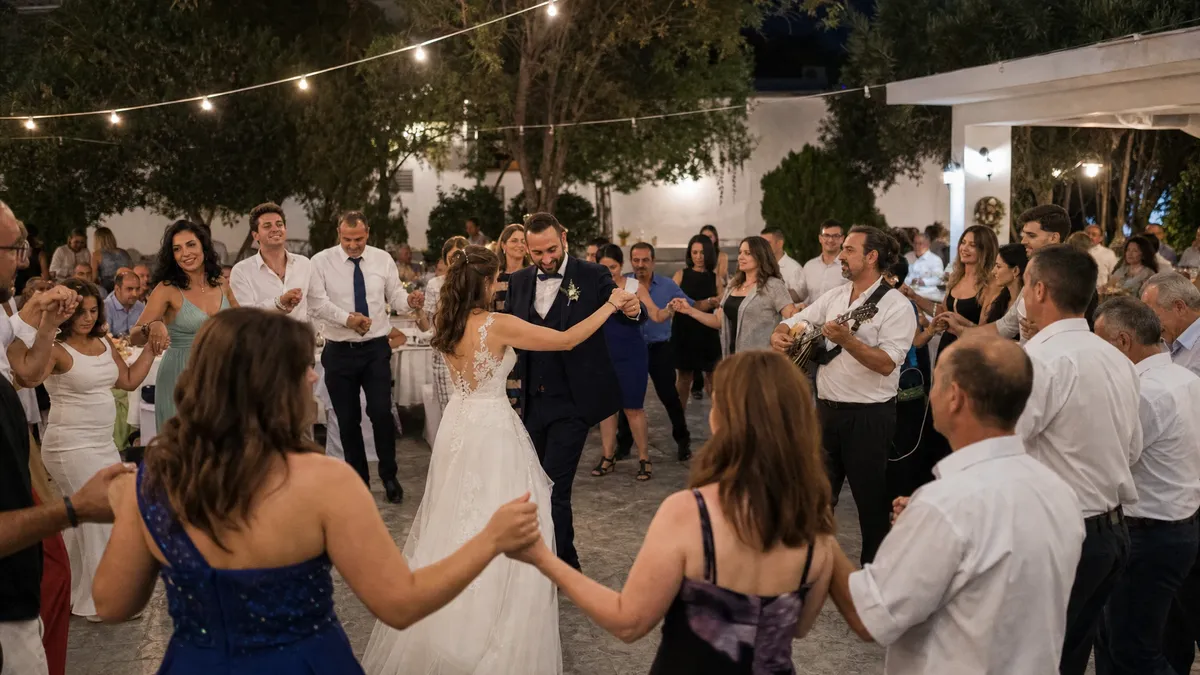
The kalamatiano is the signature Greek circle dance, danced in a 7/8 rhythm with hands linked on shoulders, the lead dancer at the front improvising while the line follows. It is joined by syrtos, tsamiko, and other regional line dances. These are open circles by design: anyone can join at any moment, which is exactly why they are the heartbeat of the reception. No experience required, just grab the hand next to you.
The Zeibekiko
The zeibekiko is the opposite of the circle: a solo, improvised, deeply personal dance, traditionally danced by one person while friends kneel and clap in a ring around them. It is emotional, unchoreographed, and often the most watched moment of the night. There is an unspoken rule that nobody else steps into another person's zeibekiko.
The Money Dance
During the dancing, guests pin money onto the bride and groom, or shower it over them as they dance, a tradition sometimes called the kollariko. It is a blessing and a contribution to the couple's new life together, and it turns a dance into a joyful, chaotic swirl of bills, music, and cheering. In many families it happens during a kalamatiano or a slower couple's dance.
Plate Smashing
Breaking plates is the tradition most people picture at a Greek celebration, historically a symbol of joy, abundance, and warding off bad luck. Here is the honest part: almost no Toronto venue permits real plate smashing anymore for safety and cleanup reasons, and many families never practised it at weddings to begin with. It is more a taverna and festival tradition than a universal wedding custom.
Koufeta and the Bombonieres
Guests leave with bombonieres, wedding favours holding koufeta, sugar-coated almonds given in odd numbers, traditionally five, representing health, wealth, happiness, fertility, and long life. The odd count matters: it cannot be divided evenly, symbolising a marriage that cannot be split. It is a small, meaningful ritual woven through the reception.
The Glendi Reception
Glendi is the Greek word for the feast and the party, and it describes the whole reception philosophy: long tables, endless food and wine, live music, and dancing that keeps circling back. Unlike receptions built around a rigid timeline, a glendi flows. The dancing is not a segment after dinner, it is the entire evening, and the celebration keeps rolling as long as the crowd wants it to.
Modern Touches & Fusion Ideas
Live Band Plus Greek Repertoire
Modern Greek-Canadian couples want the kalamatiano and the zeibekiko, and they also want their guests dancing to current pop, classic rock, and dance-floor anthems later in the night. The best receptions move fluidly between a Greek circle dance and a Western sing-along without the energy ever dropping, mirroring the dual identity of second and third generation Greek-Canadian families.
uRequest Live All-Request Reception
Rather than a fixed setlist, an all-request format lets guests drive the music from their phones all night. For a multi-generational Greek crowd this is ideal: the yiayia requests a laïko classic, the cousins request the latest hit, and the floor never belongs to one generation for too long. Participation beats presentation, and a room that helps choose the music is a room that stays on the floor.
Interactive Game Show Reception Moment
Some couples break up the night with an interactive moment that gets the whole room off their chairs and competing, a modern answer to the fact that audiences are tired of being talked at. A crowd-wide game where everyone plays from their phone works for a Greek reception's big guest counts and its come-one-come-all spirit.
AI Photo Booth with Greek Motifs
An AI photo booth transforms guest portraits into styled keepsakes, and it can be themed with Greek visual language: the blue and white of the flag, Mediterranean settings, classical motifs, or the couple's own colours. It gives guests a shareable memento that ties back to the wedding's cultural identity rather than a generic photo strip.
String Quartet or Trio for the Church and Cocktail Hour
For the moments that call for elegance rather than a full circle dance, a string quartet or a small live trio bridges the ceremony exit and the cocktail hour. They can play refined arrangements as guests gather, then hand off to the main band as the glendi builds, giving the evening a graceful arc from ceremony to full party.
Music Recommendations
Traditional Greek Folk (Dimotika)
The regional folk music that powers the circle dances: kalamatiano, syrtos, tsamiko and more, carried by bouzouki, clarinet, and violin. This is the non-negotiable core of a Greek wedding, the music the whole family knows and will dance to instantly. Regional families will want their own repertoire, so Cretan, Pontian, and Cypriot music each bring distinct instruments and dances.
Rebetiko and Zeibekiko
The soulful, urban roots music of Greece, driven by the bouzouki, is the emotional heart of the solo zeibekiko and the late-night moments. Played live, rebetiko gives the reception its depth and its most personal dances, the songs that clear the floor for one person and a ring of clapping friends.
Laïko and Modern Greek Pop
Contemporary Greek popular music keeps the younger crowd and the whole family moving. From beloved laïko singers to current Greek chart hits, this is the bridge between the traditional dances and the Western pop of the late-night set, and it sparks some of the biggest sing-along moments of the night.
Greek-Canadian Crossover and Western Pop
For a Toronto crowd that spans generations and includes plenty of non-Greek friends, a strong Western pop, rock, and dance set is essential for peak party hours. The best entertainers thread these tracks between Greek numbers so the floor never empties and every guest gets their moment.
Cultural Planning Timeline
- Talk with both families about which traditions they expect: the church ceremony, the money dance, plate smashing or a substitute, and specific regional dances
- Confirm whether the ceremony is fully Greek Orthodox, which shapes the church music and the koumbaro role
- Choose a venue with a large, central dance floor that can hold growing circle dances and big guest counts
- Start researching live bands in Toronto with genuine Greek folk repertoire, not just a token song or two
- Book your live band and MC early, since strong Greek-Canadian wedding bands in the GTA fill peak-season dates fast
- If your family is Cretan, Pontian, or Cypriot, confirm the band can cover that specific regional music and dances
- Discuss the plate smashing question with your venue now and choose a venue-safe alternative if needed
- Plan the ceremony-exit moment: live music greeting guests outside the church, cocktail-hour strings, or a brass welcome
- Share your must-play list of Greek songs with the band so they can rehearse regional and family favourites
- Brief the MC on the flow of the money dance and when it happens in the evening
- Coordinate how the night moves between circle dances and the Western dance set so energy never drops
- Confirm pronunciation of family names, the koumbaro or koumbara, and any Greek terms the MC will use
- Confirm the venue's rules on flowers, confetti, or any plate smashing substitute for the big dance moments
- Test all audio and microphones for the MC, toasts, and the live band at the venue
- Walk the band and MC through the timeline: ceremony exit, cocktail hour, first dance, money dance, and the glendi
- Place the band and dance floor at the centre of the room, away from being pulled apart by a far-off bar
Frequently Asked Questions
Can your band play traditional Greek dances like the kalamatiano?
Can we still do plate smashing at a Toronto venue?
How does the money dance work and how do you plan for it?
What entertainment works for a Greek Orthodox ceremony?
How do you keep every generation dancing at a Greek wedding?
What is a glendi and how does it change the reception timeline?
Do you provide entertainment for Greek weddings across the GTA, not just downtown Toronto?
Tell us about your Greek wedding and we will plan entertainment that honours the traditions and keeps the glendi going late.
Get a Free Quote
Get StartedExplore our live bands, all-request format, and specialty acts for Greek weddings across Toronto and the GTA.
See Our Wedding Entertainment
Contact Us