
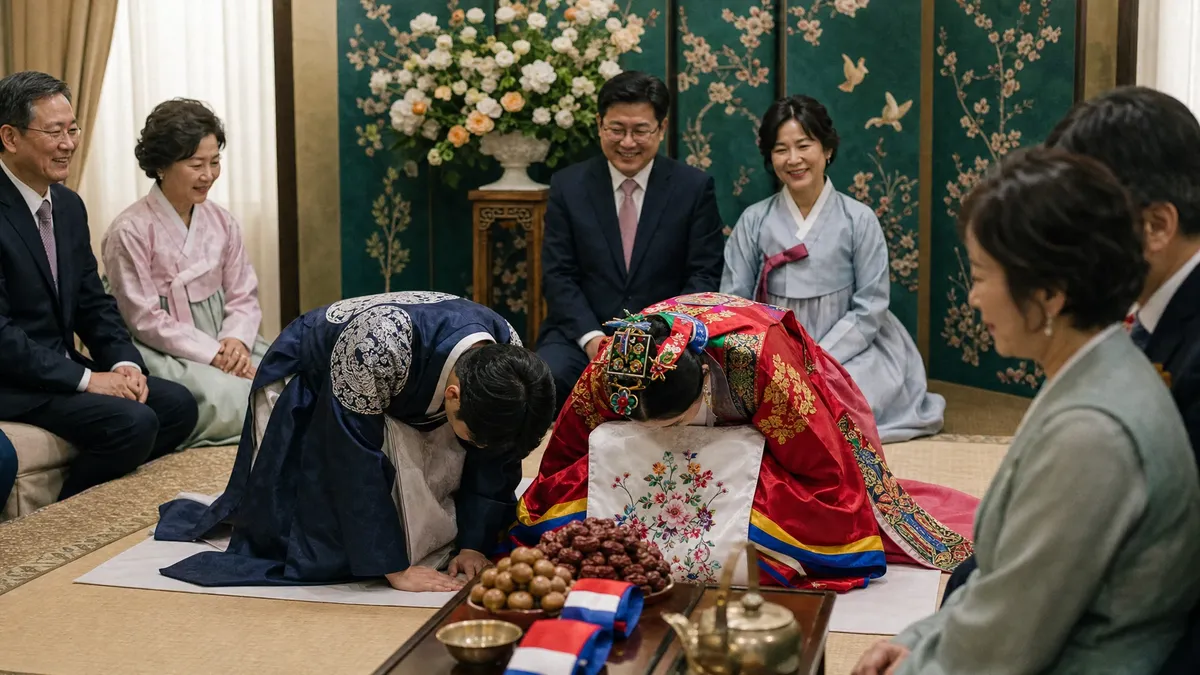
Korean Wedding Traditions & Entertainment Guide
From the paebaek bowing ceremony to a noraebang-fueled dance floor, we help Korean-Canadian couples in Toronto honor tradition and throw a reception nobody wants to leave.
Traditional Korean Wedding Elements
Paebaek Ceremony (폐백)
The paebaek is the most cherished Korean wedding ritual, a private ceremony where the couple, dressed in formal hanbok, bows deeply to parents and elders and offers them tea or wine. The elders return blessings and, in the ritual's signature moment, toss jujube dates and chestnuts for the couple to catch in the bride's outstretched skirt; folk tradition ties the number caught to the children to come. The groom often gives his bride and mother a piggyback ride to close the ceremony. Historically the paebaek honored only the groom's family, but most Korean-Canadian couples now include both sides.
Hahm Delivery (함)
Before the wedding, the groom's closest friends deliver the hahm, a lacquered box holding the marriage papers (honseo) and gifts of red and blue silk, to the bride's family. It is one of the rowdiest traditions in the Korean calendar. The friends carrying the box playfully refuse to hand it over, singing 'hahm for sale' and haggling for money, snacks, and drinks at the bride's door before the family welcomes them in with a feast. The whole thing is loud, funny, and unforgettable.
Hanbok Attire
Hanbok is the traditional Korean dress worn during the paebaek and often the reception. The bride wears a wonsam or hwarot ceremonial robe with a jokduri or hwagwan headpiece; the groom traditionally wears the samogwandae robes of a court official. Colors carry meaning, with reds, blues, and vivid embroidery signaling joy and good fortune. Many couples wear a white gown and tuxedo for the main ceremony, then change into hanbok for the paebaek and later portraits.
Jeonanrye and the Wooden Wild Geese (기러기)
In the jeonanrye rite, the groom presents a pair of wooden wild geese, the gireogi, to the bride's mother. Geese mate for life, so the gift is a vow of lifelong fidelity and devotion. In older ceremonies the groom presented a live goose; today a carved wooden pair, often painted and wrapped in cloth, stands in as the symbol. The geese frequently reappear as a decorative centerpiece at the paebaek table.
Sharing the Cup (Hapgeunrye)
During the traditional ceremony the couple drinks wine from two halves of a single gourd, then swaps and drinks again. The split gourd represents two people who were always meant to be one, and sharing the cup seals the union. It is a slow, deliberate ritual, usually performed under a canopy or at a low ceremonial table with the officiant guiding each step.
Noraebang Singing Culture (노래방)
Noraebang, literally 'song room,' is the private-room karaoke that anchors Korean social life. A night out with family or friends almost always ends with everyone crowded into a room, tambourines in hand, taking turns on the mic. This is not a shy karaoke culture; it is participatory, generous, and a little competitive. That DNA carries straight into Korean wedding receptions and afterparties, where guests fully expect to sing.
Modern Touches & Fusion Ideas
Bilingual Korean-English MC
A host who moves fluently between Korean and English keeps every guest in the room. It matters most in Korean-Canadian weddings, where grandparents may speak primarily Korean while the couple's friends are more comfortable in English. A strong bilingual MC does more than translate; they adjust humor, honorifics, and pacing for each language so both sides feel equally addressed.
K-Pop Meets Western Dance Set
Korean-Canadian couples live in two musical worlds at once, and the best receptions reflect that. A set that moves from BTS, BLACKPINK, and BIGBANG into Western pop, R&B, and classic dance floor anthems keeps every generation and every friend group moving. The transitions are the craft: done well, the room never notices it just crossed cultures.
Live Band Karaoke
The natural evolution of noraebang for a wedding is Live Band Karaoke, where guests take the mic backed by a full live band. Instead of a screen and a backing track, singers get real musicians following their lead, which turns nervous volunteers into stars and packs the dance floor with people waiting their turn. It captures the participatory heart of Korean singing culture at reception scale.
Interactive Game Show Reception
Korean gatherings reward participation, so an interactive segment where the whole room competes fits the culture perfectly. A phone-based game show gets every guest voting and playing at once, bridges the language gap through visuals and simple prompts, and gives shy relatives and rowdy friends a shared moment that has nothing to do with who is on the dance floor.
AI Photo Booth with Cultural Styles
A modern AI photo booth reimagines guest portraits in styles that suit a Korean wedding, from traditional hanbok-inspired looks to sleek K-beauty editorial finishes. These digital keepsakes go well beyond a paper photo strip and give guests something genuinely worth sharing, tying the reception's look together across every phone in the room.
Music Recommendations
K-Pop
K-pop is the engine of most Korean-Canadian dance floors. BTS, BLACKPINK, BIGBANG, TWICE, and SEVENTEEN deliver the high-energy peaks, while softer tracks from artists like IU work for slower, emotional moments. K-pop's range across pop, hip-hop, R&B, and dance gives an entertainer huge room to build and release energy across the night.
Korean Ballads and Trot
For parents and grandparents, classic Korean ballads and trot carry deep nostalgia and often spark the biggest sing-alongs of the evening. These songs matter for honoring the older generation, and slotting a few between K-pop and Western sets makes the whole family feel seen on the dance floor.
Traditional Korean Instruments (Gugak)
The gayageum (zither), daegeum (bamboo flute), and haegeum (fiddle) create an unmistakably Korean atmosphere for the paebaek, ceremony, and cocktail hour. For arrivals or a dramatic entrance, samulnori percussion brings powerful, celebratory drumming that announces the moment with real force.
Western Pop and Dance
A strong Western pop and dance set carries the peak party hours, especially when the guest list mixes Korean family with friends and colleagues of every background. Current hits, throwback anthems, and reliable sing-alongs keep the floor full, and a skilled act threads them between Korean songs so the night feels like one continuous celebration.
Live Acoustic and Jazz
Smooth acoustic covers and light jazz set an elegant tone for cocktail hour and the early reception, before the energy climbs toward dancing. Gentle arrangements also work beautifully as a bed for the paebaek and dinner, keeping the room warm and conversational without pulling focus.
Cultural Planning Timeline
- Confirm with both families which traditions you will include: paebaek, hahm delivery, jeonanrye, and whether the ceremony is Christian, Buddhist, or civil
- Decide whether the paebaek honors only the groom's family or both sides, since this shapes the guest list and timing
- Choose a venue that can host a private paebaek room plus a Western-style reception and dance floor
- Start researching Toronto entertainers with real experience at Korean-Canadian weddings
- Book your live band, DJ, or bilingual MC early, as the strongest Korean-Canadian wedding acts in the GTA fill peak dates fast
- If you want traditional gugak musicians for the paebaek or a samulnori entrance, reserve them now
- Talk through music for each segment: paebaek, ceremony, cocktail hour, dinner, and the K-pop and Western dance sets
- Decide whether Live Band Karaoke or an interactive game show will anchor the reception's participation moment
- Review the evening script with your bilingual MC, including pronunciation of family names, honorifics, and Korean terms
- Finalize must-play songs from both families, spanning trot and ballads for elders through K-pop for the couple's crowd
- Map the transition from formal ceremony and paebaek into the party, so the mood shift feels intentional
- Coordinate hahm-night logistics if you want sound support or a host for the gift delivery
- Confirm the paebaek room setup, timing, and any traditional props like the wooden geese and date-and-chestnut tray
- Sound-check every mic so bilingual speeches, toasts, and singers come through cleanly
- Brief your entertainment team on key elders, VIP tables, and the bowing and seating protocols
- Lock lighting and music cues for the entrance, paebaek, first dance, and the moment the party opens up
Frequently Asked Questions
What is the paebaek ceremony and do we need entertainment for it?
Can your band perform K-pop alongside Western songs?
How does Live Band Karaoke fit a Korean wedding?
Do you provide bilingual Korean-English MCs?
We are having a Christian ceremony. Do Korean traditions still apply?
What is hahm night and can you help with it?
How do we keep every generation happy on the dance floor?
Tell us about your Korean-Canadian wedding and we will build entertainment that respects the paebaek and packs the dance floor.
Get a Free Quote
Get StartedExplore our live bands, Live Band Karaoke, and specialty acts for Korean weddings across Toronto and the GTA.
See Our Wedding Entertainment
Contact Us