
Persian Wedding Traditions: The Sofreh Aghd, the Aroosi, and Everything In Between

From the mirror-and-candlelight of the sofreh aghd to the knife dance that holds your cake hostage, here is how we plan Persian wedding entertainment that honors the ceremony and packs the floor.

A Persian wedding is two celebrations in one: the sofreh aghd, a symbolic ceremony staged around a lavish spread of mirrors, candles, and sweets, and the aroosi, a reception built for dancing until the early hours. The first is quiet, poetic, and deeply visual. The second is loud, joyful, and relentless. Getting the entertainment right means understanding that these two halves ask for completely different things from your musicians. In the GTA, home to one of the largest Iranian communities in North America, Persian weddings are known for running late, feeding everyone generously, and keeping the dance floor packed with three generations at once. Iranian families are also wonderfully diverse in their faith and level of tradition, so the smartest planning starts with the couple's own story, not a template. This guide walks you through the ceremony traditions, the reception rituals, the music, and the sensitivities that separate a beautiful Persian celebration from a generic one.
Cultural Sensitivity Note
  • Persian is not Arab and Farsi is not Arabic. Iranians speak Persian (Farsi), and conflating the two, in music, language, or décor, reads as careless. Get this right first.
  • Iranian families are religiously diverse: Shia Muslim, secular, Zoroastrian, Baha'i, Jewish, and Christian couples all celebrate differently. The holy text at the center of the sofreh varies, from the Quran to the poetry of Hafez for secular couples to the Avesta for Zoroastrians, so ask rather than assume.
  • Many diaspora Iranians left after 1979 and are secular in practice. Never assume a high level of religious observance, and let the couple define how traditional or modern the day should feel.
  • Alcohol is commonly served at Iranian-Canadian weddings even though it is not in Iran, but confirm with the family rather than presuming either way.
  • Persian weddings run late by design. Dinner is served late and dancing goes long, so entertainment schedules and vendor overtime should be planned for a genuinely late night.
  • Be mindful that politics can be sensitive within the diaspora. Avoid imagery, flags, or songs tied to the current regime, and follow the family's lead on anything political.
  • Taarof, the Persian etiquette of gracious back-and-forth politeness, shapes how families communicate. A soft 'no' may not be a real no, so confirm important details clearly and warmly.

Traditional Persian Wedding Elements

The Sofreh Aghd (Ceremonial Spread)

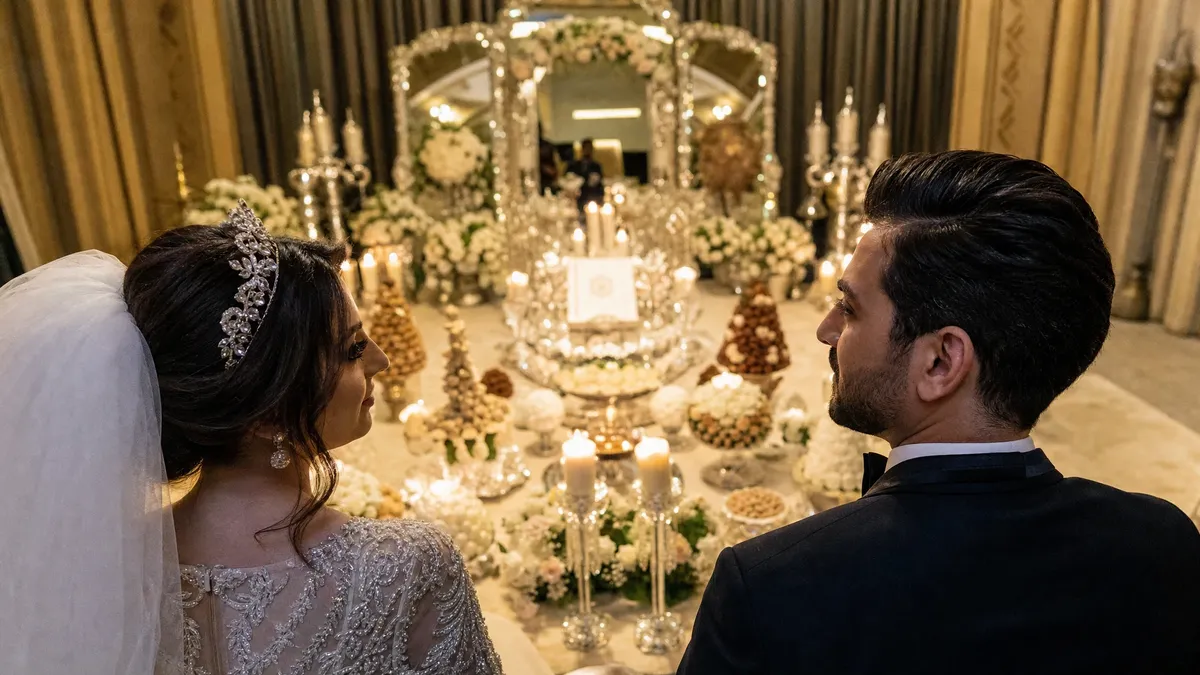
The sofreh aghd is the centerpiece of the Persian marriage ceremony (aghd): an ornate cloth, traditionally termeh (Persian cashmere), laid on the floor and covered with symbolic items. Each object means something, from the honey (sweetness) and decorated eggs and nuts (fertility) to gold coins (prosperity) and wild rue seeds (warding off the evil eye). The couple sits facing the spread while family and the officiant gather around. It is the most photographed, most personal part of the entire day.

Entertainment Opportunity: The aghd is a listening moment, not a dancing one. Soft, live acoustic music sets the tone perfectly: a solo violinist, a santur or tar player, or a string quartet playing gentle Persian and classical melodies as guests are seated and the couple takes their place. The music should breathe underneath the poetry and the blessings, never over the top of them.

The Mirror and Candelabras (Aayeneh and Shamdan)

At the heart of the sofreh sits the aayeneh-ye bakht, the mirror of fate, flanked by two candelabras representing the couple and the light they bring to each other. Tradition holds that the groom should see the bride's reflection in the mirror before he sees her directly, a moment families love to capture. The candles are lit as the ceremony begins, filling the space with warm, quiet light.

Entertainment Opportunity: This is the emotional peak of the ceremony visually, so the music underneath it matters. A single sustained instrument, a violin or a ney flute, timed to the moment the bride is seated and the mirror is revealed, turns a lovely photo into a genuinely moving one. We coordinate this cue directly with the officiant so the music arrives exactly when the couple's eyes meet in the glass.

The Sugar Cones (Kalleh Ghand)

While the couple sits at the sofreh, happily married female relatives hold a fine cloth (often a scarf or a piece of the termeh) above their heads and grind two large sugar cones together, showering symbolic sweetness over the marriage. It is one of the warmest, most communal moments of the aghd, usually accompanied by smiles, laughter, and a few tears from the aunties.

Entertainment Opportunity: This ritual invites a subtle lift in the music. As the sugar is ground and the honey is shared, the ceremony instrumentalists can move from a slow, reverent melody into something brighter and more hopeful, signaling that the solemn part is ending and the celebration is about to begin.

The Honey and the Three-Time 'Bale'

The officiant asks the bride three times whether she consents to the marriage. Custom dictates she stays silent the first two times (a relative playfully announces she has 'gone to pick flowers' or is otherwise unavailable), and only on the third asking does she answer 'bale' (yes) to cheers from the room. The couple then dip their little fingers in honey and feed each other, a sweet start to married life.

Entertainment Opportunity: The 'bale' is a built-in crescendo. The instant the bride says yes, the room erupts, and that is the cue for the first celebratory burst of music, applause, and often a shower of noghl (sugar-coated almonds). A live musician who knows to hit that beat turns a scripted moment into a spontaneous-feeling explosion of joy.

Esfand and Warding Off the Evil Eye

Many Persian families burn esfand (wild rue seeds) on charcoal before or during the celebration, sending fragrant smoke through the room to protect the couple from the evil eye (cheshm zakhm). It is an old, pre-Islamic custom shared across many Iranian households regardless of faith, and the crackle and scent are woven into the memory of the day.

Entertainment Opportunity: This is more of a sensory ritual than a musical one, but entertainers should know it is happening so they do not mistake the smoke for a problem and can hold or soften the music while an elder performs it. Coordinating around these small family rituals is exactly what separates an experienced Persian-wedding band from a generic one.

The Knife Dance (Raghse Chaghoo)

At the aroosi, when it is time to cut the cake, the cake knife has mysteriously vanished. A relative or a hired dancer holds it hostage, dancing flirtatiously around the couple and refusing to hand it over until they are 'paid' with cash or jewelry. Guests laugh, cheer, and egg it on. It is playful, theatrical, and one of the most beloved and unmistakably Persian moments of the whole reception.

Entertainment Opportunity: The knife dance lives or dies on its soundtrack. It needs a cheeky, upbeat Persian number, often a Baba Karam or bandari groove, that a live band or DJ can stretch out and build as the negotiation drags on. We time the music to the comedy, ramping the energy each time the couple 'refuses' to pay, so the whole room is in on the joke.

The Aroosi Dance Floor (Bandari and Baba Karam)

The aroosi is a marathon of dancing. Persian celebrations are famous for keeping the floor full from the first song to the last, powered by bandari (fast, joyous music from Iran's Gulf coast), the flirtatious Baba Karam style, and wave after wave of Persian pop. Grandparents, kids, and everyone in between are expected to be out there, and the night often runs long past midnight.

Entertainment Opportunity: This is where a live band or an all-request setup earns its keep. Reading the room, stretching a bandari set when the floor is on fire, and pivoting between Persian and Western hits so no generation sits down: that is the whole game. We built our reputation on swapping the setlist mid-show when we can feel the next song will not land, and a Persian dance floor rewards exactly that instinct.

Modern Touches & Fusion Ideas

A Fusion Live Band That Speaks Both Languages

Modern Iranian-Canadian couples want a band that can drop a bandari classic and then slide straight into a current Top 40 or R&B hit without breaking the momentum. The best Persian wedding bands treat Googoosh and Beyonce as equally essential, reflecting a couple that is proudly Persian and completely at home in Toronto.

Fusion Tie-In: Our roots are in live wedding and corporate bands, and our musicians build custom setlists that fold Persian pop and bandari favorites in alongside our deep contemporary catalog, learning specific family requests ahead of the night.

An All-Request Aroosi with uRequest Live

Instead of a fixed setlist, some couples want their guests to drive the night. An all-request live band takes song requests in real time, so the aunt who needs one specific Moein song and the cousin who wants an Ebi throwback both get their moment, and the floor never goes cold guessing what the crowd wants.

Fusion Tie-In: uRequest Live is our all-request live band experience, built for exactly this. Audiences are tired of being talked at, and participation beats presentation every time, especially with a Persian crowd that has strong opinions about the playlist.

An AI Photo Booth with Persian Styling

An AI photo booth transforms guest portraits into artful styles, from Persian miniature painting to modern editorial, creating shareable keepsakes that feel personal to the culture. Pair it with props and a backdrop that nods to the sofreh, and you have a station that draws a line all night.

Fusion Tie-In: Our AI photo booth can be themed around a couple's Persian heritage and personal style, and it works best parked near the action, not off in a corner, because the bar is a gravity well and so is a good photo booth.

A Live Game Show Between Dinner and Dancing

The lull between a long Persian dinner and the dance floor is where energy quietly leaks out of a wedding. An interactive game show that gets the whole room voting from their phones, sharing stories about the couple, and competing across tables refills that energy instead of letting the night drift.

Fusion Tie-In: Majority Rules is our interactive game show where the entire audience votes from their phones, and it scales from an intimate 50-guest wedding to a 2000-plus crowd, turning a slow moment into the story people tell afterward.

Music Recommendations

Traditional Persian Classical

The instruments of Persian classical music, the santur, tar, setar, ney, and kamancheh, create the ideal atmosphere for the sofreh aghd and cocktail hour. Gentle, intricate, and unmistakably Iranian, this is ceremony and arrival music, not dance music.

Recommended Fusion Act: Solo instrumentalist or string ensemble for the ceremony

Persian Pop (Tehrangeles)

The diaspora pop sound built in Los Angeles and beloved across Iranian households worldwide: Googoosh, Andy, Dariush, Moein, Ebi, and newer names like Kamran and Hooman. These are the sing-along anthems that fill a Persian dance floor across every generation.

Recommended Fusion Act: All-Request Live Band with Persian repertoire

Bandari

Fast, percussive, joyful music from Iran's southern Gulf coast, built for group dancing with signature shoulder and hand movements. Bandari sets are often the highest-energy stretch of the entire aroosi and a non-negotiable request at most Persian weddings.

Recommended Fusion Act: Live band or DJ with Persian dance experience

Contemporary Pop and Dance

Current Top 40, classic R&B, and dance hits keep the younger crowd and non-Persian guests fully engaged. The art is weaving them seamlessly between Persian sets so the night flows as one celebration rather than two separate playlists.

Recommended Fusion Act: All-Request Live Band

Ceremony Entrance and Celebration Cues

Signature moments call for signature songs, from a traditional wedding entrance melody like 'Mobarak Bad' as the couple arrives to the celebratory burst the instant the bride says 'bale.' These cues should be planned and rehearsed, not improvised.

Recommended Fusion Act: String Quartet or solo violinist for ceremony cues

Cultural Planning Timeline

12-18 months before
Early Planning
  • Talk with both families about how traditional the aghd should be and which sofreh rituals matter most to them
  • Decide whether the ceremony and reception are the same day or split, which shapes how much entertainment you need
  • Book ceremony musicians who genuinely know Persian classical repertoire, not just a generic string quartet
  • Start researching bands and DJs with real Persian wedding experience, since the best ones book far ahead in the GTA
8-12 months before
Entertainment Booking
  • Confirm your reception band or DJ has strong Persian pop and bandari repertoire and has run a knife dance before
  • Book cocktail-hour and sofreh musicians (solo instrumentalist, santur, or string ensemble)
  • Discuss whether alcohol is being served, which is common at diaspora weddings and affects the room's energy and timing
  • Plan for a late start and a long night, as Persian dinners run late and dancing goes well past midnight
3-6 months before
Detail Planning
  • Build segment-by-segment music lists for the aghd, the entrance, dinner, the knife dance, and the dance floor
  • Give the band specific family song requests, including must-plays and any do-not-plays
  • Coordinate the knife dance logistics: who hides the knife, who dances, and how the music builds the comedy
  • Confirm any bandari or Baba Karam sets and roughly how long the family wants each high-energy block to run
2-4 weeks before
Final Preparations
  • Provide transliterated Persian song titles and artist names so nothing gets lost in translation on the night
  • Rehearse the ceremony cues with the officiant, especially the music that hits the instant the bride says 'bale'
  • Brief the entertainers on family rituals like esfand and the sugar cones so they hold or soften the music appropriately
  • Confirm the room layout keeps the bar near the dance floor so the party stays in one place instead of splitting

Frequently Asked Questions

What is the sofreh aghd and why does it matter so much?
The sofreh aghd is the ceremonial spread at the heart of a Persian wedding: a decorated cloth laid with symbolic items like a mirror, candelabras, honey, sugar cones, nuts, gold coins, and a holy text. The couple sits before it during the marriage ceremony (the aghd) while relatives perform small rituals around them. It is the most visual and personal part of the day, and every item on it carries meaning, from sweetness and prosperity to protection and fertility. Ceremony music should stay soft and live so it supports the moment without overwhelming it.
What is the knife dance (raghse chaghoo)?
The knife dance is a playful Persian reception tradition. When it is time to cut the wedding cake, the knife has been 'stolen,' and a relative or hired dancer holds it hostage, dancing flirtatiously and refusing to hand it over until the couple pays with cash or jewelry. Guests cheer the negotiation on, and it usually ends in laughter. It is one of the most beloved and distinctly Persian moments of the aroosi, and it needs a cheeky, upbeat song that the band or DJ can stretch and build as the comedy plays out.
Should we book a live band or a DJ for a Persian wedding?
Both work, and many Persian weddings use a mix. A live band brings energy, spectacle, and the ability to read a demanding multi-generational dance floor and adjust in real time, which suits the long, high-energy aroosi and moments like the knife dance. A DJ offers the exact recordings of specific Persian pop and bandari tracks that families often want note for note. A common approach is live ceremony and cocktail musicians, then a live band or an all-request setup for the reception, sometimes paired with a DJ for specific tracks. The right answer depends on your budget and how much you value live spectacle versus exact recordings.
What music is essential for a Persian wedding?
For the ceremony, gentle Persian classical instruments like santur, tar, or ney set the tone. For the reception, the essentials are Persian pop (Googoosh, Andy, Dariush, Moein, Ebi, and newer artists), bandari for high-energy group dancing, and Baba Karam for the flirtatious moments like the knife dance. Most couples also want a strong stream of contemporary Western pop and dance music woven in so every guest stays on the floor. Give your entertainers your specific family favorites well ahead of time, including any must-plays and do-not-plays.
Are Persian weddings religious, and does that change the entertainment?
It varies widely. Most Iranians are culturally Shia Muslim, but the diaspora includes many secular families as well as Zoroastrian, Baha'i, Jewish, and Christian couples, and the sofreh's central text changes accordingly. Some ceremonies are quite traditional, while many Iranian-Canadian weddings are largely secular with alcohol, mixed dancing, and a modern reception. Never assume the observance level. Ask the couple how traditional they want the day to feel, and build the entertainment around their answer rather than a template.
Why is the Toronto area such a strong place for a Persian wedding?
The Greater Toronto Area is home to one of the largest Iranian communities in North America, concentrated across North York, Richmond Hill, and Thornhill. That means deep local access to Persian-experienced musicians, DJs, caterers, and venues, plus vendors who already understand traditions like the sofreh aghd and the knife dance. It also means an audience that knows the music intimately and expects it done well, which is exactly why booking entertainers with genuine Persian wedding experience matters here.
How late do Persian weddings usually run?
Later than many couples expect. Persian celebrations are famous for late dinners and long dance floors, and the party often stretches well past midnight. Plan your entertainment schedule, vendor overtime, and venue hours around a genuinely late night, and make sure your band or DJ is comfortable sustaining energy over a long stretch. Pacing matters: experienced Persian wedding entertainers know how to build waves of energy rather than peaking too early and leaving the crowd flat for the final hour.

Work with our team to plan entertainment that honors the aghd and keeps the aroosi dance floor packed all night.

Plan Your Persian Wedding Entertainment

Get Started

Explore our live bands with Persian wedding experience across Toronto and the GTA.

Browse Wedding Bands

Contact Us