

Somewhere right now, a marketing director is sitting in a meeting listening to someone say "we need to leverage AI for our event strategy" — and nobody in the room can explain what that actually means.
I know because I used to be the one saying it.
Here's the thing: AI in event marketing has become the most overhyped, under-explained concept in the industry. Everyone nods along. Nobody shows their screen. The gap between the LinkedIn thought-leadership post and the actual Tuesday morning workflow is enormous — and it's costing event teams real money and real time.
So let's fix that. No manifestos about "the future of events." No slides with robot clip art. Just the actual workflows, tools, and results that happen when you stop talking about AI and start using it.
The Problem Nobody Wants to Admit
You ran a killer corporate event. Great speakers, packed room, client handshakes that turned into contracts. Your photographer shot 400 photos. Your videographer delivered a highlight reel three weeks later.
And then... nothing.
Maybe your marketing coordinator posted a carousel on LinkedIn the following Monday. Maybe someone wrote a recap blog that took two weeks to publish. By then, the momentum was gone. The 400 photos sat in a Google Drive folder that nobody opened again.
This is the norm, not the exception.62% of organizers are now using AI for event marketing — but most of them are using it for basic email copy. They're using a jet engine to power a bicycle.
If you've read our breakdown on you already know the content is there. The bottleneck was never the raw material. It was the production speed.
AI doesn't just speed that up. It fundamentally changes what's possible.
What "AI Event Marketing" Actually Means (It's Not Chatbots)
Let's kill the most common misconception first: AI event marketing is not about chatbots greeting attendees on your event website. That's fine, it exists, it's table stakes. We're talking about something bigger.
Real AI event marketing is a production pipeline. It looks like this:
Capture → Analyze → Create → Distribute → Optimize
Each stage can now be augmented or automated by AI. Not in theory. Right now. Today. With tools that exist and work.
- Capture: AI-powered photobooths like BananaCam transform guest photos with 15+ AI styles, branded overlays, and instant QR sharing — giving you a stream of shareable, on-brand content during the event, not weeks after.
- Analyze: Vision AI scans your event photos, identifies what's in them (speakers, products, venue details, crowd shots), and categorizes them automatically.
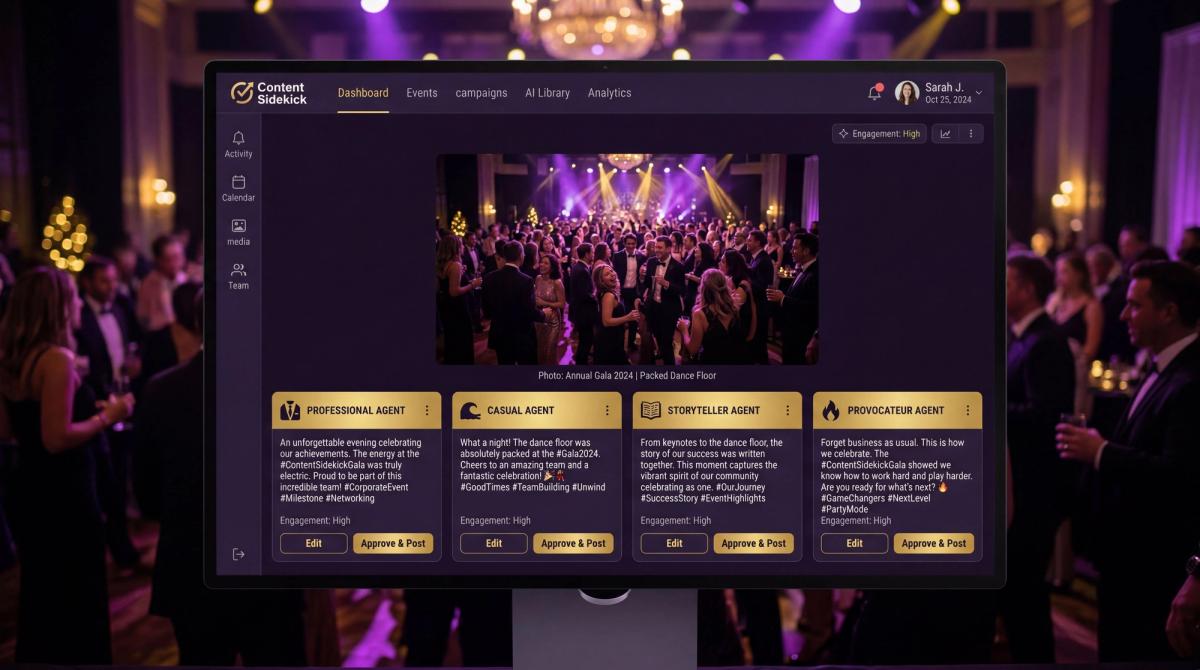
- Create: Specialized AI agents generate platform-specific captions, stories, and posts — each with a different tone, for a different audience.
- Distribute: Multi-platform publishing from a single source image.
- Optimize: AI tracks what's performing and adjusts the content mix.
That's not a pitch deck. That's a workflow.
The Real Workflow: One Photo, Nine Angles, Five Platforms
Let me walk you through what this looks like in practice. I'm going to use as the example because it's what we built specifically for this problem — and because I can show you the actual steps, not theoretical ones.
You upload a single event photo. Maybe it's a keynote speaker mid-presentation with your client's logo visible on the screen behind them.
Here's what happens:
Step 1: Vision AI analyzes the image.OCR reads the text on the screen. The system identifies it's a presentation setting, corporate environment, professional context. This matters because the image becomes the constraint. Most AI writing tools start with a blank prompt and produce generic slop. Starting with the image grounds everything in reality.
Step 2: Nine specialized agents go to work — simultaneously.Not one generic "write me a caption" prompt. Nine distinct voices:
- The Professional Agent writes a LinkedIn post about the keynote insights — polished, quotable, shareable with your B2B audience.
- The Storyteller Agent crafts a narrative about the moment — "When Sarah took the stage, you could feel the room shift..."
- The Provocateur Agent pulls a bold claim from the presentation and frames it as a debate starter.
- The Comedian Agent finds the human moment — maybe the speaker's reaction to a tough question.
- The UGC Agent writes it like an attendee would — raw, authentic, first-person.
And four more. Each purpose-built for a different content strategy.
Step 3: Brand voice keeps everything on-rails.Content Sidekick trains on your website URL, social accounts, or content examples. So the Professional Agent doesn't just write "professional content" — it writes professional content that sounds like your brand. That's the difference between AI content that works and AI content that sounds like it was written by a robot with a thesaurus.
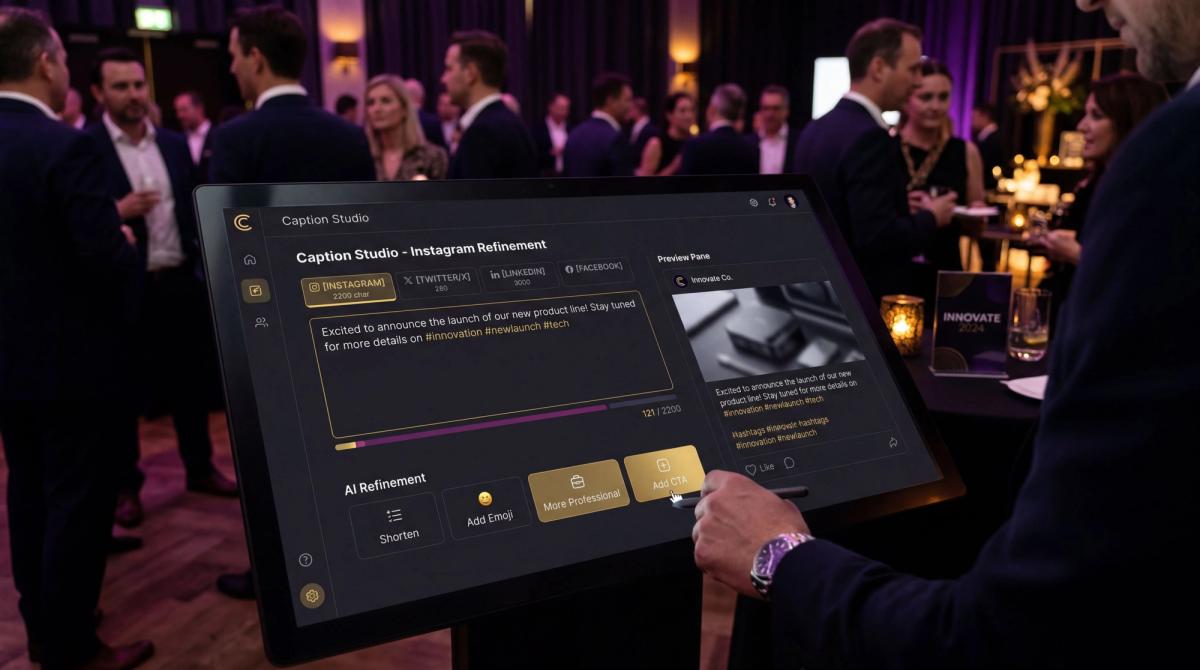
Step 4: Platform-specific output.Instagram gets the visual-first version with hashtags. LinkedIn gets the thought-leadership angle with a hook in the first line. TikTok gets the punchy, scroll-stopping take. Facebook gets the community-oriented framing. All from one photo. All in seconds.
Brand Voice at Scale (The Part Most People Get Wrong)
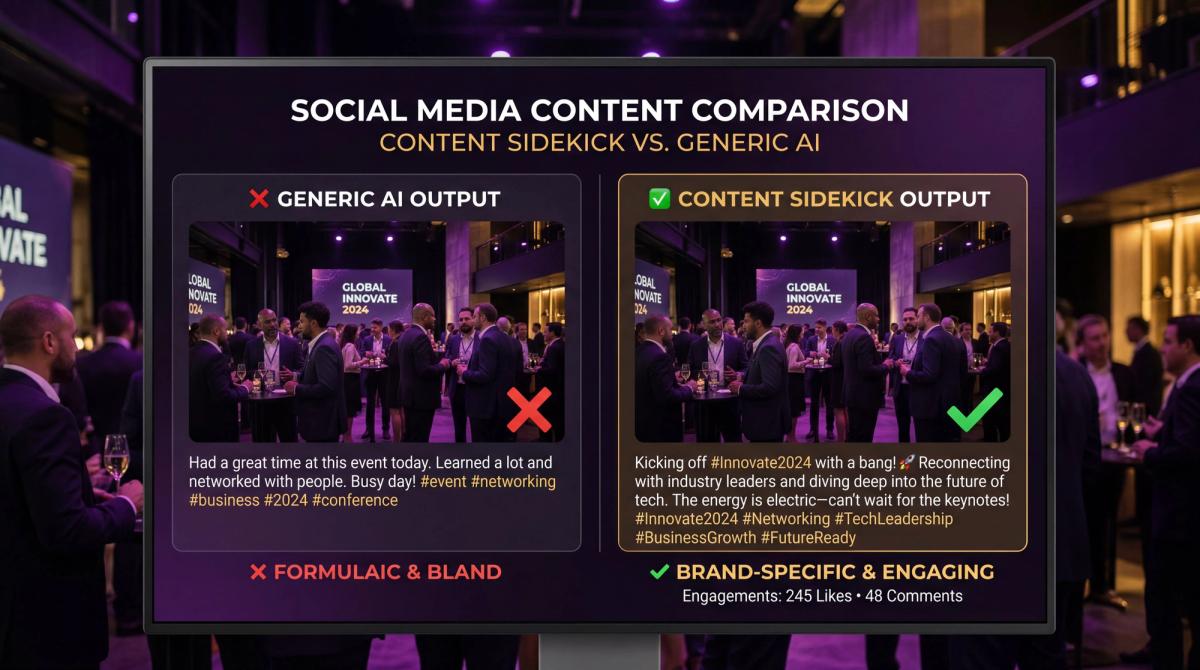
Here's where I get opinionated: the biggest failure of AI content isn't that it's inaccurate. It's that it's generic.
You've seen it. The LinkedIn posts that all sound the same. The Instagram captions that could belong to any brand on earth. "We had an amazing time at [Event Name]! 🙌 So grateful for the incredible speakers and attendees!"
That's not content. That's filler.
The real problem is that most teams use AI as a replacement for thinking instead of an amplifier for their voice. They type "write me a social media post about our corporate event" into ChatGPT and call it AI-powered marketing.
Real AI-powered marketing means the system already knows your brand voice before you give it a single prompt. It's trained on your existing content. It knows you say "clients" not "customers." It knows your tone is authoritative but approachable, not corporate-speak. It knows you never use the word "synergy" unironically.
That's what brand voice training does in . Feed it your website, your best social posts, your company's content guidelines — and every output reflects your actual brand, not some generic "professional tone."
When you're producing content at the volume that events demand — 400 photos from a single gala, recap content across five platforms, follow-up campaigns for three audience segments — brand consistency isn't a nice-to-have. It's the whole game. One off-brand post in a sea of great ones undermines the entire effort.
The Video Content Opportunity Everyone's Sleeping On
Photos are the starting point. But let's be honest — video is where the attention is. And video has traditionally been the bottleneck that kills event content pipelines. You hire a videographer. They shoot the event. They edit for two weeks. You get one highlight reel. It's great. You post it once. Done.
AI is destroying that bottleneck in three specific ways:
1. AI-Generated Event Recaps Tools now exist that can take your event footage and generate short-form recap clips automatically — identifying key moments, cutting to the energy, adding captions. What used to take a video editor a full day takes minutes.
2. AI UGC Video Creation This one's wild. Content Sidekick's AI UGC video creator generates videos with AI characters that look like real people, talking about your event. Not uncanny valley robots — believable human presenters delivering your key messages. For event teams that need testimonial-style content but can't coordinate 15 attendee video interviews, this is a game-changer.
3. AI Image-to-Video Take your best event photos and turn them into motion content. A still shot of your venue becomes a cinematic pan. A speaker photo becomes a dynamic video post. Tools like Wan 2.5, Kling, and Veo 3 (all available inside Content Sidekick) make this accessible without any video editing skill.
The teams that figure this out first own the attention. Everyone else is still waiting three weeks for their highlight reel.
What to Look for in AI Marketing Tools (And What to Avoid)
Not all AI marketing tools are built the same. I've tested dozens. Most are glorified ChatGPT wrappers with a nicer interface. Here's what actually matters:
Look for:
- Image-first workflow.If the tool starts with a blank text prompt, it's going to produce generic content. The best tools start with your actual content — photos, video, existing posts — and use that as the creative foundation.
- Multiple voice outputs.One AI-generated caption is a suggestion. Nine different angles on the same content is a strategy.
- Brand voice training.Not just "select a tone" from a dropdown. Actual training on your content, your URL, your social accounts.
- Multi-platform optimization.Character counts, format requirements, hashtag strategies — all platform-specific, all automatic.
- Content library and organization.If you're generating at volume, you need to find, filter, and manage what you've created.
Avoid:
- Tools that promise to "do everything" but do nothing well.
- Anything that can't show you a real demo with real output.
- Platforms that require a prompt engineering degree to get decent results.
- "AI-powered" tools that are really just template libraries with a chatbot bolted on.
The Turn: Why Resistance Is the Real Risk
I talk to and every week. The ones who haven't adopted AI tools yet always have the same reason: "We're waiting to see how it plays out."
I get it. New tech is scary. The AI hype cycle has been exhausting. And there are legitimate concerns about quality, authenticity, and over-automation.
But here's what I've learned after building and using these tools for two years: AI is more powerful than people realize. It goes way beyond chatbots. Every day you resist it, you fall further behind.
And I don't mean "behind" in some abstract, thought-leadership way. I mean your competitor who adopted AI content tools six months ago is now producing 10x the content from every event, with consistent brand voice, across every platform, in a fraction of the time. Their events look bigger, more exciting, more worth attending — because the content engine never stops running.
event teams that integrate AI into their marketing workflows are seeing measurable improvements in content output and engagement. This isn't theoretical anymore.that generative AI is now a "deeply integrated automation layer" for forward-thinking event teams — not an experiment, not a pilot program, but core infrastructure.
The cost of waiting isn't zero. It's compounding.

Getting Started Without Losing Your Mind
You don't need to overhaul your entire marketing stack tomorrow. Here's the practical starting point:
- Pick one upcoming event.Not your biggest one. A mid-tier event where the stakes are manageable.
- Set up your capture pipeline.Make sure you're getting quality photos — and consider adding an AI photobooth like BananaCam for real-time shareable content.
- Feed those photos into an AI content engine.Try Content Sidekick. Upload 10 photos. See what nine agents produce. You'll know within five minutes whether this changes your workflow.
- Post the content.Actually publish it. See what performs. Compare the engagement to your previous event content.
- Scale from there.Once you see the results from one event, the ROI case makes itself.
The event teams that win in 2026 aren't the ones with the biggest budgets or the fanciest venues. They're the ones who figured out that the event itself is just the beginning — and that AI is the engine that turns a single night into months of content.
Stop waiting. Start testing. The tools are ready. The question is whether you are.
Frequently Asked Questions
What is AI event marketing?
AI event marketing uses artificial intelligence tools to automate and scale the content creation, distribution, and optimization that happens around events. This includes using vision AI to analyze event photos, specialized AI agents to generate platform-specific social media content, brand voice training to maintain consistency, and AI video tools to produce recap content. It's not just chatbots — it's a full production pipeline that turns event assets into ongoing marketing content.
How do you use AI to create social media content from event photos?
The most effective approach uses image-first AI tools. You upload event photos to a platform like which uses vision AI and OCR to analyze what's in the image. Then multiple specialized AI agents generate different versions — professional, casual, storytelling, humorous — each optimized for specific platforms like LinkedIn, Instagram, TikTok, and Facebook. Brand voice training ensures everything sounds like your brand, not generic AI output.
Can AI maintain brand voice across event marketing content?
Yes, but only if the tool is built for it. The best AI content platforms train on your existing content — your website, social accounts, and brand guidelines — so every output reflects your actual voice. Generic AI tools that start from a blank prompt will produce generic content. The key differentiator is whether the AI has been trained on your brand specifically, not just given a tone dropdown with options like "professional" or "casual."
What's the difference between AI event marketing tools and just using ChatGPT?
ChatGPT is a general-purpose language model. It requires you to write detailed prompts, manually specify platform requirements, and doesn't learn your brand voice across sessions. Purpose-built AI event marketing tools like Content Sidekick start with your images (not blank prompts), run multiple specialized agents simultaneously, train on your brand voice, optimize for each platform's requirements automatically, and organize your content library. The difference is between having a general assistant and having a specialized marketing team.
How much content can AI generate from a single event?
From a single corporate event with 200-400 photos, AI tools can generate hundreds of unique social media posts across multiple platforms — each with different angles, tones, and formats. Add AI video generation (converting photos to motion content, creating AI UGC videos, producing automated recaps) and you're looking at weeks or months of content from a single event. The bottleneck shifts from production to curation — choosing the best content rather than struggling to create enough.
Is AI-generated event content authentic?
It can be — if you do it right. The key is using AI as an amplifier, not a replacement. When AI starts with real event photos (not stock images), is trained on your actual brand voice (not generic prompts), and produces content grounded in what really happened, the output feels authentic because it is based on authentic moments. The inauthenticity problem comes from lazy implementation: generic prompts, no brand training, no human review. AI is a tool. Authenticity depends on how you use it.