

Your event agenda isn't just boring. It's structurally designed to be boring.
I've seen the same agenda template recycled across hundreds of corporate events, conferences, and galas. It reads like a hostage negotiation timeline: registration, keynote, panel, break, panel, lunch, keynote, panel, "networking," close. And every single time, someone on the planning committee calls it "a packed agenda" like that's a compliment.
It's not. A packed agenda is a warning label.
Here's the thing — most event planners aren't lazy. They're trapped inside a format that nobody questions because everybody uses it. The standard conference agenda is the QWERTY keyboard of the events industry: designed for a problem that no longer exists, and kept alive purely by inertia.
Let's break it apart. Then let's rebuild it.
!
The Anatomy of a Boring Agenda
You know this schedule. You've lived it. You've probably built it.
8:00 AM— Registration & Continental Breakfast
8:45 AM— Welcome Remarks (15 min that always runs 25)
9:00 AM— Keynote Address (45 min)
9:45 AM— Panel Discussion: "The Future of [Industry]" (45 min)
10:30 AM— Networking Break (translation: bathroom + coffee line)
10:50 AM— Breakout Sessions (60 min)
12:00 PM— Lunch
1:00 PM— Keynote #2 (45 min)
1:45 PM— Panel Discussion #2 (45 min)
2:30 PM— Afternoon Break
2:45 PM— Breakout Sessions (60 min)
3:45 PM— Closing Remarks
4:00 PM— Cocktail Reception
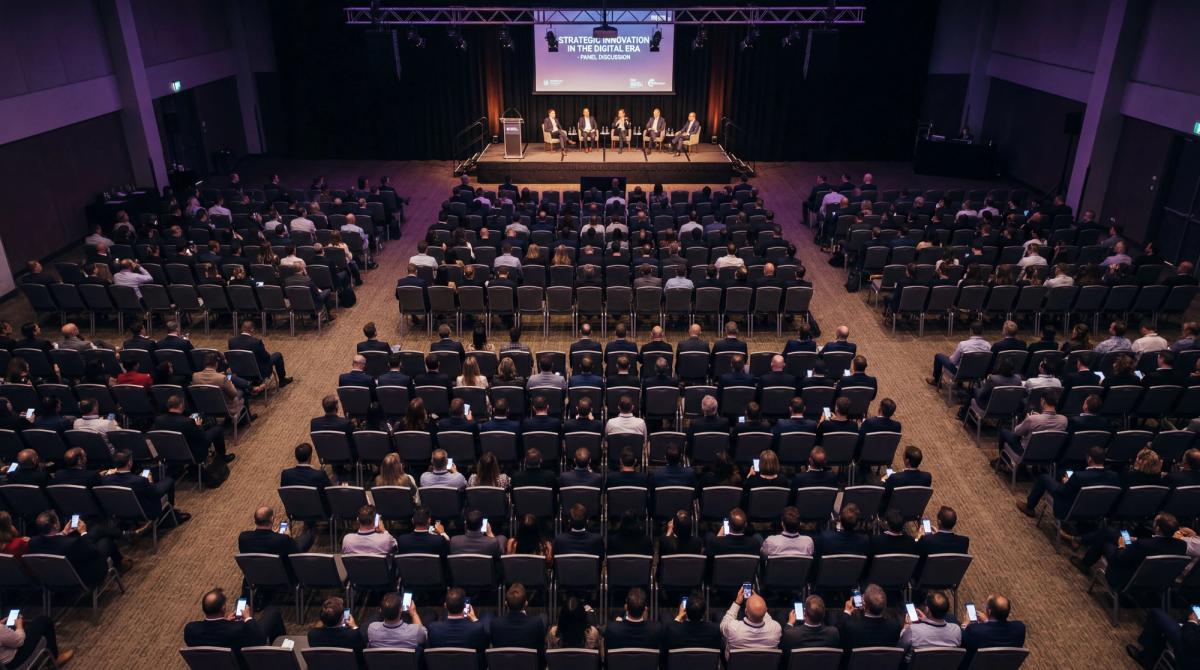
Look at that schedule and tell me where the energy peak is. You can't — because there isn't one. It's a flat line. It's the event equivalent of highway driving: technically you're moving, but you're three bad minutes from falling asleep.
Here's what's actually happening in that room by time slot:
- 9:00 AM: Audience is alert but passive. They're absorbing.
- 10:30 AM: First major attention crash. Phones come out.
- 1:00 PM: Post-lunch coma. You could announce a fire and half the room would stay seated.
- 2:45 PM: The Walking Dead. Bodies in chairs, minds elsewhere.
- 3:45 PM: Closing remarks to a room that mentally checked out 90 minutes ago.
Nobody designed this schedule to do anything. It was designed to fill time. And that's the core problem.
Why It Keeps Happening
This isn't incompetence. It's a system failure with identifiable causes.
1. The Speaker-First Trap
Most agendas are built around speaker availability, not audience energy. You book your keynote for 9 AM because that's when she's available, not because that's when your audience is primed for a 45-minute monologue. The schedule becomes a Tetris game of fitting speakers into slots rather than designing an experience arc.
2. The "More Content = More Value" Fallacy
Stakeholders equate a dense agenda with a valuable event. Six panels and two keynotes feels like more ROI than three sessions with breathing room. But cramming more content into a day doesn't create more learning — it creates more forgetting. Your attendees won't remember if they were mentally gone by hour three.
3. The Committee Effect
Every department wants a slot. Marketing wants a panel. Sales wants a breakout. The CEO wants a 45-minute keynote even though her best material is 20 minutes. The agenda becomes a political document, not an experience design.
4. Nobody Owns the Energy
There's a stage manager. A production lead. An AV team. But nobody's job title is "audience energy architect." No one is looking at the schedule and asking:where is the audience's attention at 2:15 PM, and what are we doing about it?
The Energy Arc Framework
Here's the redesign method I use with our . It's based on one principle:design for energy, not for content.
Every event day has a natural energy arc — a wave pattern of attention, engagement, and fatigue. Your job isn't to fight it. It's to ride it.
The Four Energy Zones
Zone 1: Ignition (First 90 minutes) Your audience arrives with social energy and curiosity. This is your highest-potential window, but it's fragile — a boring opener kills it instantly. Use this zone for your single most compelling, most interactive experience. Not a welcome speech. Not housekeeping announcements. Something that makes people put their phones away because they want to.
Zone 2: Deep Work (Mid-morning) After the ignition, your audience is primed for depth. This is where your best content sessions belong — the meaty keynotes, the expert-led workshops, the stuff that requires sustained focus. But respect the clock: no session over 45 minutes without an interaction reset.
Zone 3: Recovery (Post-lunch) This is the graveyard shift.. The audience has eaten, their blood sugar is crashing, and you're asking them to sit in a dark room and listen to someone read slides.Do not put passive content here.This is where you deploy your highest-energy, most participatory programming —live entertainment, gamified sessions, anything that requires the audience to move or do rather than sit and listen.
Zone 4: Crescendo (Final stretch) End on a peak, not a whimper. Your closing should be the second-highest energy moment of the day — right behind the ignition. A powerful story, a surprise entertainment moment, a community-building activity. Never end with "closing remarks from the committee chair."

The 90-Minute Rule
Sleep researcher Nathaniel Kleitman identified in the 1950s — natural cycles of roughly 90 to 120 minutes during which our brains oscillate between higher and lower alertness. This isn't motivational pseudoscience. It's observable neurobiology: your EEG patterns shift on a predictable cycle, and pushing past the 90-minute mark without a genuine reset leads to measurable drops in focus and retention.
Here's what this means for your agenda:no content block should exceed 90 minutes without a real state change.
And no, a "networking break" where people stand in a hallway checking email is not a state change. A real reset means:
- Physical movement— standing, walking, changing rooms
- Social interaction— structured conversation, not just proximity
- Modality shift— from listening to doing, from passive to active
- Sensory change— different lighting, different music, different energy
The best understand this instinctively. A live DJ set between sessions isn't "filler" — it's a neurological reset button. An after lunch isn't "fun" — it's the difference between an audience that's present and one that's comatose.
Sample Redesigned Agenda: Before & After
Let me show you what this looks like applied to a standard corporate conference day.
BEFORE (The Default)
The Standard Agenda (Before)
8:00 — Registration & Breakfast (Passive)
8:45 — Welcome Remarks (Passive)
9:00 — Keynote, 45 min (Passive)
9:45 — Panel Discussion, 45 min (Passive)
10:30 — Networking Break (Passive)
11:00 — Breakout Sessions, 60 min (Semi-active)
12:00 — Lunch (Passive)
1:00 — Afternoon Keynote, 45 min (Passive)
1:45 — Panel Discussion #2, 45 min (Passive)
2:30 — Closing Remarks (Passive)
Passive-to-active ratio: ~80/20
Passive-to-active ratio: 80/20.No wonder people leave at 3.
AFTER (Energy Arc Framework)
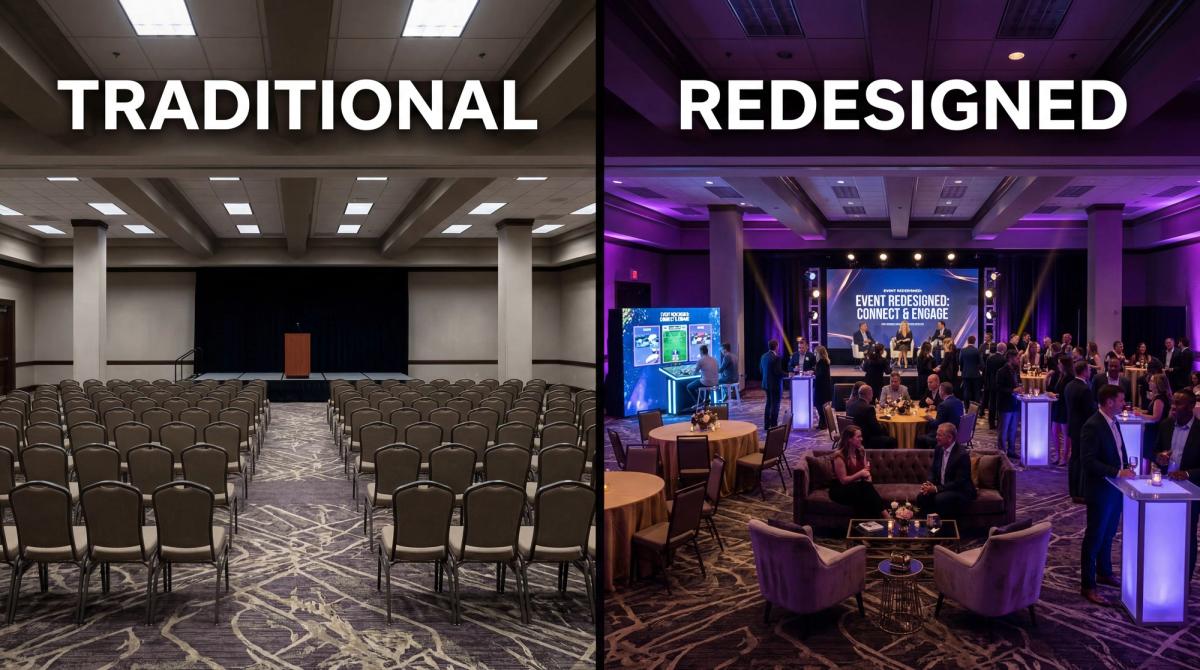
The Redesigned Agenda (After)
8:00 — Registration + Live DJ & Interactive Welcome Wall (Active social / Ignition)
8:30 — 10-Min High-Energy Open with emcee + crowd interaction (Active / Ignition)
8:40 — Keynote, 20 min with live polling (Active / Deep Work)
9:00 — Facilitated Table Discussions, 25 min (Active / Deep Work)
9:25 — Interactive Game Show Round 1 (Active / Recovery)
9:45 — Movement Break with music + snacks (Active social / Recovery)
10:00 — Workshop Sprint, 40 min with deliverables (Active / Deep Work)
10:40 — Lightning Talks, 3x7 min (Semi-active / Deep Work)
11:00 — Game Show Finals + Awards (Active / Crescendo)
11:30 — Lunch + Networking with conversation prompts (Active social / Recovery)
12:30 — Afternoon Keynote, 15 min + live Q&A (Active / Deep Work)
1:00 — Team Challenge with presentations (Active / Crescendo)
1:45 — Peak Moment: uRequest Live or signature experience (Active / Crescendo)
2:15 — Closing: highlights reel + one powerful takeaway (Active / Crescendo)
Passive-to-active ratio: ~30/70
Passive-to-active ratio: 30/70.Every transition is intentional. Every zone has a purpose.
Notice what changed: sessions got shorter. Formats got varied. The post-lunch slot — the deadliest hour in events — is now anchored by instead of another keynote. And the entire day ends 25 minutes earlier, which means people actually stay for the close.
How Entertainment Fits Into the New Framework
I run an . So yes, I have a bias. But the bias exists because I've watched the same pattern play out hundreds of times: the event that programs entertainment as an energy tool outperforms the event that treats it as an afterthought.
Entertainment isn't the cherry on top. It's the defibrillator.
Here's where it fits in the Energy Arc:
- Ignition Zone: A live performer or DJ during registration transforms "awkward milling" into "I'm already having a good time." Energy baseline goes up before a single speaker takes the stage.
- Reset Moments: A 10-minute interactive segment between content blocks isn't a distraction — it's the thing that makes the next session land.
- Recovery Zone: This is where entertainment earns its keep. A game show experience at 1 PM will do more for your afternoon retention than any amount of "engaging content."
- Crescendo: A surprise performance in the final stretch creates an emotional peak that becomes the story people tell. Not the keynote. Not the breakout. The moment they didn't expect.
The organizations that get the best results from their events aren't spending more on speakers. They're spending smarter on experience design — mapping entertainment to energy zones instead of bolting it onto the end of the day.

Start With One Change
You don't need to blow up your entire agenda tomorrow. Start with the single highest-impact change:fix your post-lunch slot.
Take whatever passive content you've programmed for 1:00 PM and replace it with the most interactive, most participatory, most physical thing you can find. A . A hands-on workshop. A competitive activity. Anything that requires people to stand up, talk to each other, and do something other than stare at a screen.
That one change will improve your afternoon retention more than redesigning any other part of your day.
Then, next event, apply the full Energy Arc. Map your zones. Audit your passive-to-active ratio. And stop building agendas that are designed to fill time instead of creating energy.
Your attendees will notice. Your stakeholders will notice. And you'll stop wondering why everyone leaves before the closing remarks.
Frequently Asked Questions
How do I convince stakeholders that a less packed agenda is better?
Frame it as ROI, not reduction. A 6-session day where people are mentally present for all six delivers more value than a 10-session day where they checked out after session three. Use the passive-to-active ratio as a metric — show stakeholders that most of their current agenda is passive consumption, which has the lowest retention rate of any learning format.
What's the ideal session length for a corporate conference?
There's no universal magic number, but the research supports keeping presentations between 20 and 45 minutes, with variety being the key factor.. Workshops can run 45-60 minutes because they're participatory. The real rule: no passive listening block over 30 minutes without an interaction point (Q&A, table discussion, audience poll).
How do I handle the post-lunch energy crash at conferences?
Never schedule a passive keynote or panel in the 1:00-2:00 PM slot. This is the lowest-energy window of any event day. Program your most interactive content here —team challenges, hands-on workshops, live entertainment. Physical movement and social interaction are the only reliable antidotes to the post-lunch crash.
Can I use the Energy Arc Framework for half-day events?
Absolutely. A half-day event compresses into two zones: Ignition and Crescendo, with a brief Deep Work section in the middle. The same principle applies — open with energy, build to depth, close on a peak. The advantage of a shorter format is that you're less likely to hit the deep fatigue zones, so your passive-to-active ratio can be a bit more forgiving.
How much of my event budget should go toward entertainment and interactive elements?
The real question is how much of your budget currently goes toward content that nobody retains. If you're spending 80% on speakers and 5% on experience design, your ratios are inverted. I'd recommend allocating at least 15-20% of your programming budget to interactive elements, entertainment, and experience design. It's not an add-on expense — it's the infrastructure that makes everything else work. Talk to an that understands experience design to see where your budget can work harder.
What's the difference between "networking breaks" and real energy resets?
A networking break is unstructured dead time where people default to checking email alone. A real energy reset involves intentional design: structured conversation prompts, physical relocation, a sensory shift (music, lighting change, different environment), or a facilitated activity. The difference is between hoping people connect and designing the conditions for connection.
Arthur Kerekes is the founder of [Fusion Events](https://www.fusion-events.ca/entertainment-agency), a Toronto-based entertainment agency that helps corporate clients design events people actually remember. When he's not redesigning broken agendas, he's probably arguing that your keynote should be 20 minutes shorter.