

I've produced over 5,000 events. Galas where the champagne budget exceeded most people's annual salary. Corporate conferences where a single AV failure cost someone their promotion. Holiday parties that ended careers and holiday parties that started marriages. Fundraisers, product launches, trade shows, incentive trips, and at least three events I'm legally not allowed to describe.
That's not a brag. That's a sample size.
And when your sample size is that large, you stop guessing about where things are heading. You start seeing it. The patterns. The shifts. The slow-moving trains that most of the industry pretends aren't barreling toward them.
So here are 10 predictions about the future of events. Not the safe ones. Not "events will continue to evolve" or "sustainability matters." The specific, defensible, probably-going-to-age-badly-or-brilliantly ones.
Let's go.
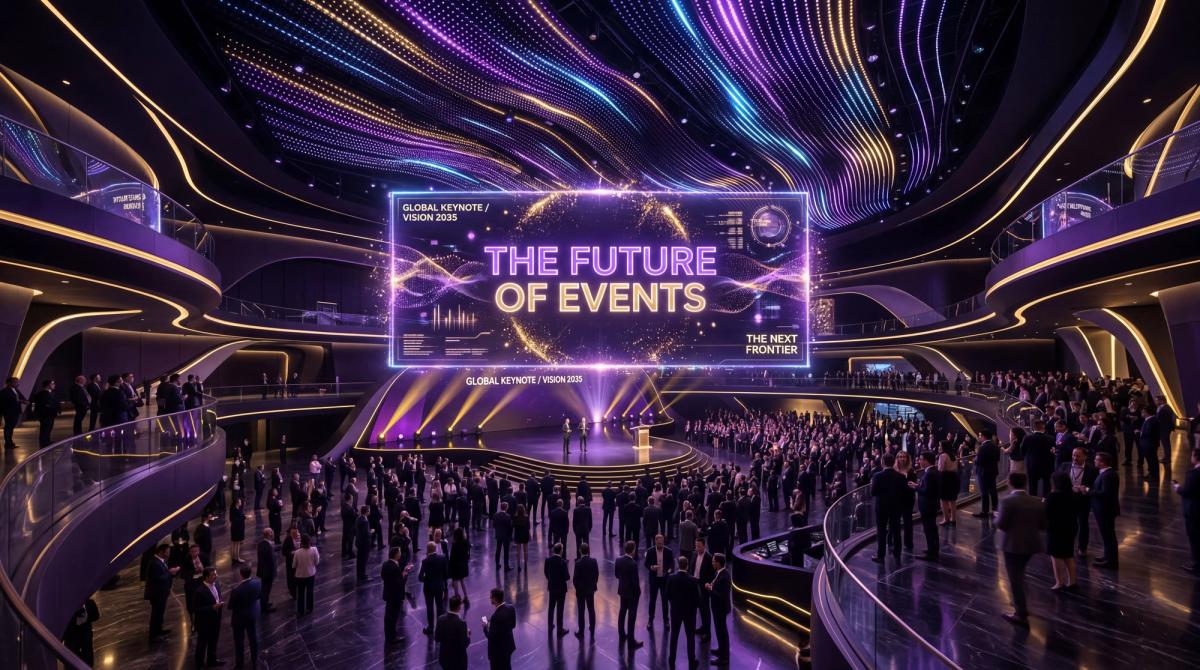
1. The "Event App" Is Dead. Experiences Will Replace Interfaces.
Every major conference still asks you to download an app. You do it in the registration line, use it twice to check the schedule, and delete it before your Uber to the airport.
The event app was a solution to a problem that no longer exists. Schedules live on websites. Maps live on Google. Networking happens on LinkedIn. The app was always a clunky middleman — and attendees voted with their screen time years ago.
What's replacing it isn't another app. It's physical interaction design. The future of event technology isn't on your phone. It's in the room.
Think:that respond to attendee behavior in real time. AI-driven environments that adjust lighting, music, and content based on crowd energy. Spatial audio zones that let 500 people have 50 different experiences in the same ballroom.
The best event technology will be the kind you don't realize you're using. The moment you ask someone to pull out their phone, you've already lost them.
The prediction:By 2028, the top 20% of corporate events will have zero dedicated event apps. The experience is the interface.
2. AI Will Handle 80% of Event Marketing Within 2 Years.
This isn't a guess. It's already happening — most people just haven't noticed because they're still using AI to write email subject lines and calling it a strategy.
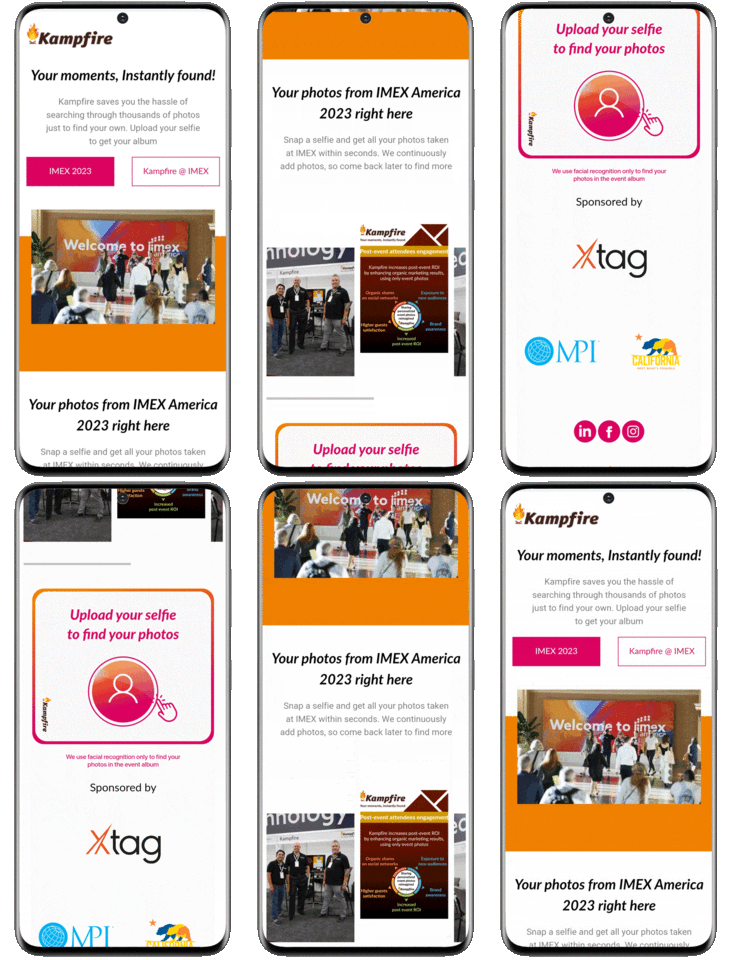
Here's what real AI event marketing looks like right now: a single event photo gets analyzed by vision AI, categorized automatically, then fed to specialized content agents that generate platform-specific posts — each with a different voice, tone, and angle. LinkedIn gets the professional take. Instagram gets the story. Twitter gets the hot take. All from one image. All in under 90 seconds.
We built specifically for this workflow, and I watched it compress what used to be a two-week post-event marketing cycle into an afternoon. If you want the full breakdown, I wrote about it in .
But content generation is just the visible layer. AI is also eating the invisible work: attendee segmentation, send-time optimization, follow-up sequencing, sponsor ROI reporting.found that 50% of event professionals are planning to use AI across the entire event lifecycle this year — and that number will look quaint by 2028.
The prediction:Within two years, 80% of event marketing output — from pre-event campaigns to post-event content — will be AI-generated with human editorial oversight. The teams that resist this won't be "authentic." They'll be slow.
3. Entertainment Budgets Will Finally Overtake Decor Budgets.
I've watched companies spend $40,000 on floral arrangements that get thrown away at 11 PM and $3,000 on the entertainment that 300 people actually experienced for four hours. The math has never made sense. The industry is starting to figure that out.
The shift is already underway. Attendees don't photograph centerpieces. They photograph moments. They share experiences, not tablescapes. And when the CFO asks "what was the ROI on that event?" nobody points to the linen selection.
is the thing people remember. It's the thing they talk about on Monday. It's the thing that turns a corporate obligation into a genuine experience. And budgets are finally starting to reflect that reality.
The prediction:By 2027, the majority of corporate events with budgets over $50K will allocate more to entertainment and interactive experiences than to decor and design. The ones that don't will wonder why their post-event surveys keep saying "it was fine."
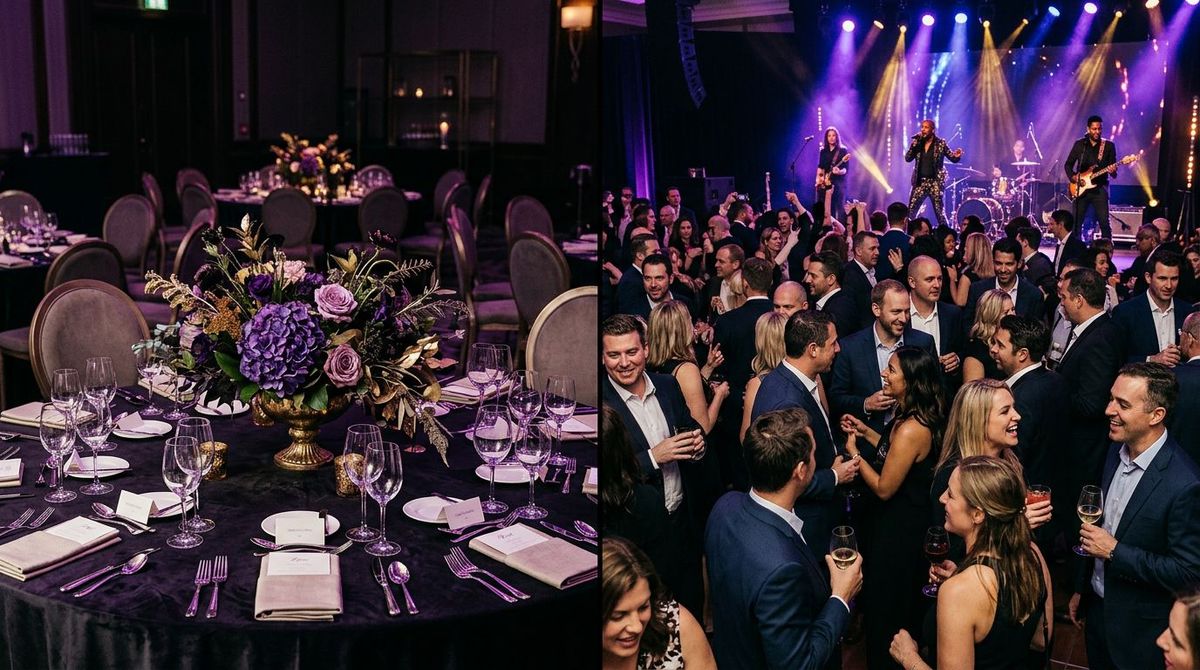
4. Hybrid Events Will Return — But Completely Redesigned.
Everyone thinks hybrid events died in 2022. They didn't die. The bad version of hybrid died — the one where you pointed a camera at a stage and called it "virtual access."
That version deserved to die.
But the underlying need didn't go away. Companies are still global. Teams are still distributed. Travel budgets are still scrutinized. The demand for remote participation in live events hasn't decreased — we just stopped meeting it because the first attempt was so painful.
The hybrid events coming back look nothing like the 2021 version. They're not trying to replicate the in-person experience remotely. They're designing two distinct experiences that share a common thread. The in-person audience gets the room. The remote audience gets something designed specifically for a screen — interactive, participatory, and built around the medium instead of fighting against it.
that actually works requires treating the remote audience as a first-class participant, not an afterthought with a muted microphone.
The prediction:By 2030, "hybrid" will be rebranded (probably as "multi-format" or something equally corporate) and will account for 30%+ of major conferences. The key difference: remote attendees will have experiences designed for them not leftovers from the live show.
5. Personalization Will Go From Buzzword to Baseline.
Right now, "personalized event experience" means your name is printed on a badge and you picked between chicken and fish during registration. That's not personalization. That's a mail merge.
Real personalization is coming, and it's going to make the current version look embarrassing. AI-driven registration that builds a custom agenda based on your role, industry, past attendance, and stated goals. Real-time content recommendations pushed to your device (okay, maybe the app isn't entirely dead — but it becomes a concierge, not a schedule). Networking suggestions based on actual compatibility algorithms, not "you're both in marketing."
highlights hyper-personalization as a defining theme — especially for the Gen Z workforce entering corporate events and expecting the experience to feel like "the event was built for them." They're not wrong to expect that. The technology exists. The industry just hasn't deployed it yet.
The prediction:Within three years, attendees at major corporate events will receive meaningfully different experiences based on their profile — different content tracks, different networking matches, different follow-up sequences. The "one event fits all" model will feel as outdated as a paper program.
6. The RFP Process for Entertainment Will Collapse.
Let's talk about the thing everyone in the industry knows is broken but nobody wants to fix: the Request for Proposal.
Here's how entertainment booking works at most large organizations right now. An event planner writes a vague RFP. Sends it to 6-10 agencies. Each agency spends 5-15 hours putting together a proposal. The planner collects them all, presents options to a committee that doesn't understand entertainment, and the committee picks the cheapest one. Or the one their CEO's wife saw at another gala.
This process wastes hundreds of hours of collective human labor. It rewards the agencies best at writing proposals, not producing events. And it produces mediocre outcomes because the winning bid is almost always a compromise.
AI is going to dismantle this. Intelligent matching platforms will connect event planners with entertainment options based on specific criteria — audience demographics, venue specs, event objectives, budget range — in minutes, not weeks. Video portfolios, verified reviews, and transparent pricing will replace the 40-page PDF nobody reads.
The prediction:By 2028, the traditional multi-agency RFP for entertainment will be used by fewer than 30% of corporate event planners. The rest will use AI-powered matching, direct booking platforms, or established agency relationships that bypass the process entirely.

7. Micro-Events Will Outperform Mega-Conferences for ROI.
The 5,000-person conference isn't going away. But it's going to get serious competition from something smaller, sharper, and dramatically more effective.
Micro-events — think 30-150 people, highly curated, single-purpose gatherings — consistently outperform large conferences on every metric that matters: attendee satisfaction, lead quality, partnership formation, and cost per meaningful connection.
confirms what we've been seeing on the ground: networking is now the number-one reason people attend events. And networking at a 5,000-person conference is chaos. Networking at a 75-person dinner is a relationship.
The economics are compelling too. A company that spends $200K on one mega-conference could run eight micro-events, each targeting a specific audience segment, with better overall results and built-in testing for what resonates.
The prediction:By 2028, the fastest-growing segment of the corporate events market will be curated micro-events (under 150 attendees). Smart companies will reallocate 30-40% of their mega-conference budgets to these formats.
8. AI Photo/Video Activations Will Become the #1 Event Content Driver.
This one's personal because I've watched it happen in real time.
Traditional photobooths were already the most shared piece of content from any event. A decent photobooth generates more social impressions than the keynote speaker, the branded hashtag campaign, and the event photographer combined. That's been true for years.
Now add AI to the equation and it's not even close.
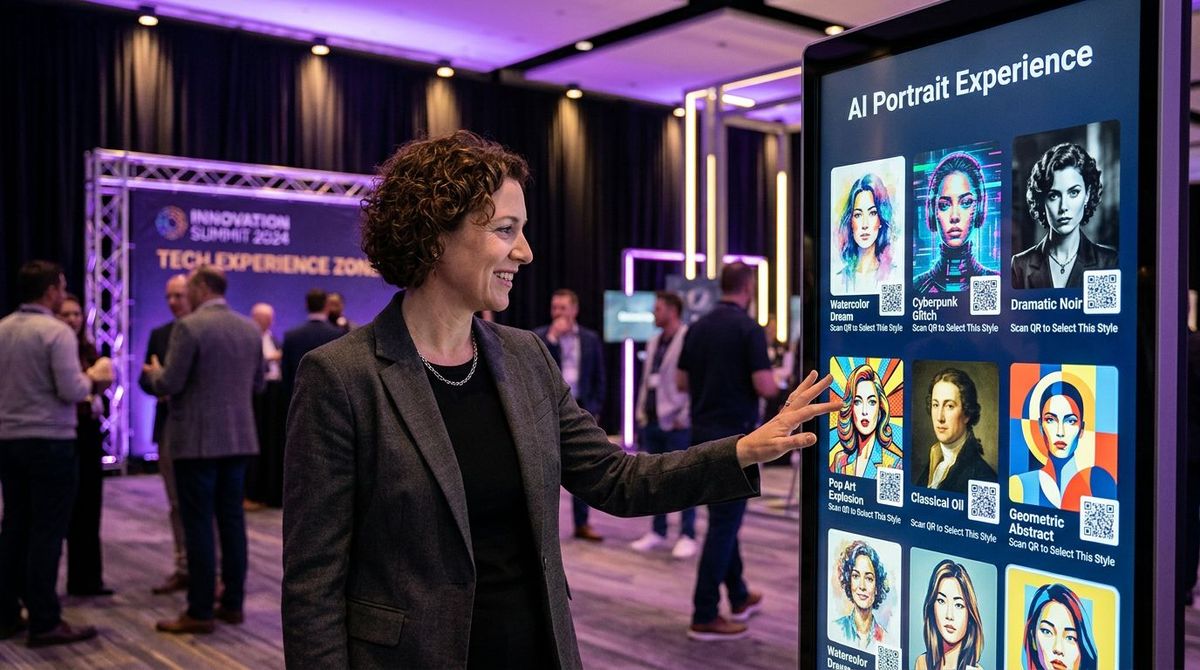
— an AI-powered photobooth platform — transforms a single guest selfie into 15+ creative styles with branded overlays, instant QR sharing, and real-time analytics. One activation at a 500-person event can generate thousands of branded, shareable pieces of content during the event. Not three weeks later when the photographer delivers their selects. During.
That's a content engine disguised as entertainment. The attendee gets a fun experience. The brand gets thousands of organic social impressions. The marketing team gets a library of user-generated content with zero production cost.
The prediction:By 2027, AI photo and video activations will be the single largest source of event-generated social content — surpassing official photographer galleries, speaker clips, and brand-produced recaps combined.
9. Event Planners Who Resist AI Will Be Replaced by Those Who Don't.
This is the one that gets me angry emails. I'm going to say it anyway because it's true.
AI is not going to replace event planners. But event planners who use AI are going to replace event planners who don't.
The gap is already visible. A planner using AI tools can produce event marketing content in hours instead of weeks. They can analyze attendee data in real time instead of waiting for post-event reports. They can generate venue comparison matrices, budget scenarios, and timeline variations while their competitor is still formatting a spreadsheet.
This isn't about being a tech enthusiast. It's about capacity. The planner who can manage 30 events a year with AI assistance will outcompete the one who can manage 15 without it — at the same quality level. The economics are ruthless and the market doesn't award points for principle.
And before someone says "but events are about human connection, not technology" — yes. Exactly. That's the point. AI handles the operational overhead so the planner can focus on the human parts: reading a room, managing a nervous speaker, knowing that this particular CEO hates surprises. Those skills become more valuable when the mechanical work is automated, not less.
The prediction:Within three years, AI fluency will be a baseline requirement in event planning job postings — not a "nice to have." Agencies that don't adopt AI tools will lose clients to those that do, not because the AI is better at planning events, but because it makes the humans faster.
10. The Best Events Will Feel Less Like Productions and More Like Conversations.
Here's the prediction I'm most confident about, and it's the least technological one on the list.
After 5,000+ events, the single clearest pattern I've seen is this: the events people remember aren't the ones with the biggest stages, the loudest speakers, or the most impressive pyrotechnics. They're the ones where they felt something. Where they connected with someone. Where the room became a place where something real happened.
The future of events isn't more production. It's more intention.
The best events coming will feel less like a TED Talk and more like a dinner party hosted by someone who actually knows you. Smaller breakout moments. More facilitated conversation, less broadcast. Entertainment that pulls people in instead of performing at them — which is exactly the philosophy behind where the audience drives the experience instead of watching it.
All the technology on this list — AI, personalization, interactive activations — exists to serve one outcome: making the human experience better. The moment the technology becomes the point instead of the enabler, you've lost the plot.
Innovation is earned, not declared. You don't get to call yourself innovative. Your attendees decide that.
The prediction:The highest-rated corporate events of the next five years will be defined not by their production value but by the quality of human connection they facilitate. The technology will be invisible. The feeling won't be.
The Through-Line
If you read all 10 predictions, you'll notice they point in the same direction:events are becoming more human, not less — and technology is the reason, not the obstacle.
AI doesn't make events robotic. It makes event operations robotic so that the event itself can be more human. Personalization doesn't reduce events to algorithms. It means each attendee gets the experience they actually wanted instead of the one that was easiest to produce.
The event industry has spent decades optimizing logistics. The next decade will be about optimizing experience. And the producers, planners, and agencies that understand the difference will own the market.
I plan to be one of them. If you're reading this, you probably do too.
Frequently Asked Questions
What are the biggest trends shaping the future of events in 2026?
AI integration across the full event lifecycle — from marketing and personalization to real-time analytics — is the dominant force. Beyond AI, the industry is shifting toward micro-events and curated experiences, hyper-personalization driven by attendee data, interactive entertainment replacing passive performances, and a renewed focus on measurable ROI. The era of "throw a big party and hope it works" is ending.
Will AI replace event planners?
No — but event planners who use AI will replace those who don't. AI excels at operational tasks: content generation, data analysis, scheduling optimization, and attendee segmentation. The uniquely human skills — reading a room, managing relationships, creative problem-solving under pressure, understanding what a specific audience needs — become more valuable as the mechanical work gets automated. The role evolves; it doesn't disappear.
Are hybrid events still relevant in 2026?
Yes, but they look nothing like the Zoom-with-a-camera model from 2021. The hybrid events gaining traction in 2026 design two distinct experiences — one for the in-person audience, one for the remote audience — connected by a common theme but optimized for each medium. The key difference is treating remote attendees as first-class participants with their own designed experience, not an afterthought.
How is AI being used in event marketing right now?
The most advanced applications go far beyond chatbots and email subject lines. AI-powered tools like analyze event photos with vision AI, then generate platform-specific content across multiple tones and formats simultaneously. AI photobooth platforms like create shareable branded content in real time during events. On the analytics side, AI handles attendee segmentation, send-time optimization, and sponsor ROI reporting.
What's the ROI difference between micro-events and large conferences?
While large conferences offer scale and brand visibility, micro-events (30-150 attendees) consistently outperform on per-attendee metrics: higher satisfaction scores, better lead quality, more meaningful networking outcomes, and lower cost per qualified connection. A company spending $200K on one mega-conference could run eight targeted micro-events with measurably better results across most KPIs. The trade-off is reach vs. depth — and the industry is increasingly choosing depth.
How should event planners prepare for the future of events?
Start with AI literacy — not expertise, just fluency. Understand what AI tools can do for event marketing, attendee personalization, and operational efficiency. Prioritize entertainment and interactive experiences in your budget conversations. Build relationships with agencies that think in terms of experiences not just logistics. And invest in the human skills that AI can't replicate: empathy, creativity, and the ability to make a room full of strangers feel like they belong.
Arthur Kerekes is the founder of [Fusion Events](https://www.fusion-events.ca/entertainment-agency), a Toronto-based entertainment agency that has produced over 5,000 corporate events across North America. He also builds AI tools for the event industry, including [Content Sidekick](https://www.contentsidekick.ai) and [BananaCam](https://www.bananacam.ai).