

Most events have entertainment. Almost none of them have an experience.
That's not a branding line. It's a diagnosis. And if you've ever sat through a corporate gala where the band was technically excellent and the crowd was technically asleep, you already know exactly what I mean.
I've spent over a decade on both sides of this — performing at events and designing them. And the single biggest shift I've seen in that time isn't about technology, or budgets, or even talent. It's about intent.
The question has changed. It used to be:"Who should we book?"
Now — for the planners who actually move the needle — it's:"What should people feel?"
That's not a subtle difference. That's a completely different discipline.
!
The Transactional Trap
Here's how entertainment gets booked at most corporate events:
- Someone remembers they need entertainment about six weeks out.
- They Google "corporate entertainment Toronto."
- They watch a few demo reels, compare prices.
- They pick the one that looks good and fits the budget.
- The act shows up, performs, leaves.
- Nobody talks about it Monday morning.
I call this transactional booking. And it's not wrong — it's just incomplete. It treats entertainment as a line item. A box to check. Something that fills the gap between dinner and the keynote so people don't leave early.
The problem? When you treat entertainment as a commodity, you get a commodity result. Pleasant background noise that evaporates the moment the lights come up.
If that sounds familiar, you're not alone. I wrote about this pattern in detail in — the lie being that entertainment is something you figure out "later." Later is where experiences go to die.
What "Creating an Experience" Actually Means
Let me be precise here, because "experience" has become one of those words the event industry has beaten into meaninglessness. Like "elevated" or "curated" or "bespoke." (If I hear "bespoke" one more time at a venue walkthrough, I'm walking out.)
Creating an experience means designing the emotional arc of your event with the same rigor you'd apply to the agenda, the AV, or the seating chart.
It means asking:
- What's the emotional state of the room when people arrive? (Hint: probably distracted, skeptical, checking email under the table.)
- What do we want them to feel at the peak of the evening?
- What's the last thing they should experience before they leave?
- How does entertainment serve those transitions — not just fill time between them?
This is and it's fundamentally different from entertainment booking. One is logistics. The other is architecture.
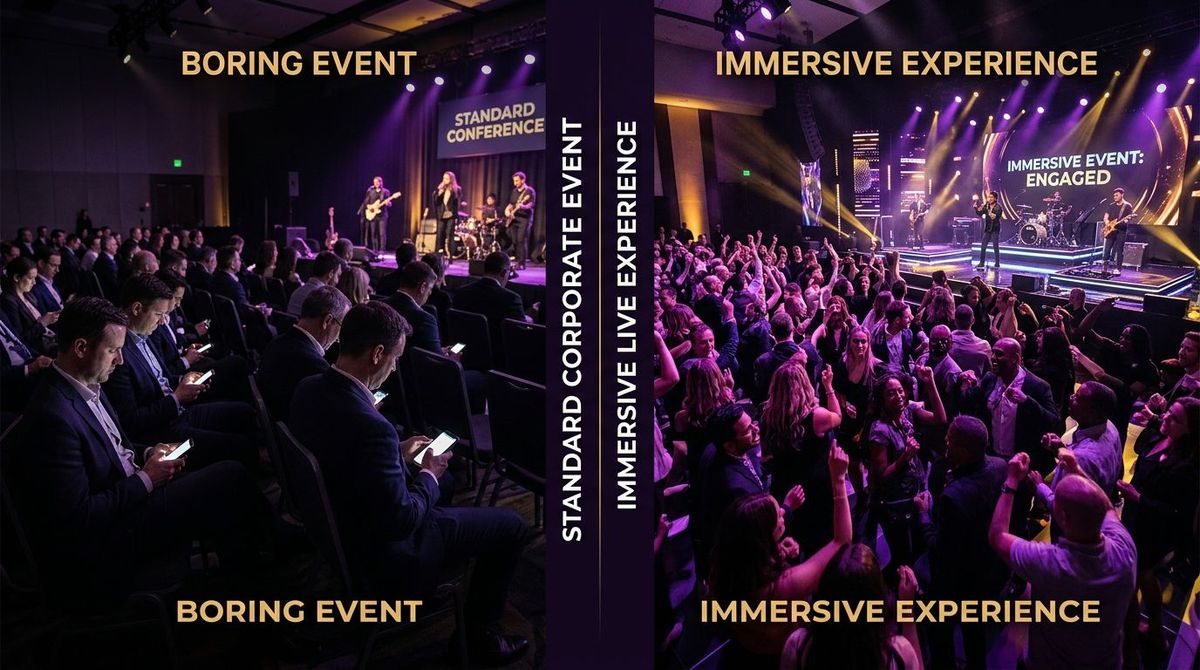
The Five Markers of Experience Design vs. Entertainment Booking
Let me break this down practically. Here's how you can tell which approach is driving your event:
1. Entertainment Booking Starts with the Act. Experience Design Starts with the Audience.
Transactional: "We need a DJ and a photo booth."
Strategic: "Our attendees are 200 senior executives, most of whom didn't want to come. How do we make the first 15 minutes so compelling they put their phones away?"
The act is a tool. The audience is the brief.
2. Entertainment Fills Time. Experiences Shape It.
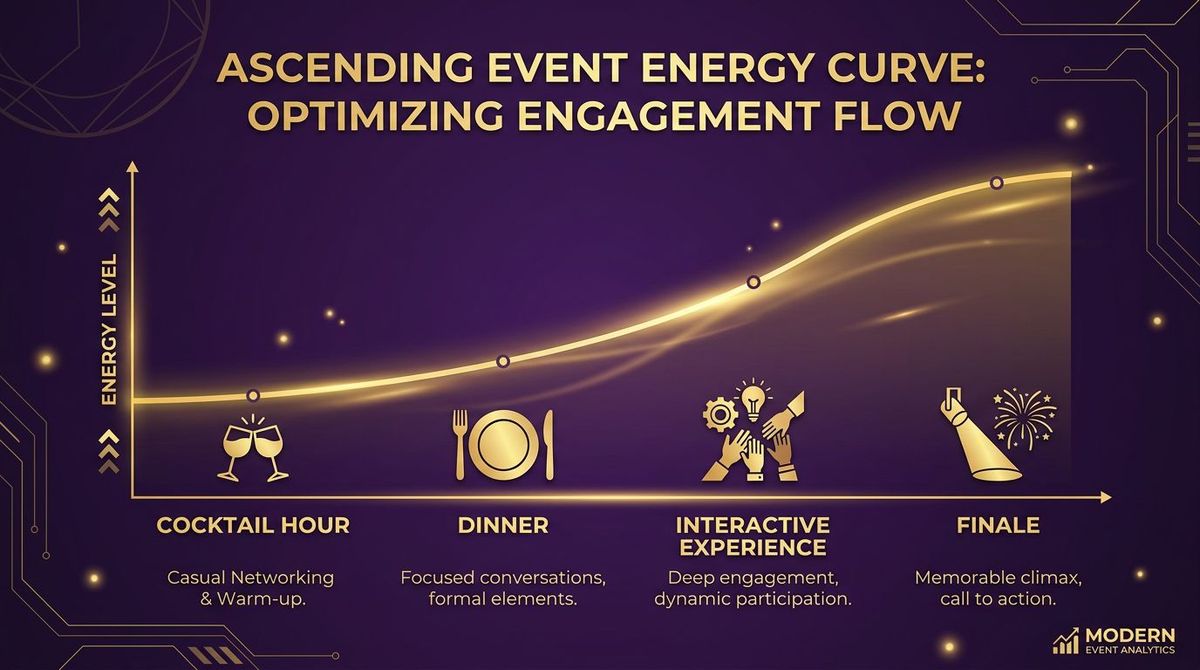
A band playing from 8 to 11 fills a slot. An experience architect maps the energy curve of the entire evening — the slow build during cocktails, the peak during the main event, the cool-down that makes people linger instead of bolt for the parking lot.
This is what we do when we work with clients through our . We don't hand over a playlist. We hand over a blueprint.
3. Entertainment Is Watched. Experiences Are Felt.
This is the big one. A great performer commands attention. A great experience commands participation.
Think about the difference between watching a magic show and being the person whose card gets pulled. Between hearing a band cover "Don't Stop Believin'" and being in a room where 200 people are singing it together because the energy was carefully built to that exact moment.
That participation gap is where memory lives. Neuroscience backs this up — we remember what we do far more vividly than what we see. Our are built on exactly this principle.
4. Entertainment Has a Tech Rider. Experiences Have a Narrative.
Every professional act has a tech rider — stage dimensions, power requirements, sound specs. That's necessary. But when a tech rider is the only document guiding the entertainment, you've got logistics without story.
Experience design adds a narrative layer: What's the theme? What's the throughline? How does the entertainment connect to the brand message? How does it reference something that happened earlier in the program?
My conviction on this: Experience design > event tech. If your tech doesn't make the human experience better, it's furniture.
You can have $50K in LED walls and lighting rigs. If nobody feels anything, you've built a very expensive screensaver.
5. Entertainment Is Evaluated by Performance. Experiences Are Evaluated by Aftermath.
Was the band good? Sure, probably. Did people dance? Some of them.
But the real metric for experience design is what happens after. Did people talk about it? Did they share it? Did they remember a specific moment three months later? Did it change how they feel about the company that hosted it?
That's the ROI that matters. And it's exactly what confirms — the events that generate real business impact are the ones designed around emotional engagement, not just entertainment value.
The Experience Economy Isn't Coming. It's Here.
This isn't theoretical anymore. The shift from passive entertainment to active experience design is the dominant trend in the corporate event space.calls out that audiences now crave environments that feel "layered, tactile, and dimensional" — they want to be inside the event, not watching it.
And that experiential-led engagement is the fastest-growing format in the meetings industry for 2026.
This tracks with everything I've seen on the ground. Five years ago, a client would say "we need a band." Now the best clients say "we need people to feel like they're part of something." That's a fundamentally different brief — and it requires a fundamentally different partner.
What This Looks Like in Practice
Let me give you a real example, no names.
A financial services company — 300 people, annual gala, Toronto. Previous year: they booked a cover band, had a DJ after, open bar. Standard playbook. Feedback was "fine." The dreaded F-word.
We came in and redesigned the evening around a single concept:surprise escalation. The idea was that every 30-40 minutes, something would shift — the music, the lighting, the energy, the interactive element — and each shift would be bigger than the last. The audience wouldn't know what was coming next.
Cocktails opened with an ambient electronic duo and roaming close-up magicians — low-key, conversational. Dinner featured our live band transitioning from jazz to high-energy pop as courses progressed. After dinner, we introduced our interactive request platform, and the room went from "watching a band" to "running the show."
The final act was an LED performance piece with our group NEON that turned the ballroom into something that felt more like a concert than a corporate event.
The result? The CEO told us it was the first time in seven years that people stayed until the end. Not because the bar was still open — because they didn't want to miss what happened next.
That's experience design. Same budget category as the previous year. Completely different outcome.
The Uncomfortable Truth About "Good Enough" Entertainment
Here's where I put on the provocateur hat for a minute.
If your entertainment is "good enough," it's not good enough.
"Good enough" means forgettable. And forgettable means your event — which you spent six months planning and $150K executing — produced zero lasting impact. Your attendees will merge it in memory with every other corporate event they've attended. Same ballroom, same chicken, same band, same speech. A blur.
The bar isn't "did people complain?" The bar is "did people remember?"
And if that sounds like an impossible standard for a Tuesday night awards dinner, I'd push back. I've seen a five-piece band turn a 150-person insurance company holiday party into something people referenced in their performance reviews. ("Best team event we've ever had — it felt like the company actually gets us.") That's not magic. That's design.
How to Start Thinking Like an Experience Designer
You don't need to hire a "Chief Experience Officer" or read a book about design thinking. You just need to shift three habits:
Start with Emotion, Not Logistics
Before you open a single vendor proposal, write down three words that describe how you want people to feel at your event. Not what you want them to see or do— how you want them to feel. Build backward from there.
Hire Partners, Not Vendors
A vendor delivers a service. A partner helps you solve a problem. When you're evaluating entertainment options, the question isn't "what's in your demo reel?" It's "how would you approach our event?" If they can't answer that with specifics, they're a vendor.
This is the core of what we do at — we don't show up with a setlist. We show up with questions.
Design the Transitions
The moments between acts — the walk from cocktails to dinner, the shift from speeches to entertainment, the end of the night — are where most events lose their audience. Design those transitions as carefully as you design the main content. Music changes, lighting shifts, host cues. The connective tissue is where the experience lives.

The Future Belongs to Experience Architects
The event industry is splitting into two lanes. One lane is commoditized: platforms where you can book entertainment like you book an Uber, sorted by price and availability. That lane will always exist, and it serves a purpose.
The other lane is consultative: partners who design the emotional architecture of events, who treat entertainment as a strategic tool rather than a line item. As puts it — experience designers are becoming the new event planners.
I know which lane we're in. The question is which lane your event is in.
Frequently Asked Questions
What's the difference between event entertainment and experience design?
Event entertainment is a performance you book to fill a time slot — a band, a DJ, a comedian. Experience design is a strategic approach that shapes the entire emotional arc of your event, using entertainment as one of several tools to create specific feelings and outcomes for your audience. Entertainment is a what. Experience design is a why.
Does experience design cost significantly more than standard entertainment booking?
Not necessarily. The difference is often in how you allocate the budget, not how much you spend. A strategically designed event with a mid-range band, smart lighting, and intentional transitions can outperform an expensive act dropped into an unplanned evening. It's architecture, not just procurement.
How far in advance should we start planning if we want an experience-designed event?
The earlier the better, but 8-12 weeks minimum for a meaningful experience design process. The planning that matters most — defining emotional objectives, mapping energy curves, coordinating between entertainment and production — happens before any act is booked. This is why we wrote about .
Can experience design work for smaller corporate events (under 100 people)?
Absolutely — and in many ways it's even more effective at smaller scale. With fewer people, you can create more intimate, participatory moments. Interactive elements like actually scale better in smaller rooms because participation rates are higher and the shared energy is more concentrated.
How do you measure the success of an experience-designed event versus a standard one?
Beyond the usual metrics (attendance, satisfaction surveys), look for: social sharing during the event, unsolicited feedback after, how long people stayed past the "expected" end time, whether people reference specific moments weeks later, and — for annual events — whether attendance increases the following year. The best experiences generate their own word-of-mouth marketing.
We already have a preferred entertainment vendor. Can experience design work with existing relationships?
Yes. Experience design isn't about replacing your vendors — it's about giving them a better brief. A good band with a clear emotional objective and a mapped energy curve will deliver a fundamentally different performance than the same band told "play from 8 to 11." The design layer elevates everything underneath it.