
64 Team Building Games That Build a Real Skill, Not Just Kill an Hour
Sorted by time, setting, and the skill they build. Quick 15-minute games, indoor and outdoor formats, competitive tournaments, problem-solving challenges, and games that scale to a room of 2,000.
Quick 15-Minute Team Building Games
Human Knot
A group of 8 to 12 stands in a circle, everyone grabs two different hands across the circle, and the team untangles into a ring without letting go. Takes 10 minutes, needs zero materials, and builds nonverbal coordination fast. It always ends in a cheer.
Line Up Silently
The group arranges itself in order by birthday, height, or years at the company using only gestures, no talking allowed. Takes 5 minutes, needs no materials, and builds nonverbal communication. Time it and let them try to beat their own record on a second run.
One Word Story
The team builds a single story out loud, each person adding exactly one word in sequence. Works for 6 to 20, runs 5 to 10 minutes, and builds active listening because you cannot plan your word until you hear the one before it. The absurd results are the bonding.
Common Ground
In small groups, the team races to find five things every single member shares that are not work related. Takes 8 minutes, needs paper, and forces conversation to surface real overlaps. Push them past the obvious ones like we all drink coffee.
Back-to-Back Drawing
Pair people up sitting back to back. One describes a simple shape while the other draws it from words alone. Takes 10 minutes, needs paper and a printed image, and is a genuinely useful lesson in how badly instructions can be misheard. Compare drawings for the laugh.
The Perfect Square
Blindfold a team of 6 to 10, hand them a loop of rope, and ask them to form a perfect square and lay it on the floor. Takes 10 minutes and builds communication under a constraint, because someone has to lead without being able to point. Reveal the shape and watch the reactions.
Would You Rather Split
Pose a forced-choice question, then have people physically move to one side of the room to answer. Runs 5 to 10 minutes, needs no prep beyond a question list, and warms up a cold room by getting bodies moving and debates started before the real work.
Group Count to Twenty
The whole group tries to count aloud to twenty, one voice per number, with no order and no signals. If two people speak at once, it resets to one. Takes 5 to 10 minutes and builds an almost eerie shared awareness. Deceptively hard and weirdly addictive.
Rock Paper Scissors Champion
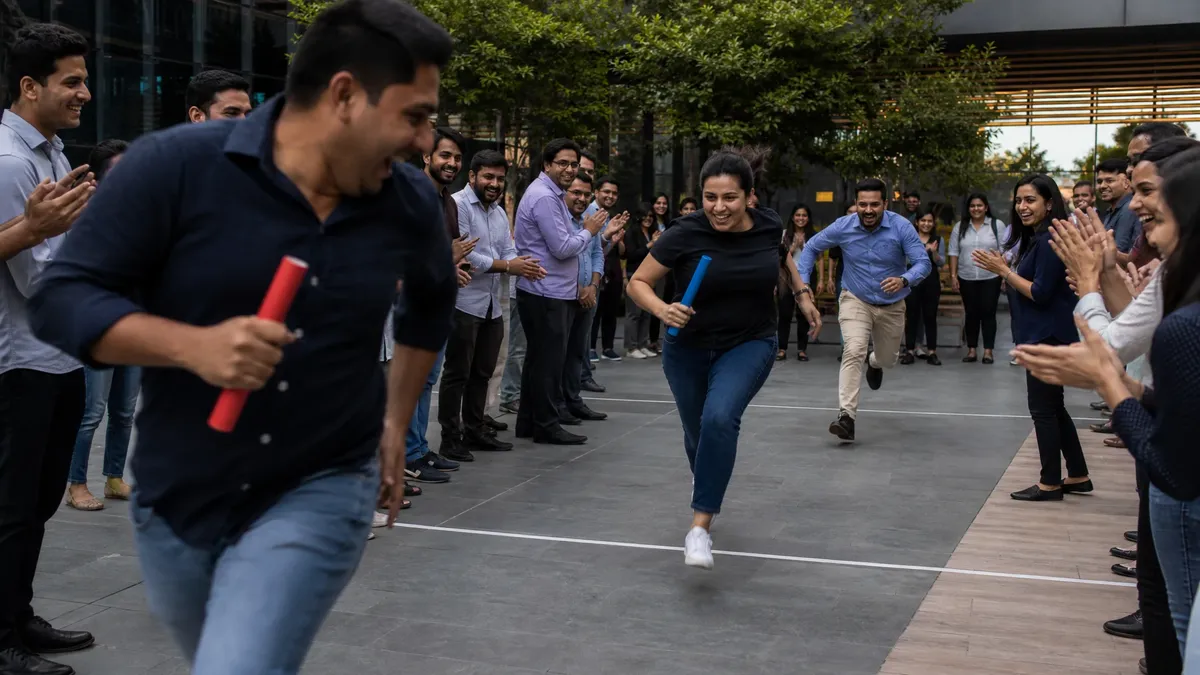
Everyone pairs off for rock paper scissors, and each loser becomes a loud cheering fan of whoever beat them. Winners keep advancing until two finalists play in front of the whole chanting room. Scales to hundreds, takes 5 to 8 minutes, and the growing cheer squads generate instant energy.
Indoor Office Team Building Games
Marshmallow Challenge
Give each small team 20 sticks of spaghetti, a metre of tape, a metre of string, and a marshmallow, then 18 minutes to build the tallest freestanding tower with the marshmallow on top. Teams of 4 to 6 are ideal. It exposes how a group plans, prototypes, and handles a deadline.
Song CoLab
Teams write and record an original song together, coached by real producers, and leave with a finished track that is theirs. Works from 20 to a few hundred, runs 90 minutes to half a day, and builds creative collaboration in people who swear they are not creative. We ran it for Spotify and they called it transformational, and their team wrote Stand By Me. This is our Song CoLab songwriting experience.
Office Trivia
Split the room into teams and run themed trivia rounds with points, a scoreboard, and a prize. Scales from 12 to hundreds, runs 20 to 30 minutes, and the team format lets quiet people contribute answers without performing. We produce this with hosts like Adam Growe, the longtime host of Cash Cab Canada, for large corporate events.
Pictionary Relay
Teams take turns drawing a prompt while teammates guess against the clock, racing through a stack of cards. Works for 8 to 40, takes 15 to 20 minutes, and the time pressure produces both terrible drawings and loud laughter. A whiteboard or flip chart is all you need.
Build a Better Mousetrap
Give teams a random bag of office supplies and a silly problem to solve, like moving a ping pong ball across the room without touching it. Runs 20 minutes for teams of 4 to 6 and builds lateral problem-solving. The constraint of weird materials forces creativity fast.
The Barter Game
Hand each team one small object and challenge them to trade their way up to something bigger by negotiating with other teams in a set time. Runs 15 to 20 minutes and builds negotiation and strategy. The reveal of who ended up with what is always a surprise.
Escape Room Challenge
Teams work against the clock to solve a chain of linked puzzles and escape a themed room. Best for teams of 4 to 8, runs 45 to 60 minutes, and builds problem-solving and role-finding under pressure. See our full guide to escape room team building for setups and scaling.
Blind Retriever
One blindfolded teammate navigates a simple obstacle course to fetch an object, guided only by the voices of the rest of the team. Takes 15 minutes, needs a few props, and builds trust and clear verbal direction. Swap the guide each round so everyone leads once.
Company Culture Bingo
Hand out cards with squares like has worked here five years or has met the CEO, and people mingle to find a match and a signature for each. Scales to hundreds, takes 10 to 15 minutes, and quietly surfaces hidden connections across departments. Print the cards ahead of time.
The Newspaper Fashion Show
Give teams newspaper and tape and 15 minutes to design an outfit, then a model walks it in a runway show. Teams of 5 to 8, and it builds creative collaboration and a lot of laughing. Judge it on a clear metric plus one surprise bonus category at the reveal.
Outdoor Team Building Games
Scavenger Hunt Race
Teams race to complete a checklist of photo and item challenges around a park, neighbourhood, or venue within a time limit, scoring for creativity and speed. Works for 15 to 200, takes 30 to 60 minutes, and gets people moving, collaborating, and exploring together. Build the list around your location.
Tug of War
The oldest team game there is: two teams, one rope, pull the other side past a line. Works for any size split into two, takes 10 minutes across a few rounds, and builds pure coordinated effort. Best on grass, and mix the teams so it stays close.
Human Foosball
Players hold onto ropes in rows on a taped or roped grid and can only move side to side, playing a live game of human foosball with a soft ball. Works for 10 to 22, runs 20 minutes, and builds positional teamwork because you literally cannot leave your lane. Loud and hilarious.
Egg Drop Challenge
Give teams straws, tape, and cardboard and a set time to build a rig that protects a raw egg from a drop off a ladder or balcony. Teams of 4 to 6, runs 30 minutes, and builds engineering thinking and shared risk. The drop is the payoff, so make it a ceremony.
Capture the Flag
Two teams defend a flag on their side of a field and try to steal the other team's without being tagged. Works for 12 to 60, runs 20 to 40 minutes, and builds strategy, roles, and communication across a moving group. Set clear boundaries and a safe zone before you start.
The Great Race
Teams follow a series of clues from station to station, completing a quick physical or mental challenge at each to earn the next clue. Works for 15 to 100, runs 45 to 90 minutes, and builds planning and division of labour. Design the route around a park or downtown core.
Water Balloon Toss
Pairs toss a water balloon back and forth, stepping apart after each successful catch until only one pair survives. Works for any number of pairs, takes 10 minutes, and builds coordination and a shared willingness to get a little wet. A perfect low-stakes summer opener.
Blindfold Tent Build
A team pitches a real tent while blindfolded, taking direction from one sighted teammate who cannot touch anything. Runs 20 minutes for teams of 4 to 6 and builds precise verbal instruction and patience. Frustrating in the best way, and the finished tent is a trophy.
Field Olympics
Run a series of silly outdoor stations like a three-legged race, sack race, and water relay, with teams rotating to earn points. Runs 45 to 90 minutes, works for 20 to 100, and the variety keeps everyone in it. Cap it with a medal ceremony for maximum buy-in.
Competitive Tournament Games
Majority Rules Game Show
Our live game show turns a whole room into contestants who vote and compete from their phones, with a host, big-screen visuals, and a live leaderboard. Works from 50 to 2,000, runs 45 to 90 minutes, and builds a shared, connected energy that no breakout activity reaches. We launched it to about 300 event planners, got rebooked within two months, and it now tours nine cities. See our interactive corporate entertainment.
Minute to Win It Tournament
Teams race through 60-second physical challenges using simple props, advancing through a bracket to a live leaderboard. High energy, endlessly adaptable, and a proven crowd-pleaser for any size. Browse our full list of Minute to Win It games for setups you can run today.
Quiz Show Buzzers
Use buzzers or a phone quiz app to run a fast, points-based knowledge game with a live leaderboard. Works from a boardroom of 12 up to a ballroom of 2,000, runs 30 minutes, and the buzzer race adds urgency that regular question and answer never has. Add themed rounds to keep it fresh.
Team Build-Off
Give teams identical materials and a build challenge, tallest tower or strongest bridge, judged on one clear metric. Runs 15 minutes for teams of 4 to 6 and reveals how groups organize under pressure. The head-to-head stakes make it stickier than any solo activity.
Category Bracket
Run a March Madness style bracket on a fun debate like best pizza topping or greatest movie, with the room voting each matchup. Scales to any size, takes 15 minutes, and the passionate arguments are the entire point. Seed it with intentionally controversial options.
Relay Challenge Circuit
Teams rotate through timed stations, each a quick skill or puzzle, and rack up points against the clock. Works for 20 to 100, runs 30 to 45 minutes, and builds hand-offs and pacing because a slow station drags the whole team. Score cumulatively so every station matters.
Trivia Face-Off
Split into teams and run themed trivia with points, a scoreboard, and a prize. Scales from 12 to hundreds, runs 20 to 30 minutes, and the team format means quieter people contribute answers without having to perform. Pair prompts from our fun trivia questions to build the rounds.
Dodgeball Bracket
Run a single-elimination dodgeball tournament with soft balls and short games. Works for teams of 5 to 8, runs 30 to 45 minutes, and builds fast coordination and a lot of shouting. Cheap, physical, and a reliable way to blow off steam as a group.
Cook-Off Challenge
Teams get the same ingredients and a time limit to plate the best dish, judged on taste and presentation. Runs 45 to 90 minutes for teams of 4 to 6 and builds planning, roles, and calm under a clock. The tasting at the end is the team-bonding moment everyone remembers.
Problem-Solving Team Games
Desert Survival
The team ranks a list of salvaged items by survival value, first alone, then as a group, and compares the group score to an expert ranking. Works for 5 to 8, runs 30 minutes, and proves that a good group decision beats the best individual one. The debrief is where the learning lands.
Escape Room
Teams solve a chain of linked puzzles against the clock to escape a themed room. Best for 4 to 8, runs 45 to 60 minutes, and builds role-finding under pressure because someone naturally becomes the tracker, the tester, and the timekeeper. See our escape room team building guide.
The Minefield
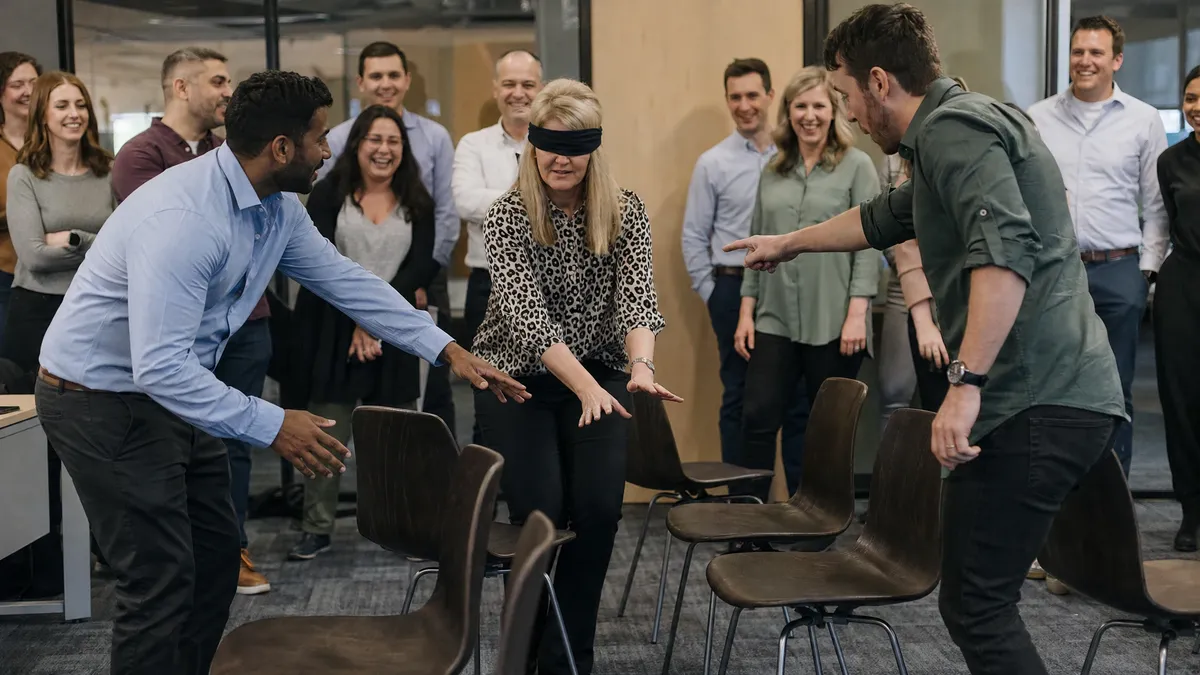
Scatter objects across a floor as mines, then blindfolded players cross guided only by a teammate's voice. Runs 20 minutes, needs a few props, and builds trust plus precise verbal direction. Add a second team calling out at the same time to test focus under noise.
Bridge Build
Two teams each build half of a bridge from the same kit without seeing the other half, then join them in the middle. Runs 40 minutes for two teams of 4 to 6 and builds cross-team communication, because the halves only meet if the two groups actually talked.
Code Breakers
Teams race to crack a series of ciphers and locks to open a box. Works for 4 to 8, runs 30 minutes, and builds logical division of labour, since the fastest teams split the puzzles instead of crowding one. Set difficulty so the finish is close, not easy.
Lost at Sea
A ranking-and-consensus survival scenario like Desert Survival but set on a sinking ship. Works for 5 to 8, runs 30 minutes, and builds structured decision-making and the skill of disagreeing productively. Insist on genuine consensus, not just averaging everyone's numbers.
The Puzzle Swap
Give each team a jigsaw with a few pieces secretly mixed into other teams' boxes, so no team can finish without trading. Runs 25 minutes and builds negotiation and the realization that hoarding loses. Nobody is told the pieces are swapped, which is the fun.
Mission Control
One team has instructions they cannot see the equipment for, the other has equipment they have no instructions for, connected only by radio. Runs 30 minutes and builds remote communication under pressure. A brilliant model for how teams actually work across departments.
Shrinking Island
The whole group stands on a tarp and must flip it over without anyone stepping off. As they succeed, fold it smaller. Works for 8 to 15, runs 15 minutes, and builds collective problem-solving and physical trust. The escalating difficulty keeps it from ending too soon.
Communication Team Building Games
Telephone Pictionary
Each person writes a phrase, passes it on, the next person draws it, the next writes what they see, and so on down a stack. Works for 6 to 12, runs 15 minutes, and shows exactly how a message mutates as it travels. The final reveal of how far it drifted is the lesson.
Guess the Emotion
One person reads a neutral sentence in an assigned emotion while the team guesses which. Works for any size, runs 10 minutes, and builds awareness of tone and nonverbal signal. A quick, low-prep way to talk about how much meaning lives outside the words.
Blindfold Obstacle Guide
A blindfolded teammate crosses a course guided only by a partner's spoken directions. Takes 15 minutes, needs a few props, and builds clear instruction and trust. Swap roles so everyone experiences both giving and following precise directions.
The Interview Game
Pairs interview each other for three minutes, then introduce their partner to the group as if they were them. Works for 8 to 30, runs 20 minutes, and builds active listening because you have to remember and represent someone accurately. A warm choice for newer teams.
Assembly Line Instructions
One person builds something simple from blocks behind a screen, then describes it so the rest rebuild it from words alone. Runs 20 minutes, needs identical block sets, and builds precise instruction and clarifying questions. Compare the results for a sharp, funny lesson.
Yes And Storytelling
Borrowed from improv, pairs or small groups build a scene where every line starts with yes and, accepting and adding. Runs 15 minutes, needs no props, and builds the habit of building on ideas instead of shutting them down. It changes how a team brainstorms afterward.
Silent Sorting
Hand out cards with parts of a process out of order and have the team arrange them correctly with no talking. Runs 15 minutes and builds nonverbal collaboration and shared mental models. Debrief on how they agreed without a single word being spoken.
The Feedback Round
In a trusted small team, each person gives every other member one specific thing they appreciate about working with them. Runs 20 minutes, needs no props, and builds the muscle of direct, positive feedback. Use it only with teams that already know each other.
Two Truths and a Lie
Each person shares three statements about themselves, two true and one false, and the group guesses the lie. Works for 4 to 40, about a minute per person, zero materials, and builds attentive listening plus a few surprises. For a deeper bank of prompts, see our Two Truths and a Lie ideas.
Team Building Games for Large Groups
Live Interactive Game Show
A professional host runs the whole room through trivia, buzzer rounds, and challenges on a big screen with a live leaderboard, and every table plays along on their phones. Turns 50 to 2,000 people into one connected audience. This is our Majority Rules format, the most reliable way to unite a big room because nobody has to volunteer to be watched.
Human Bingo
Hand out grid cards of traits like has run a marathon or speaks three languages, and people mingle to find a match and a signature per square. Scales to hundreds, takes 10 to 15 minutes, and forces everyone to talk to strangers. First to fill a row or the card wins.
The Wave Story
The host starts a one-sentence story, then each section of the room adds a single sentence in sequence like a stadium wave. Scales to any size, takes 10 minutes, and the collaborative absurdity bonds a large room fast. A confident MC makes or breaks it.
Group Juggle Names
In circles of 10 to 15, the group passes a ball in a set pattern by name, then more balls get added into the same pattern. Runs 10 minutes and builds names, focus, and shared timing across a big room broken into pods. The escalating chaos is the fun.
Mass Rock Paper Scissors
Everyone pairs off, losers become cheering fans of the winner, and the crowd narrows to two finalists with the whole room split into chanting camps. Scales to any size, takes 5 to 8 minutes, and generates a huge burst of shared energy from almost nothing.
Flash Mob Build
Break a large crowd into teams for a fast creative build or dance they perform back at once. Works for 50 to a few hundred, runs 20 to 30 minutes, and builds coordination inside teams plus a shared spectacle across the room. Great for a conference energizer.
The Big Puzzle
Each small team completes one piece of a giant shared image or mural, not knowing how theirs fits until every piece assembles at the front. Works for 30 to 300, runs 30 minutes, and builds the feeling that separate teams built one thing together. The reveal is genuinely moving.
Stand Up If
The host calls out statements like stand up if you have been here five years, and people rise if it applies. Takes 5 minutes, needs no materials, and instantly maps a big room by tenure, hometown, or shared experience. A fast, low-pressure opener before the main event.
Table Trivia Tournament
Each table is a team competing across trivia rounds with a running leaderboard. Scales from 60 to 1,000, runs 30 to 45 minutes, and the table format means every seat is on a team from the first question. We produce these with broadcast hosts for large corporate audiences.
Expert Pro Tips
Frequently Asked Questions
What are good team building games?
What games build teamwork?
What are the best team building games for work?
What is the difference between a team building game and a party game?
How long should a team building game take?
What team building games work for large groups?
Do team building games actually work?
What team building games need no materials or preparation?
Our songwriting experience gets a whole team creating together and leaves them with a finished track. Spotify called it transformational.
Book Song CoLab for your team
Get StartedWhen your group is 50 or more, a hosted game show does what a breakout activity cannot: it connects the whole room at the same time.
Turn team building into a live game show
Contact Us