
50 Outdoor Team Building Activities That Actually Land
Field games, scavenger hunts, sports-day formats, adventure challenges, and seasonal ideas for corporate groups of 10 to 2,000. Plus a full indoor rain-day backup, because we plan Canadian.
Park and Field Games (Grass, Space, and No Gear to Ship)
Human Knot
Needs: nothing but a circle of people. Runs: everyone grabs two different hands across the circle, then the group untangles into a ring without letting go. Why it works: it forces physical problem-solving and instant communication, and the tangle is a great equalizer because seniority does not help you find the exit.
Blanket Flip
Needs: one tarp or blanket per team. Runs: the whole team stands on the blanket and must flip it completely over without anyone stepping onto the grass. Why it works: the shrinking surface pushes people literally closer together and rewards the group that talks through a plan before it moves.
Giant Jenga Circuit
Needs: two or three oversized wooden block towers. Runs: teams rotate between towers pulling blocks, and the team that topples a tower owes the winners a forfeit. Why it works: the slow tension of a wobbling waist-high tower draws a crowd, and the stakes keep spectators invested between turns.
Parachute Games
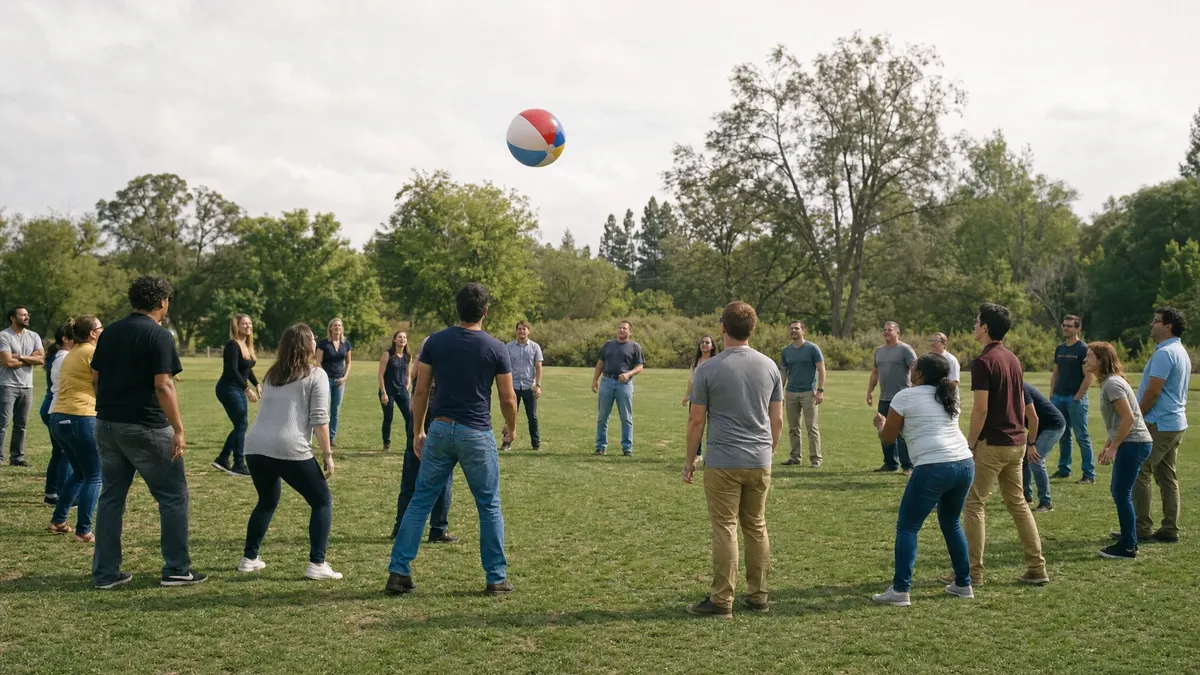
Needs: one large play parachute. Runs: the group ripples the chute together to launch balls, run underneath, or trap a target. Why it works: it is one shared object that only moves if everyone pulls in rhythm, which makes coordination visible in a way a slideshow never manages.
Ball Pit Numbers Chaos
Needs: numbered balls or beanbags scattered across the field. Runs: teams race to collect balls that sum to a target number the host calls out. Why it works: it splits the group into runners and math-callers instantly, so both the fast and the calm find a role without being told to.
Toxic Waste Transfer
Needs: a bucket, bungee cords, and a marked drop zone. Runs: the team moves a full bucket across a distance using only the tension of cords they all hold, no hands on the bucket. Why it works: a spill resets the round, so the group learns to move slow and speak up, which is the actual lesson dressed as a game.
Field Frisbee Golf
Needs: a few discs and objects to serve as holes. Runs: teams play a rough course across a park, scoring throws to each target. Why it works: it moves people through a large space in small mixed groups, which is where the real conversations happen, away from the main pack.
Capture the Flag
Needs: two flags, a marked field, and boundary cones. Runs: two teams raid each other's territory to steal a flag without getting tagged in enemy ground. Why it works: it is the rare activity where strategy, speed, and nerve all pay off, so nobody sits it out feeling useless.
Scavenger-Hunt Formats (The Most Reliable Big-Group Play)
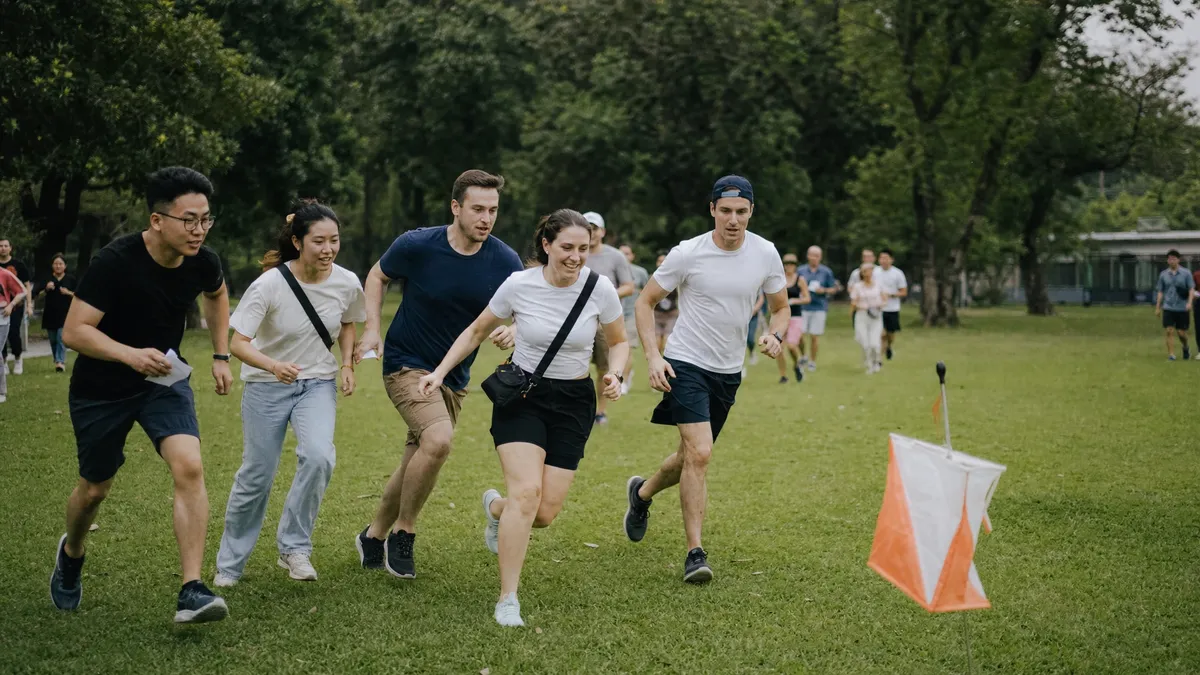
Photo Challenge Hunt
Needs: a printed list and a phone per team. Runs: teams have a set window to photograph as many list prompts as they can across a neighbourhood or park. Why it works: the creative prompts get quiet people directing shots, and the photo reveal at the end is a built-in highlight reel.
GPS or App-Based Hunt
Needs: a scavenger-hunt app and phones. Runs: teams unlock location-based clues that only reveal on-site, racing a live leaderboard. Why it works: the live scoreboard turns a walk into a competition, and the app handles logistics so facilitators can watch the dynamics instead of running scores.
Landmark Trivia Trail
Needs: a route past notable local spots and a question sheet. Runs: each landmark holds a clue whose answer points to the next stop. Why it works: it teaches the group the story of a place while they move, so out-of-town attendees leave knowing the city, not just the ballroom.
Charity Build Hunt
Needs: a shopping list and a budget per team. Runs: teams gather items for a local shelter or food bank against a checklist, then the haul gets donated. Why it works: it bolts a genuine purpose onto the competition, and a hunt that ends in a donation lands harder than one that ends in a gift card.
Riddle Relay Hunt
Needs: a set of staged riddle clues. Runs: solving each riddle reveals the location of the next, so teams cannot skip ahead. Why it works: it rewards the lateral thinkers who stay quiet in field sports, spreading the hero moments across different personalities.
Video Mission Hunt
Needs: phones and a list of short filmed missions. Runs: teams shoot 15-second video challenges around a location, from a group chant to a staged rescue. Why it works: filming forces roles, a director, a cast, a camera, and the screening afterward is the payoff everyone remembers.
Neighbourhood Bingo
Needs: printed bingo cards of things to find or do. Runs: teams complete rows by finding sights, doing tasks, or gathering signatures. Why it works: the flexible card lets fast and slow teams both feel progress, and there is always a way back into contention.
Puzzle Piece Hunt
Needs: a large puzzle or map cut into hidden pieces. Runs: teams find scattered pieces, then the whole group assembles one shared final image. Why it works: it starts as competition and ends as collaboration, since no team can finish alone, which is a quiet lesson that lands without a lecture.
Sports-Day Formats (Backyard-Olympics Energy for Any Crowd)
Three-Legged Race
Needs: soft ties and a marked track. Runs: paired players tie one leg together and race down and back. Why it works: it is instant forced coordination between two people who might never speak otherwise, and the falls are harmless and funny.
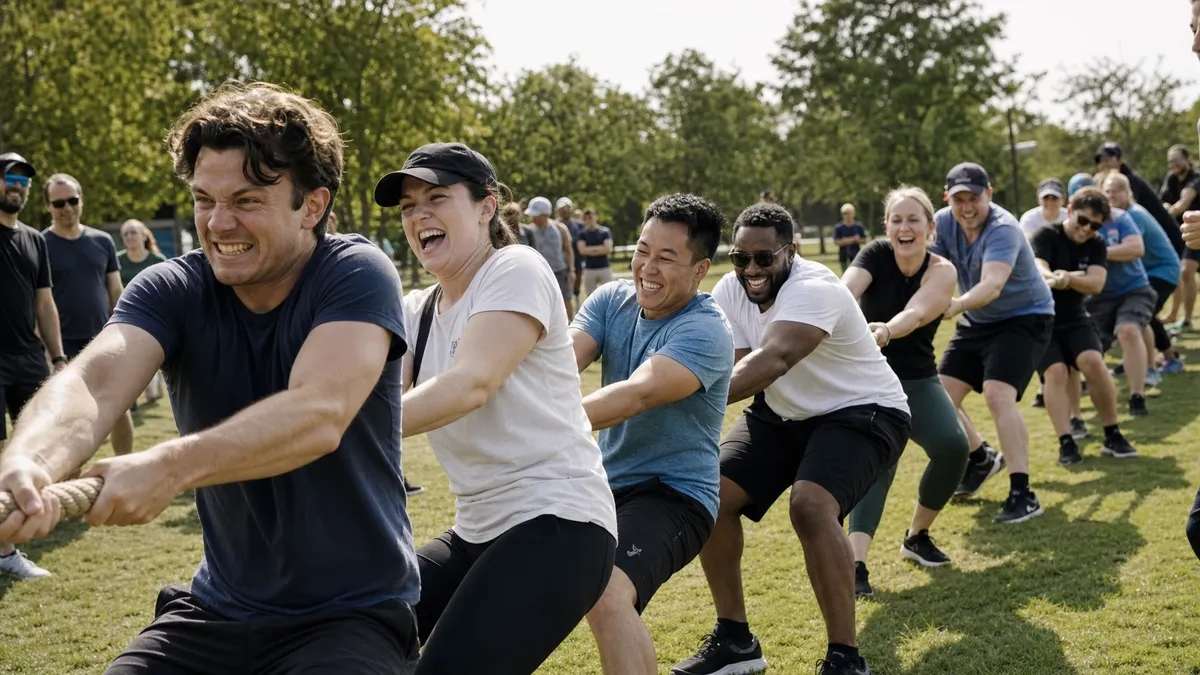
Tug of War
Needs: a heavy rope and a flat field. Runs: two teams pull until one crosses the centre line. Why it works: nothing unites a group faster than pulling the same rope against a common opponent, and it needs zero explaining.
Sack Race Relay
Needs: burlap or fabric sacks per lane. Runs: players hop the course in a sack, tagging the next teammate. Why it works: it is a pure nostalgia trigger that gets even reluctant adults committing, because everyone remembers it and nobody can do it gracefully.
Egg and Spoon Course
Needs: spoons and eggs or balls. Runs: players carry an egg on a spoon through a course without dropping it. Why it works: it slows the fastest people down and levels the field, so speed alone will not win, which keeps the whole group in it.
Water Balloon Toss
Needs: water balloons and paired players. Runs: partners toss and step back after each catch until only one dry pair remains. Why it works: the rising stakes and inevitable soaking make it a summer crowd-pleaser, and the near-misses build real suspense.
Relay Medley
Needs: a mix of stations and a baton. Runs: teams run a relay where each leg is a different silly task, from a spin-and-run to a balance walk. Why it works: the varied legs mean everyone has a stretch they are good at, so team order becomes a genuine strategy conversation.
Dodgeball Bracket
Needs: soft foam balls and a court. Runs: teams play a fast knockout bracket to a champion. Why it works: short, high-energy matches keep eliminated players cheering rather than bored, and a bracket gives the afternoon a clear finale.
Wheelbarrow Race
Needs: a soft grass field. Runs: one partner walks on their hands while the other holds their legs, racing a short course. Why it works: it demands total trust between two people at speed, and that trust is exactly the muscle a team day is meant to build.
Adventure and Challenge Formats (Higher Stakes, Bigger Payoff)
Outdoor Escape Trail
Needs: a facilitator and a series of staged puzzle stations. Runs: teams solve linked outdoor puzzles against a clock to reach a final unlock. Why it works: it brings escape-room tension into open air with room for bigger groups, and time pressure surfaces who leads and who supports.
Low Ropes Course
Needs: a certified ropes facility and guides. Runs: teams cross balance and rope elements close to the ground, spotting each other. Why it works: the manageable physical risk builds real trust, and spotting a colleague through an element does more than any trust-fall cliche.
Raft or Cardboard Boat Build
Needs: build materials and a body of water or pool. Runs: teams design and build a vessel from limited supplies, then race or float-test it. Why it works: the design-then-test arc gives engineers and dreamers each a phase to shine, and the sink-or-float finale is pure theatre.
Orienteering Challenge
Needs: maps, compasses, and marked checkpoints. Runs: teams navigate to find checkpoints in the right order across a park or trail. Why it works: stripping away GPS forces teams to trust one navigator and commit, which surfaces decision-making dynamics fast.
Survival Skills Rotation
Needs: an outdoor instructor and stations. Runs: teams rotate through fire-building, shelter, and knot stations, scoring each. Why it works: learning a tangible new skill together creates shared novelty, and nobody arrives already an expert, so the group starts level.
Archery or Axe-Throwing Tournament
Needs: a licensed range and coaches. Runs: teams compete in a supervised target tournament. Why it works: it delivers a satisfying, slightly daring skill that most people have never tried, so first-timers and hidden ringers both get a moment.
Kayak or Canoe Relay
Needs: a lake, boats, and safety staff. Runs: paired teams paddle a course relay-style. Why it works: a two-person boat only moves if both paddlers sync up, so it is coordination you cannot fake, and the water raises the energy.
Bridge or Catapult Build-Off
Needs: timber, rope, or kit materials. Runs: teams engineer a structure to a spec, then it gets load-tested or fired for distance. Why it works: the objective test at the end removes opinion from scoring, so the win is clear and the losing teams still learned by watching.
Seasonal Ideas (Summer Patio to Winter Snow Day)
Rooftop or Patio Mixer Games
Needs: a patio, lawn games, and a bar. Runs: low-key cornhole, giant Connect Four, and ring toss run alongside food and drinks. Why it works: summer patios lower the pressure so games become conversation starters, not competitions, which suits a team that just wants to unwind together.
Backyard BBQ Cook-Off
Needs: grills, ingredients, and stations. Runs: teams cook a dish against a theme and a clock, then a panel judges. Why it works: a shared meal they built themselves bonds a group better than one they were served, and the tasting is the natural celebration.
Beach Olympics
Needs: a beach or sand court. Runs: volleyball, sandcastle builds, and tug of war run as a scored circuit. Why it works: sand levels the athletic field, since nobody moves well on it, and the setting itself signals that the workday rules are off.
Summer Water Wars
Needs: water balloons, soakers, and open space. Runs: teams play capture-the-flag or a target battle with water gear. Why it works: heat plus water equals guaranteed energy, and getting a manager soaked is the kind of role reversal that loosens a whole group.
Winter Snow Sculpture Contest
Needs: snow, gloves, and simple tools. Runs: teams build and theme a snow sculpture against a clock, then vote. Why it works: Canadian winters are long, so leaning into the snow instead of fleeing it turns a liability into the whole point of the day.
Broomball or Pond Shinny
Needs: a rink or safe frozen surface and gear. Runs: teams play broomball, which is hockey without skates, so anyone can join. Why it works: removing skates removes the skill barrier, so the accountant and the beer-league captain compete on even footing.
Winter Scavenger Hunt
Needs: a route, clues, and warm gear. Runs: a shortened cold-weather hunt with indoor checkpoints built into the trail. Why it works: building warm-up stops into the route keeps a winter hunt fun instead of a survival march, and the pacing respects the weather.
Fall Harvest Challenge
Needs: a farm or orchard venue. Runs: teams compete in a corn-maze race, apple-picking relay, and pumpkin toss. Why it works: the autumn setting gives a familiar activity fresh backdrop and built-in food, and a seasonal venue does half the atmosphere work for you.
Bonfire Story and Song Circle
Needs: a permitted fire pit and seating. Runs: the group closes a day outdoors with a fire, shared stories, and a singalong. Why it works: a fire is the oldest team-building tool there is, and closing loud activity with a warm quiet circle is how a day becomes a memory people talk about.
The Indoor Backup Plan (Weather Insurance and Indoor Team Building Activities)
Live Interactive Game Show
Needs: a room, a screen, and everyone's phone. Runs: the whole audience votes and competes live from their phones through a hosted game show. Why it works: it scales from 50 to 2,000-plus people indoors with zero physical space needed, which makes it the ultimate rain-day rescue. Our Majority Rules game show launched to about 300 event planners in Edmonton, rebooked within two months, and now tours nine cities.
Songwriting Team Building
Needs: a room and a facilitator. Runs: teams write and record a custom anthem together in a couple of hours, no musical skill required. Why it works: it produces a real artifact the team made together, which outlasts any trust exercise. We ran our Song CoLab experience for Spotify and they called it transformational after cutting their own take on Stand By Me.
Indoor Escape Room
Needs: a booked venue or a portable kit. Runs: small teams solve linked puzzles against a clock to escape a themed room. Why it works: the enclosed time pressure surfaces communication habits fast, and it plays perfectly indoors when the field is a swamp.
Trivia Tournament
Needs: a host, questions, and tables. Runs: teams battle through themed rounds to a champion table. Why it works: mixed-knowledge rounds mean every table has a hero moment, and it fills a ballroom with noise and rivalry indoors. We have produced virtual trivia hosted by Adam Growe, the longtime host of Cash Cab Canada, for large international corporate crowds.
Minute to Win It Circuit
Needs: cups, balloons, and office supplies. Runs: teams rotate through 60-second physical challenges built from common objects. Why it works: it brings field-day energy indoors with no shopping and almost no space, so a hallway becomes a stadium.
Indoor Sports Day
Needs: a gym or large hall. Runs: relay races, sock curling, and balloon games run as a scored circuit inside. Why it works: most outdoor sports-day formats port straight indoors with softer equipment, so you keep the format and lose the mud.
Culinary Team Challenge
Needs: a kitchen space or portable stations. Runs: teams cook or plate a dish against a theme and a clock, then a judge scores. Why it works: it moves the cook-off indoors intact, and a shared meal at the end is the same bonding payoff rain or shine.
Improv and Comedy Workshop
Needs: an open room and a facilitator. Runs: a pro leads low-stakes improv games that build listening and quick trust. Why it works: improv is structured permission to be silly together, which is the exact loosening a rained-out group needs, and it needs nothing but space.
Expert Pro Tips
Frequently Asked Questions
What are good outdoor team building activities?
What outdoor team building works for large groups?
What is a good rain backup for outdoor team building?
How long should an outdoor team building day last?
What outdoor team building works in winter?
How do you plan outdoor team building that includes everyone?
Our Majority Rules game show is the rain-proof centerpiece that scales from 50 to 2,000-plus people, all voting live from their phones. It is the indoor plan you may keep as plan A.
Bring a live game show to your team day
Get StartedFrom Song CoLab songwriting to facilitated challenge days, see the full menu of experiences we design and run for corporate groups.
Explore our team-building experiences
Contact Us