

Team Building Scavenger Hunt: How to Design One That Works
A full playbook for hunts that build teams instead of checking boxes. Team splits, clue design, scoring, 55 ready-to-run challenges, plus office, city, photo, themed, and virtual formats.
How to Design a Hunt That Actually Builds Teams
Split teams to mix, not to cluster
Build teams of 4 to 6 people and deliberately cross departments, seniority, and friend groups. The point of the hunt is to make people who never talk actually collaborate. If you let people self-select, they cluster with the coworkers they already know and you get zero of the connection you paid for. Assign teams in advance and give each one a name to compete under.
Design challenges that punish divide-and-conquer
The single most common way a hunt fails is teams splitting up to grab items faster. Kill that instinct by designing challenges that require the whole team in one place: a group photo where everyone is in frame, a clue that needs three different people's knowledge, a physical task that takes six hands. When the format forces togetherness, the bonding happens on its own.
Write clues with a difficulty curve
Mix easy wins, riddles, and one or two genuinely hard puzzles. Open with a couple of gimmes so every team scores early and feels the momentum, then ramp up. A hunt that is all hard clues frustrates people into quitting, and a hunt that is all easy clues bores them. The sweet spot is a curve that keeps every team believing they can still win.
Set a tight time window
Give the hunt a hard deadline, usually 60 to 90 minutes, and make it visible with a countdown. Time pressure is what turns a casual stroll into an energized race. Without a clock, teams meander, energy sags, and the finish drifts. With one, every decision matters and the room stays loud. Announce the cutoff loudly and enforce it to the minute.
Bake in photo and video proof
Every completed challenge should require a photo or short video submitted to a shared album, group chat, or scoring app. Proof does three jobs at once: it stops cheating, it forces the whole team into frame, and it hands you a highlight reel for the closing ceremony. The photos are usually the part people talk about for weeks afterward.
Assign points, not just completion
Do not score every challenge equally. Weight the hard puzzles higher, add bonus points for creativity, and let teams choose which challenges to chase within the time limit. Variable scoring turns the hunt into a strategy game where a small clever team can beat a big fast one. It also means the leaderboard stays close and the finish is dramatic.
Choose the right host and scoring system
For small groups a printed clue sheet and a judge work fine. For 50 people or more you want a live host, a screen, and phone-based scoring so results update in real time. The bigger the crowd, the more a hosted format matters, which is exactly where we plug in tech-scored interactive entertainment that runs the leaderboard and the reveal for you.
Office Scavenger Hunt Ideas
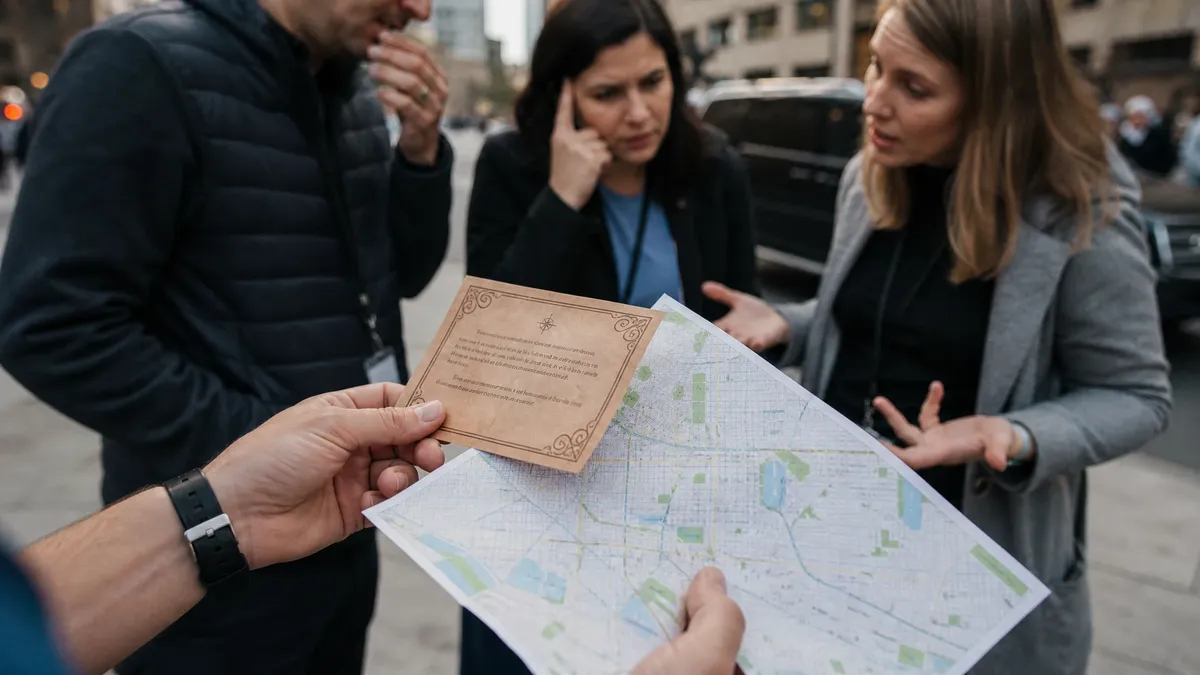
Find the company origin story
Hide clues that lead teams to facts about your company history: the year you were founded, the first product, the original office. Teams have to ask longtime employees, dig through the intranet, or find framed photos on the wall. It doubles as onboarding and gets new hires talking to veterans they would never otherwise approach.
Desk detective
Give each team a list of quirky personal items to photograph on colleagues' desks, like a plant, a funny mug, or a childhood photo, then match each item to the right owner. It forces conversation across the whole floor and reveals sides of coworkers that never come up in meetings. Fast to set up and works in any office layout.
Meeting room mystery
Hide a sequence of clues, each one pointing to the next meeting room or common area, ending at a final prize. Teams solve a riddle to figure out which room to hit next. It maps the whole office for newcomers and gets everyone out of their chairs and moving between floors together.
Supply closet challenge
Create a list of everyday office items teams must collect and arrange into a creative photo, like building a tower from staplers and sticky notes or spelling the company name with supplies. It rewards teamwork and imagination over speed, and the photos are genuinely funny. Set a rule that everything gets returned.
The human directory
Give teams a bingo-style card of facts like speaks three languages, has run a marathon, or joined this year, and they race to find a colleague who matches each square and snap a photo together. It surfaces hidden talents and connections across departments in a way an org chart never will.
Trivia checkpoint hunt
Place QR codes or printed trivia questions around the office. Teams find each station, answer a question about the company or general knowledge, and earn points for correct answers. It blends movement with a quiz and works beautifully when you want a hunt that also teaches people something about the business.
Reverse scavenger hunt
Instead of finding items, teams are given a strange object and must find the person or place it belongs to, or invent and photograph the most creative use for it. Flipping the usual format keeps experienced teams on their toes and produces the kind of absurd problem-solving that bonds a group fast.
Build-a-thing relay
Scatter component pieces around the office that teams must find and then assemble into a finished object, like a marble run or a paper bridge that holds a stapler. Finding the parts is half the challenge and building it together is the other. It rewards planning, communication, and a bit of engineering under pressure.
City and Neighbourhood Hunt Ideas
Landmark photo quest
Give teams a list of local landmarks, murals, or statues to find and recreate with a team pose. It gets people exploring the neighbourhood around your venue and produces a hilarious set of group photos. Works especially well downtown where there is a landmark on every block. Set clear boundaries so nobody strays too far.
Local business challenge
Send teams to nearby shops and cafes to complete small tasks: learn the story behind a family restaurant, find the oldest item for sale in a store, or get a staff member to teach them something. It builds goodwill with local businesses and forces teams to talk to strangers, which is where the real courage-building happens.
Public transit dash
Design a hunt that uses streetcars, subways, or buses to reach checkpoints across a wider area within the time limit. Teams have to plan routes together and make quick calls about which checkpoints are reachable. It scales the hunt across a whole city and adds a genuine logistics puzzle on top of the challenges.
Historic clue trail
Write clues tied to the history of the neighbourhood, where teams solve a riddle to identify a heritage building, plaque, or old landmark, then photograph it. It turns a walk into a story and teaches people about the area they work in. Great for cities with a dense, walkable core full of markers.
Foodie hunt
Task teams with tracking down specific local eats: the best patio, a hidden dessert spot, a dish from a specific country. They photograph each find and can even bring back a small item to share. It combines exploration with a genuine reward and gives teams a reason to slow down and enjoy the neighbourhood together.
Street art safari
Give teams a checklist of murals, graffiti, and public art to find and pose with in a creative way. Cities with strong street-art districts make this effortless, and the creative posing requirement guarantees the whole team ends up in every shot. Award bonus points for the most inventive recreation of a piece.
Stranger kindness quest
Build challenges around small acts of connection: get a group of strangers to join a team photo, learn a fun fact from a shopkeeper, or find someone wearing the team colour. It pushes people well outside their comfort zone in a low-stakes, high-laughter way and always produces the boldest stories of the day.
Compass and coordinates hunt
Use GPS coordinates or a phone compass to send teams to precise spots where the next clue is hidden or a challenge waits. The navigation adds a real orienteering layer that rewards teams who plan and communicate. It works well in parks and open areas where landmark clues are harder to write.
Photo and Video Challenge Ideas
Recreate a famous scene
Challenge teams to stage and photograph a recognizable movie moment, album cover, or painting using only what they can find nearby. It demands creativity, coordination, and a lot of laughing, and the results are always the highlight of the closing reel. Award points for accuracy and for sheer audacity.
The whole team in frame
Any challenge worth building requires every single team member visible in the shot. Make it explicit: a human pyramid, everyone touching one object, a jumping photo with all feet off the ground. This is the mechanic that quietly guarantees nobody splits off to work solo, which is the entire point of a team building hunt.
15-second story
Teams film a short video with a beginning, middle, and end telling a tiny story on a given theme, like a heist or a nature documentary about the office. Scripting and shooting something in minutes forces fast collaboration and role-splitting. The finished clips are the most rewatchable thing you will produce all day.
Frozen moment
Teams stage a photo that looks like they froze mid-action: a dramatic fall, a celebration, a chase scene. Getting everyone to hold the exact right pose at once takes real coordination and several failed attempts, which is where the group chemistry shows up. Simple to judge and endlessly funny.
Emotion charades on camera
Assign each team an emotion or a word and have them capture a photo where every member acts it out visibly. The group has to agree on how to express it, which turns into a quick, loud negotiation. It is a fast challenge that packs in surprising amounts of collaboration for the time it takes.
Brand mascot for a day
Teams invent a mascot using found props and costumes, name it, and shoot a short promo video introducing it. It rewards imagination and gives quieter creatives a chance to shine. The reveal of eight different homemade mascots at the closing ceremony is reliably one of the biggest laughs of the event.
Stop-motion mini
Ask teams to create a very short stop-motion clip using objects they find, snapping a burst of photos and stitching them together in a phone app. It is ambitious, which is the point, and it forces teams to plan a sequence and divide roles cleanly. Cap the required length low so it stays achievable inside the window.
Perfect timing photo
Teams must capture an optical-illusion or forced-perspective shot: someone holding up a building, pinching the sun, being crushed by a giant object. It requires a photographer, a subject, and spotters all coordinating precisely. When it finally works after a dozen tries, the whole team celebrates together, which is exactly the moment you want.
One-take lip sync
Teams choose a song, assign parts, and film a single-take group lip sync or dance. It is pure participation and it breaks down the last of anyone's self-consciousness. If your group loves music-driven fun, it pairs naturally with the kind of shared-performance energy we build into our interactive experiences.
Themed Hunt Concepts
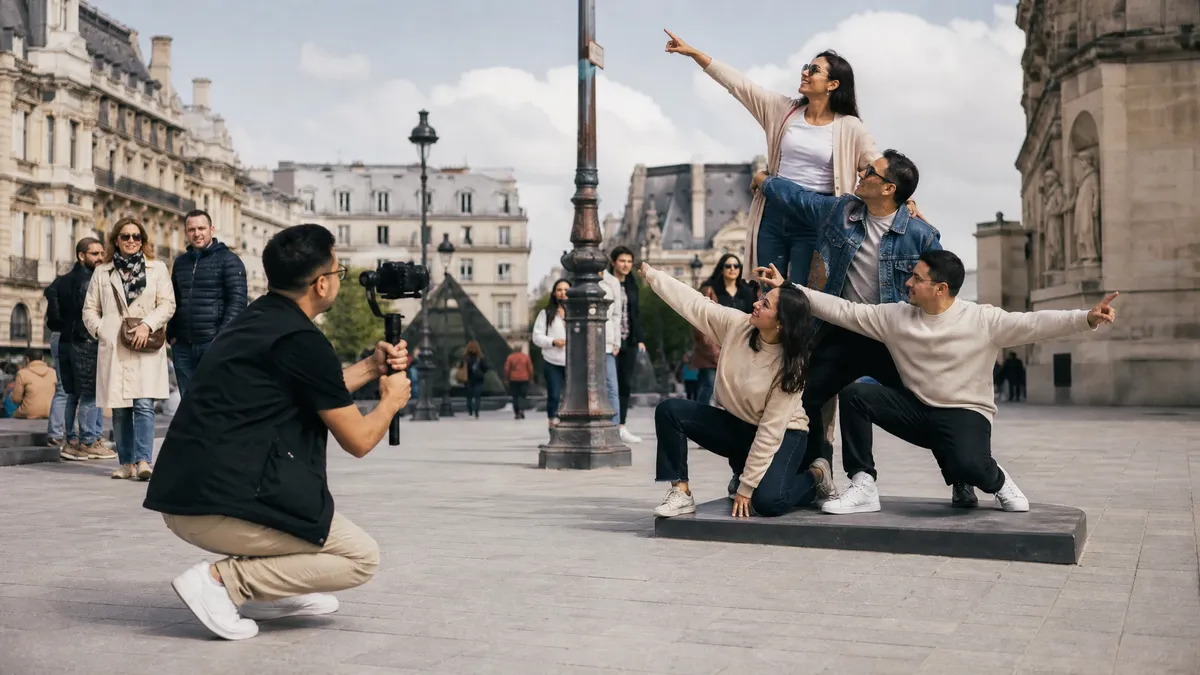
Spy and secret agent
Frame the whole hunt as a mission: teams are agents cracking codes, finding dead drops, and completing objectives before the deadline. A spy theme gives every clue a narrative reason to exist and makes even a simple task feel high-stakes. Hand out mission dossiers and code names to sell it from the first minute.
Heist crew
Teams play a crew planning the perfect heist, gathering the tools, cracking the vault clue, and pulling off the final job. The theme naturally requires specialists and coordination, which maps perfectly onto team building. Build the last challenge as the big score everyone has to execute together in one shot.
Around the world
Each checkpoint represents a different country with a themed challenge: learn a phrase, recreate a landmark, taste a food. Teams collect stamps in a passport as they go. It is colourful, inclusive, and works brilliantly for international teams who get to share their own cultures at the relevant stops.
Escape room hunt hybrid
Blend a scavenger hunt with escape-room logic, where solving each clue unlocks a lock, code, or the next envelope in sequence. Teams cannot skip ahead, so everyone has to contribute to crack each lock. It is the most puzzle-forward format and a favourite for analytical teams who love a real brain workout.
Detective mystery
Teams investigate a fictional case, gathering clues and interviewing planted characters to name the culprit before time runs out. It pairs naturally with a full narrative and rewards teams who share notes and reason together. For the fully-produced version of this, see our murder mystery game guide.
Time traveller
Send teams through decades, with each checkpoint themed to an era: recreate a 70s album cover, find something that would have existed in 1990, film a silent-movie scene. The costume and pose requirements keep everyone in frame and the era-hopping keeps the creative demands fresh at every stop.
Survival expedition
Frame the hunt as a wilderness or apocalypse survival mission where teams gather supplies, build a shelter prop, and complete rugged challenges. It suits outdoor settings and taps competitive instincts hard. For more outdoor-first formats, pair it with our outdoor team building activities.
Holiday or seasonal theme
Wrap the hunt in a seasonal skin: a summer-festival trail, a spooky autumn mystery, or a year-end celebration hunt. Theming to the calendar makes the event feel like a party rather than a corporate exercise and gives you an easy reason to run one every quarter. Match the prizes and photo challenges to the season.
Virtual Scavenger Hunt Ideas
Home item race
The host names an item like something yellow, your oldest book, or a childhood toy, and every player races to grab it and show it on camera. Points go to the fastest few. It is the simplest virtual hunt to run, needs zero prep, and instantly energizes a remote team that has been sitting still on a long call.
Breakout room clue race
Split a video call into breakout rooms and give each team a set of clues to solve together, submitting answers to a shared scoreboard. The breakout format forces real collaboration instead of a hundred people shouting over each other. It is the closest a virtual hunt gets to the in-person team dynamic.
Screenshot scavenger hunt
Teams hunt across the web for specific things: a news headline with a certain word, a product under a set price, a map location, and drop screenshots into a shared doc. It works for fully distributed teams in any time zone and rewards research skill and speed rather than physical items.
Photo prompt bingo
Give remote teams a bingo card of photo prompts to complete at home over a set window: a plant, a pet, a handwritten sign, a creative selfie. They fill a shared album as they go. It works asynchronously, so it suits teams spread across time zones who cannot all be live at once.
Virtual city street view hunt
Using an online map's street view, teams race to find specific locations, signs, or landmarks around the world from clues. It is a genuinely clever puzzle that gets remote coworkers exploring and problem-solving together. Bonus points for the team that identifies the mystery city first.
Emoji decode challenge
Post strings of emojis that spell out movies, songs, or company inside-jokes, and teams race to decode them in a shared chat. It is fast, low-bandwidth, and works for any group size on a call. Slot it between bigger challenges as a quick-fire round that keeps the energy from dipping.
Show and tell mystery
Ahead of the call, everyone submits a photo of an unusual personal object. During the hunt, the host reveals them one at a time and teams guess whose it is. It reveals surprising sides of remote colleagues and builds the personal connection that is hardest to create over video.
Tech-scored hybrid hunt
For a hunt that spans remote and in-office people at once, run it through a scoring app with a shared live leaderboard so everyone competes on the same board. This is exactly the kind of connected, phone-scored format we build for hybrid events, where the tech scales the same experience to a room of 2,000 or a grid of home offices.
Scoring and Prize Frameworks
Weighted points system
Assign every challenge a point value based on difficulty rather than scoring one point each. Easy finds are worth 10, hard puzzles worth 50, creative photo challenges worth up to 100 with judge discretion. Weighting turns the hunt into a real strategy game where teams choose what to chase, and it keeps the leaderboard genuinely competitive to the end.
Creativity bonus
Reserve a pool of points that judges award purely for creativity, humour, or audacity on photo and video challenges. It rewards the teams that take risks instead of just the fast ones and ensures a smaller team can still win on imagination. Announce that these points exist but keep the amounts a mystery until the reveal.
Speed tiebreaker
When two teams finish on equal points, break the tie by submission time so the faster team wins. Telling teams up front that speed is the tiebreaker adds urgency to every single challenge. It is the simplest fair rule and it prevents the awkwardness of a shared first place at the ceremony.
The dramatic reveal
Never announce running scores during the hunt. Hold everything back and reveal the standings from last to first at a closing ceremony with the photo reel playing behind you. The suspense of a live reveal is what makes people care about the result. This is the single highest-leverage thing you can do to make a hunt feel like an event.
Category awards
Beyond the overall winner, hand out fun superlatives: funniest photo, most creative video, best team name, biggest comeback. Multiple award categories mean more teams walk away with a win, which spreads the good feeling around the whole room instead of concentrating it on one table. Cheap trophies or certificates go a long way here.
Prizes that people actually want
Skip the branded stress ball. The best hunt prizes are experiences or perks people genuinely value: an extra day off, a team lunch on the company, a prime parking spot, tickets to something. A prize worth competing for lifts the intensity of the entire hunt. Make the top prize just aspirational enough to matter.
Everyone-plays participation reward
Give every participant something small at the end, a photo print, a snack, a token, so nobody who tried hard leaves empty-handed. Team building goes sideways when winning is the only thing that gets rewarded. A small universal thank-you keeps the mood warm and makes people say yes to the next event you run.
Expert Pro Tips
Frequently Asked Questions
How do you run a team building scavenger hunt?
What are good scavenger hunt challenges for work?
How long should a team scavenger hunt last?
How do you keep teams from splitting up during a hunt?
What group size works for a scavenger hunt?
Do scavenger hunts work as virtual team building?
What kind of prizes work best for a corporate scavenger hunt?
When your group passes 50, a hosted, tech-scored format connects the whole room at once and runs the leaderboard and reveal for you.
Scale your hunt into an interactive game show
Get StartedTell us your group size, venue, and goals and we will design a hunt or a hosted experience that fits, from a 20-person offsite to a 2,000-person conference.
Plan your team building event with us
Contact Us